Category Archives: twelve kingdoms

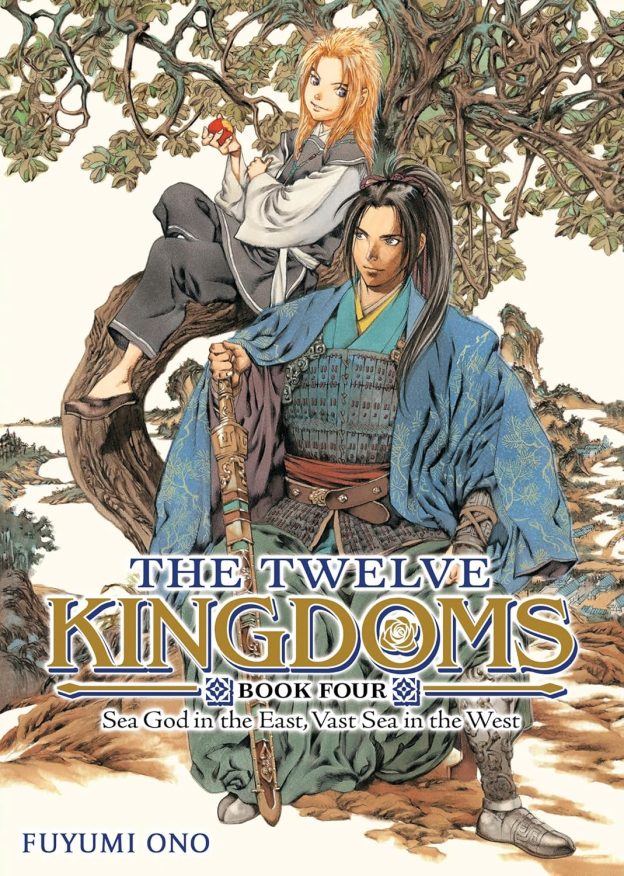
The Twelve Kingdoms, Book Four: Sea God in the East, Vast Sea in the West

By Fuyumi Ono and Akihiro Yamada. Released in Japan as “Juni Kokuki: Higashi no Wadatsumi, Nishi no Sōkai” by X Bunko White Heart. Released in North America by Seven Seas Entertainment. Translated by Kim Morrissy. Adapted by Monica Sullivan.

Everyone loves a good scoundrel who’s secretly smart and caring. They’re a very popular fictional trope. The scoundrel – almost always male, as in this book, though I have seen excellent scoundrel heroines as well – is the sort that always looks like they’re a good for nothing. They drink a lot, they don’t dress or stand properly, they’re always hanging out in the bad parts of town rather than, y’know, ruling the country. It’s always fun to read about how everyone gradually realizes that it was all part of a clever plan, and that in reality everything they’ve been doing had a very good reason. Note that I said it was fun to READ about. As it turns out, when the previous king was renowned for being awful, your kingdom is on the verge of collapsing, and you’re only just starting to recover. having a king who never goes to meetings and is hanging out in brothels can, in fact, be bad.
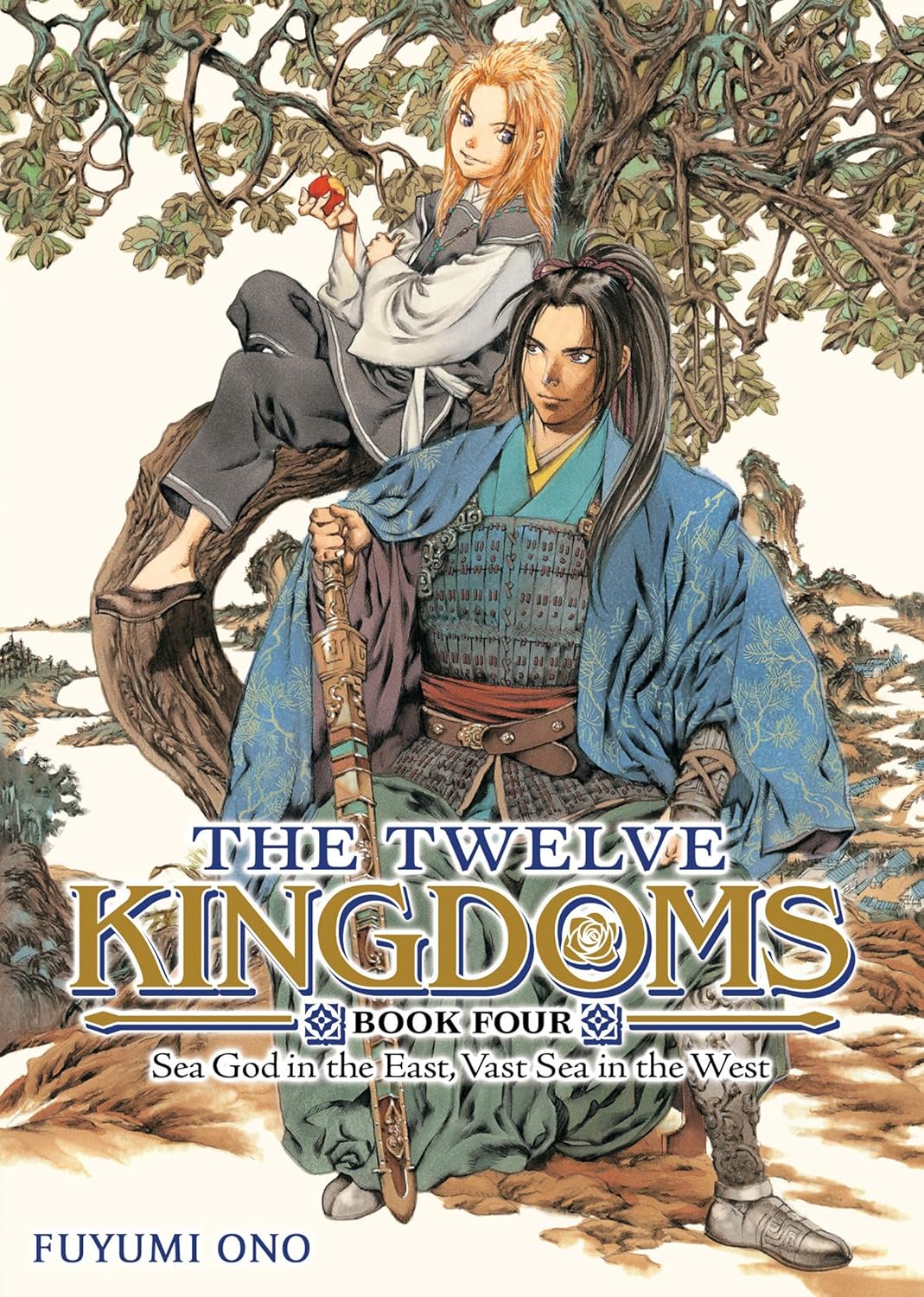
We’ve met the king of En and his kirin before, helping Youko establish herself and her own kingdom, and later on Taiki needing to choose a new ruler, but it’s clear in those that he’s well-established. Here we go back a bit and see what things were like when he was just getting started. The previous king was a tyrant who nearly destroyed the kingdom, and the land was arid and inhospitable. Twenty years later, the land is starting to recover and the domains that make up the kingdom are beginning to find their feet. But it’s a struggle, and things are not helped by the new king, Shouryuu, who seems to want to fire his most loyal subjects and replace them with people who dislike him. The king, as I noted above, avoids meetings and likes to hang out in brothels. As such, it’s not a surprise when the chancellor of the most prosperous domain decides to have the king step down and let him take over.

As always with this book, the writing is stellar and I barely know where to begin. Shouryuu *is* thinking about the kingdom, and wants to try to get by with the least amount of lives lost. Particularly as his kirin is so sensitive to blood and death. That said, it is interesting that this book pushes back against the idea of kings ruling in the way they do, especially given that this is a world with real gods who have kings chosen by what amounts to people with magical ruler sense. In a normal fantasy universe, there might be a much better argument against Shouryuu’s rule, but here the world is literally set up to show he’s the one they need – which turns out to be true, the guy starting the rebellion is a complete loser who you get to hate. Imagine Tenya from My Hero Academia, only evil. I will also warn you that there *is* bloodshed here, and it’s not the bad guys who die. Oh, and I haven’t even mentioned the kid who talks to youma, who turns out to be a far more interesting villain than the other guy, and I hope we see him again.

I hope I don’t need to tell people how good this is and that you should be reading it. Next time, it’s the first of a two-parter where we finally catch up with Youko and see how smoothly things have gone for her. (My guess: not very.)
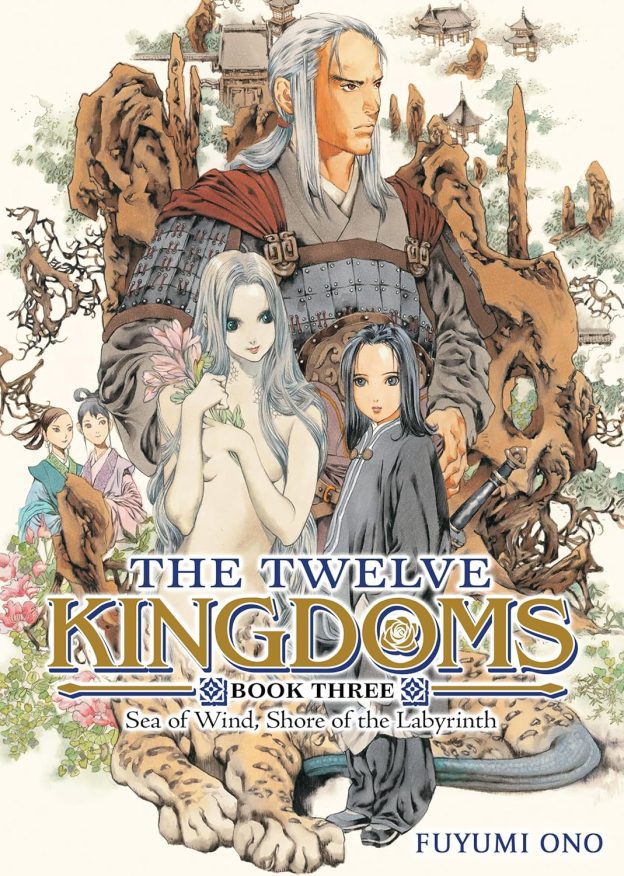
The Twelve Kingdoms, Book Three: Sea of Wind, Shore of the Labyrinth

By Fuyumi Ono and Akihiro Yamada. Released in Japan as “Juni Kokuki: Kaze no Umi, Meikyū no Kishi” by X Bunko White Heart. Released in North America by Seven Seas Entertainment. Translated by Kim Morrissy. Adapted by Monica Sullivan.

So I’m sure that after the events of the first two books, everyone is ready to dig in and find out how Youko settles in to her new ruling status. Well, hate to break it to you, but not only is Youko not in this book at all, but the entire volume takes place prior to the first two, and deals with a completely different kingdom. As I noted in the last review, the books are not called Twelve Kingdoms for nothing. That said, despite the fact that we get a new protagonist, a lot of this may feel very familiar. We see someone who grew up in Japan suddenly yanked to this world, where they’re forced to try to figure things out that everyone else assumes are either common sense or just come naturally. Youko dealt with this mostly through fury and increased paranoia. Taiki deals with it through depression and increased anxiety.

Up on Mount Hou, everyone is awaiting the birth of the new kirin, who will be the one to choose the next ruler of the country of Tai. Unfortunately, a storm blows the fruit containing the unborn Taiki off to god knows where. Ten years later, Kaname is an unhappy boy who lives with his family but can’t seem to please them, especially his strict grandmother. Then one day while standing outside in the snow as punishment, he sees a pair of arms reaching out from nowhere, and when he goes to investigate he finds himself on Hou Mountain. He *is* the missing kirin, and Tai needs a leader post haste, so he’s got to become a full-fledged kirin and choose the new leader. Unfortunately, kirin is a very instinctual position learned from birth, and since Taiki lived in Japan for ten years, he has none of that instinct. Good thing there aren’t also crushing expectations! Oh, wait, there are.

Despite the previous paragraph, this is a book with a great deal of heart. Taiki gets a lifelong familiar, Sanshi who sort of acts as a combination pet/mother/bodyguard. The sages of Mount Hou are all very nice to him… possibly they spoil him, but let’s face it, after passive abuse for ten years, Taiki needs a bit of spoiling. I really liked Youka, who we first meet ten years prior as a neophyte who still can’t find her way around the labyrinthian mountain, but who is also the best older sister for Taiki once he arrives. Taiki definitely feels like a ten-year-old with crippling anxiety throughout the book, so it’s good to see when he finally gets what a kirin needs to do, or when he’s actually enjoying and smiling over something. And for those who are sad about the fact that the first two books are in the future, Keiki is a supporting character here – indeed, he and Taiki bonding, and Keiki thus becoming less stoic and nicer, might be what leads to the troubles from the first two books.

So do we get a whole new cast next time? Not quite. The King of En has been supporting in both the first arc and the second, and the next book will look at his relationship with his own kirin. Till then, this is a wonderful fantasy series, highly recommended to everyone.

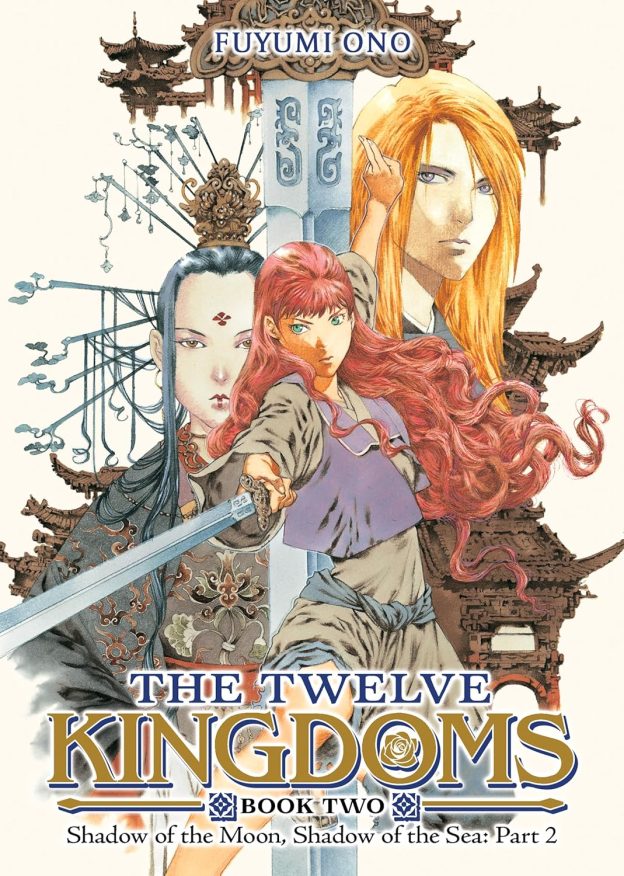
The Twelve Kingdoms, Book Two: Shadow of the Moon, Shadow of the Sea, Part 2

By Fuyumi Ono and Akihiro Yamada. Released in Japan as “Tsuki no Kage, Kage no Umi” by X Bunko White Heart. Released in North America by Seven Seas Entertainment. Translated by Kim Morrissy. Adapted by Monica Sullivan.

Last time I assumed that things would get better for Youko over the course of this second book, and to be fair they do SORT OF, but it does not remove the trauma of what has happened to her, especially once she discovers that this journey, much as she would like it to be otherwise, is pretty one-sided. By the end of the first book she was betrayed twice over, and is mentally and physically on her last legs, and so at the start of this book she regards any act of kindness at all as an attempt to soften her up before they betray her again. It doesn’t help that she’s still getting attacked by youma, which she’s getting quite good at killing – her sword skills are improving by leaps and bounds! – but it does also mean that she’s starting to regard herself as a bad person… and perhaps not even a person at all. Which, um, turns out to be correct. Except for the bad part.

After the events of the last volume, Youko is in bad shape, and unable to trust anyone. She ends up, fortunately, getting picked up by the best possible rat that she can. And no, I don’t mean a rat as in a terrible person, I mean an actual walking, talking rat. Rakushun is a Hanjyuu, a half-beast, who is smart and kind but unfortunately in the wrong kingdom to be able to get ahead. He spends a large portion of the start of the book trying to convince Youko that he’s not going to sic the guards on her the first chance he can get. He also gives her a lot more information about this world, which will come in handy when they are inevitably separated on their journey and she has to go on alone. Eventually she ends up in the kingdom of En, which is a LOT better than where she was. Unfortunately, the youma keep attacking her no matter where she is.

I was prepared for this to feel a lot different from the anime, as Sugimoto doesn’t exist in the novels beyond the very start. But wow, this book is concerned with Youko and her situation, and everything else about it is secondary. Not to spoil too much, but there’s a huge battle between an army of soldiers trying to protect a false queen and Youko and a number of crack troops, and it starts on page 209 and is done by page 210. The false queen herself takes up half of the cover art. We never meet her. This book is laser-focused on Youko and her thought process, and it’s absolutely riveting. We see her start at the lowest possible ebb, and as she gradually learns to trust again and gains more and more information, she realizes how intertwined she is with this world and how it’s practically impossible for her to run away without causing a catastrophe. The climax of the book is not the battle – it can’t be. It’s Youko’s choice. The rest is just an afterthought.

Now, the next book does not in fact focus on Youko, but moves to a different kingdom, as if to remind us that the title of the book is indeed The Twelve Kingdoms. I still can’t wait to read it.