Category Archives: twelve kingdoms

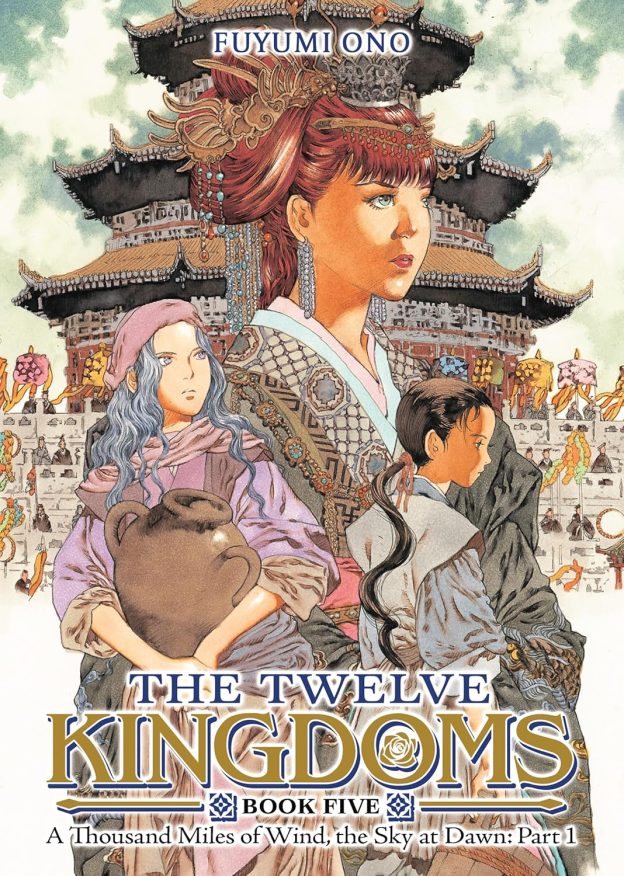
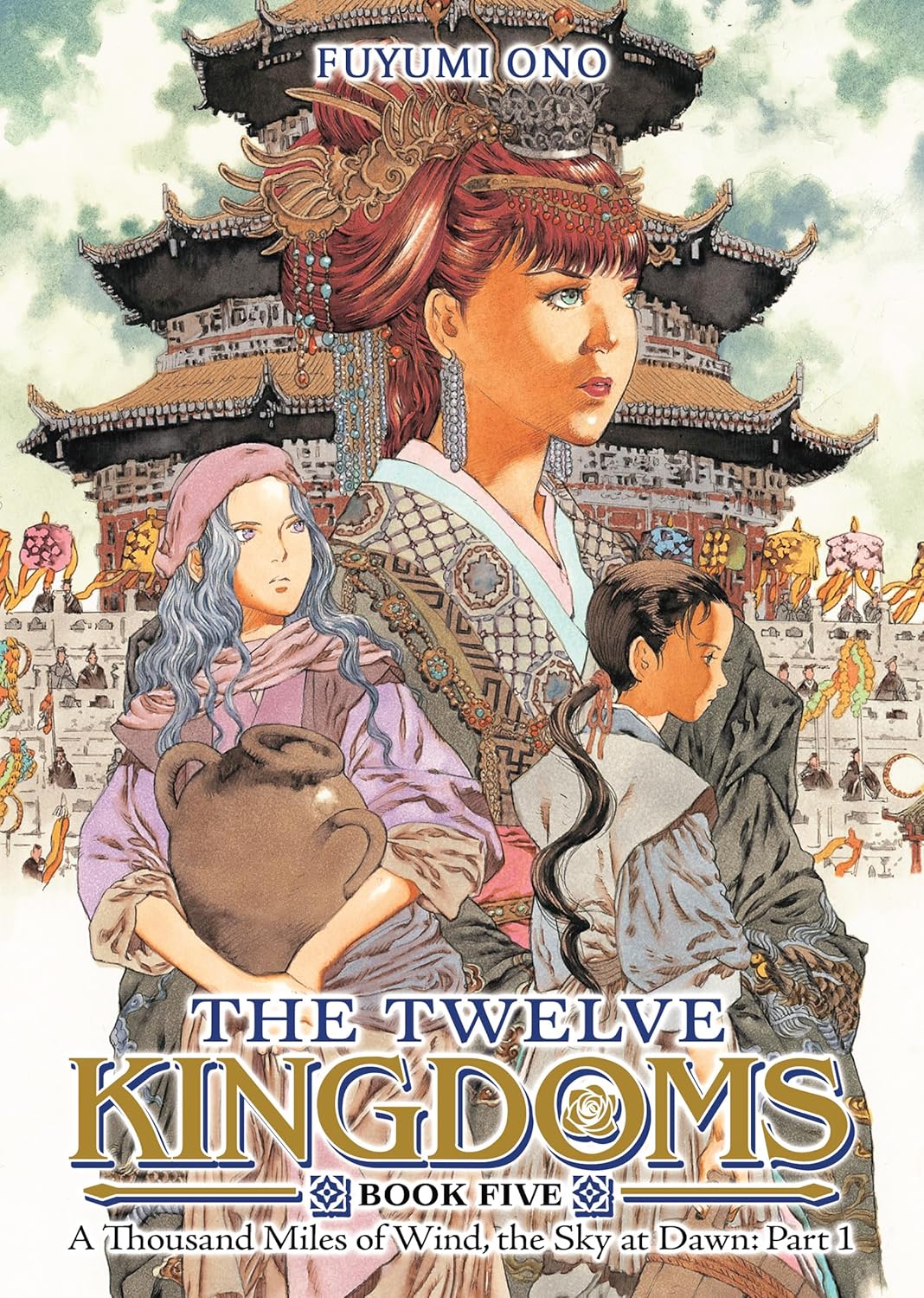
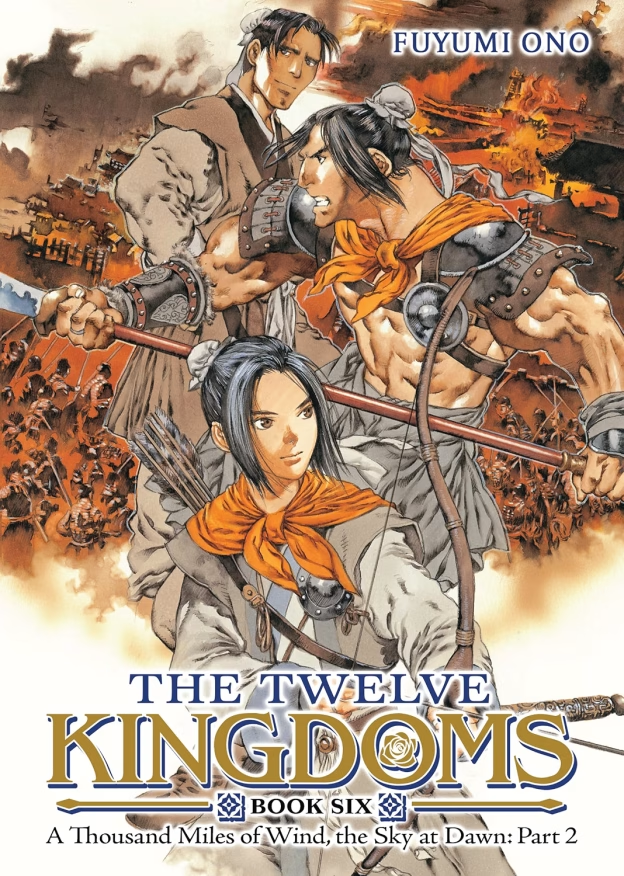
The Twelve Kingdoms, Book Five: A Thousand Miles of Wind, the Sky at Dawn, Part 1

By Fuyumi Ono and Akihiro Yamada. Released in Japan as “Kaze no Banri, Reimei no Sora” by X Bunko White Heart. Released in North America by Seven Seas Entertainment. Translated by Kim Morrissy. Adapted by Monica Sullivan.

If you recall, when I reviewed the first volume of this series, I pointed out that it being divided in two meant that the first half was mostly unrelentingly miserable, with good things only starting to happen in the second book. You can assume the same thing for this one, and if you want to leave this arc with your spirits high, you may want to wait for September for the other half. That said, fear not, this is still brilliantly written and compelling. And yay, Youko is back! Admittedly she’s not all that happy, but she’s in this one! As are two other main characters, also young women. This book is about growing up and learning about the world around you, and how closing yourself off to the world around you can lead to you being immature and disliked. Youko has learned this lesson, at least partly. The other two, not so much.

There are three interlocking plot threads, which I will streamline for ease of reviewing. 1) Youko is now Queen, but that has not magically solved everything. The people have had too many bad queens lately, and worry she’s just another one. They want a king. Also, her underlings are all conspiring against each other and taking advantage of her ignorance about this world. And Keiki, frankly, is being no help. She goes on a journey in disguise to learn about this world. 2) A hundred years ago, a girl in Japan sold as a slave falls off a cliff during a storm and ends up in the Twelve Kingdoms. After suffering at first, she becomes a servant to ex-king’s mistress Riyou… and suffers for much longer, mostly so she can speak the language. Now, though, she’s thrown out, and told she needs to learn to be less whiny and passive. 3) The king of Hou and his Queen are executed in a coup, and their daughter, Shoukei, is disguised and thrown into a shabby village in lieu of execution. She hates it, and hates being poor, but stays selfish through most of the book, till she meets a familiar face… to the reader, that is.

Not gonna lie, but Youko is easily the best thing in this, mostly as we only get a tiny bit of character development from Suzu and Shoukei, who will get most of theirs in the next book. (As a reminder for anime watchers, the high school kid who came with Youko in the anime doesn’t exist here.) She’s doing her best, but has never really been a politician, and people are running rings around her. Meanwhile, Keiki just sighs at her. I don’t blame her for running off. I did like Shoukei’s journey as well, though she’s easily the hardest to take for a good 4/5 of this volume. Meeting Rakushun is the best thing that happened to her, and she’s learning about life for non-princesses. As for Suzu, she’s very whiny and hard to like, and unfortunately her character development is also in the last fifth of the book. I’m sure she gets better.

The book ends with all three of these women converging in the same place, and I suspect the next one will have them meet up. I hope they get along. I suggest Youko not mention who she really is. In any case, essential as always.

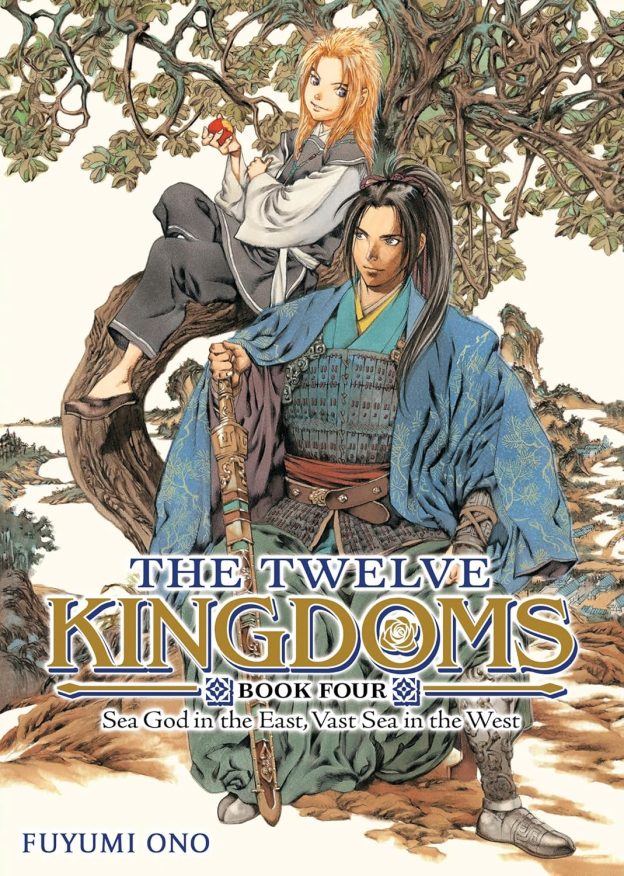
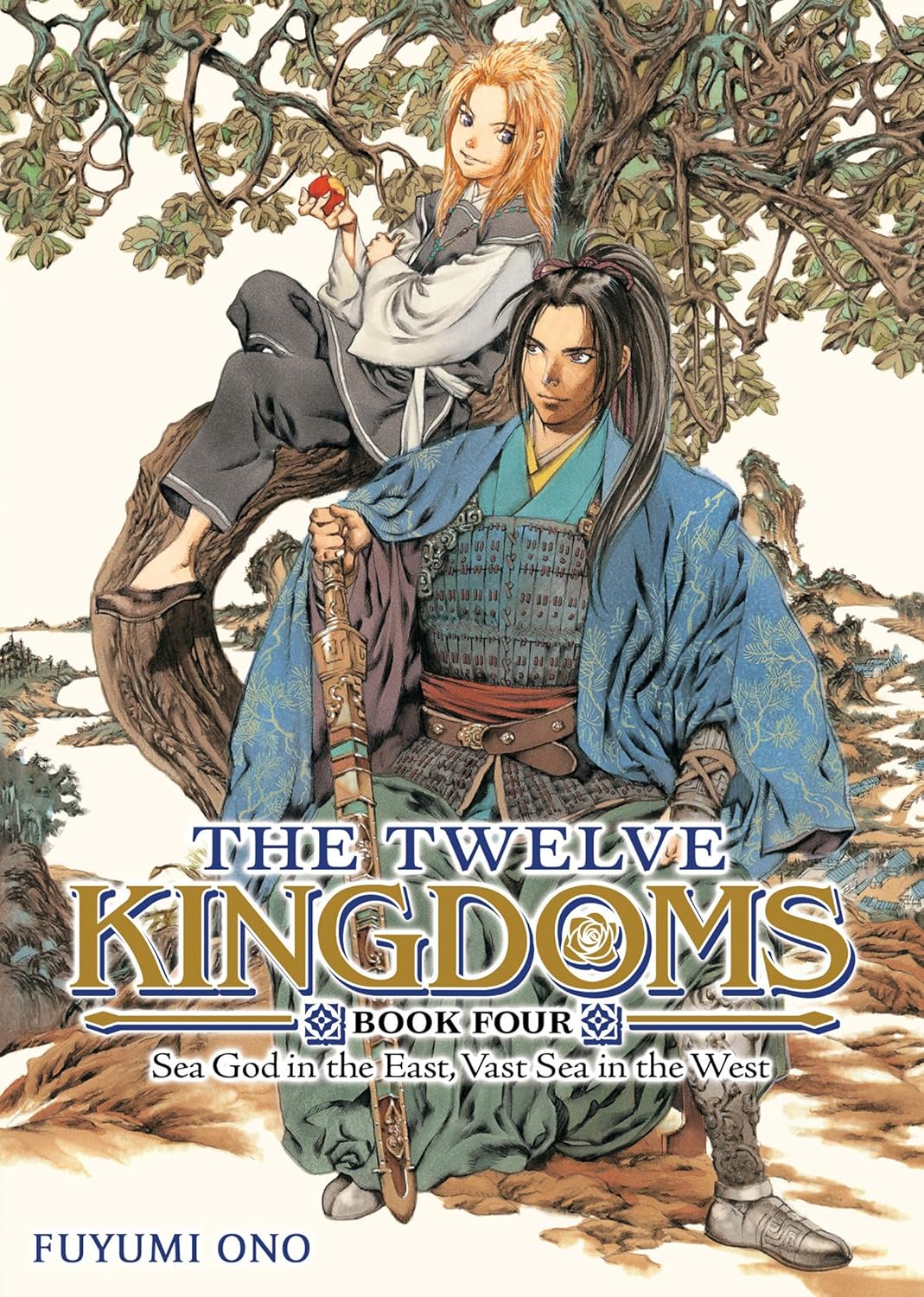
The Twelve Kingdoms, Book Four: Sea God in the East, Vast Sea in the West

By Fuyumi Ono and Akihiro Yamada. Released in Japan as “Juni Kokuki: Higashi no Wadatsumi, Nishi no Sōkai” by X Bunko White Heart. Released in North America by Seven Seas Entertainment. Translated by Kim Morrissy. Adapted by Monica Sullivan.

Everyone loves a good scoundrel who’s secretly smart and caring. They’re a very popular fictional trope. The scoundrel – almost always male, as in this book, though I have seen excellent scoundrel heroines as well – is the sort that always looks like they’re a good for nothing. They drink a lot, they don’t dress or stand properly, they’re always hanging out in the bad parts of town rather than, y’know, ruling the country. It’s always fun to read about how everyone gradually realizes that it was all part of a clever plan, and that in reality everything they’ve been doing had a very good reason. Note that I said it was fun to READ about. As it turns out, when the previous king was renowned for being awful, your kingdom is on the verge of collapsing, and you’re only just starting to recover. having a king who never goes to meetings and is hanging out in brothels can, in fact, be bad.

We’ve met the king of En and his kirin before, helping Youko establish herself and her own kingdom, and later on Taiki needing to choose a new ruler, but it’s clear in those that he’s well-established. Here we go back a bit and see what things were like when he was just getting started. The previous king was a tyrant who nearly destroyed the kingdom, and the land was arid and inhospitable. Twenty years later, the land is starting to recover and the domains that make up the kingdom are beginning to find their feet. But it’s a struggle, and things are not helped by the new king, Shouryuu, who seems to want to fire his most loyal subjects and replace them with people who dislike him. The king, as I noted above, avoids meetings and likes to hang out in brothels. As such, it’s not a surprise when the chancellor of the most prosperous domain decides to have the king step down and let him take over.

As always with this book, the writing is stellar and I barely know where to begin. Shouryuu *is* thinking about the kingdom, and wants to try to get by with the least amount of lives lost. Particularly as his kirin is so sensitive to blood and death. That said, it is interesting that this book pushes back against the idea of kings ruling in the way they do, especially given that this is a world with real gods who have kings chosen by what amounts to people with magical ruler sense. In a normal fantasy universe, there might be a much better argument against Shouryuu’s rule, but here the world is literally set up to show he’s the one they need – which turns out to be true, the guy starting the rebellion is a complete loser who you get to hate. Imagine Tenya from My Hero Academia, only evil. I will also warn you that there *is* bloodshed here, and it’s not the bad guys who die. Oh, and I haven’t even mentioned the kid who talks to youma, who turns out to be a far more interesting villain than the other guy, and I hope we see him again.

I hope I don’t need to tell people how good this is and that you should be reading it. Next time, it’s the first of a two-parter where we finally catch up with Youko and see how smoothly things have gone for her. (My guess: not very.)

The Twelve Kingdoms, Book Three: Sea of Wind, Shore of the Labyrinth

By Fuyumi Ono and Akihiro Yamada. Released in Japan as “Juni Kokuki: Kaze no Umi, Meikyū no Kishi” by X Bunko White Heart. Released in North America by Seven Seas Entertainment. Translated by Kim Morrissy. Adapted by Monica Sullivan.

So I’m sure that after the events of the first two books, everyone is ready to dig in and find out how Youko settles in to her new ruling status. Well, hate to break it to you, but not only is Youko not in this book at all, but the entire volume takes place prior to the first two, and deals with a completely different kingdom. As I noted in the last review, the books are not called Twelve Kingdoms for nothing. That said, despite the fact that we get a new protagonist, a lot of this may feel very familiar. We see someone who grew up in Japan suddenly yanked to this world, where they’re forced to try to figure things out that everyone else assumes are either common sense or just come naturally. Youko dealt with this mostly through fury and increased paranoia. Taiki deals with it through depression and increased anxiety.

Up on Mount Hou, everyone is awaiting the birth of the new kirin, who will be the one to choose the next ruler of the country of Tai. Unfortunately, a storm blows the fruit containing the unborn Taiki off to god knows where. Ten years later, Kaname is an unhappy boy who lives with his family but can’t seem to please them, especially his strict grandmother. Then one day while standing outside in the snow as punishment, he sees a pair of arms reaching out from nowhere, and when he goes to investigate he finds himself on Hou Mountain. He *is* the missing kirin, and Tai needs a leader post haste, so he’s got to become a full-fledged kirin and choose the new leader. Unfortunately, kirin is a very instinctual position learned from birth, and since Taiki lived in Japan for ten years, he has none of that instinct. Good thing there aren’t also crushing expectations! Oh, wait, there are.

Despite the previous paragraph, this is a book with a great deal of heart. Taiki gets a lifelong familiar, Sanshi who sort of acts as a combination pet/mother/bodyguard. The sages of Mount Hou are all very nice to him… possibly they spoil him, but let’s face it, after passive abuse for ten years, Taiki needs a bit of spoiling. I really liked Youka, who we first meet ten years prior as a neophyte who still can’t find her way around the labyrinthian mountain, but who is also the best older sister for Taiki once he arrives. Taiki definitely feels like a ten-year-old with crippling anxiety throughout the book, so it’s good to see when he finally gets what a kirin needs to do, or when he’s actually enjoying and smiling over something. And for those who are sad about the fact that the first two books are in the future, Keiki is a supporting character here – indeed, he and Taiki bonding, and Keiki thus becoming less stoic and nicer, might be what leads to the troubles from the first two books.

So do we get a whole new cast next time? Not quite. The King of En has been supporting in both the first arc and the second, and the next book will look at his relationship with his own kirin. Till then, this is a wonderful fantasy series, highly recommended to everyone.