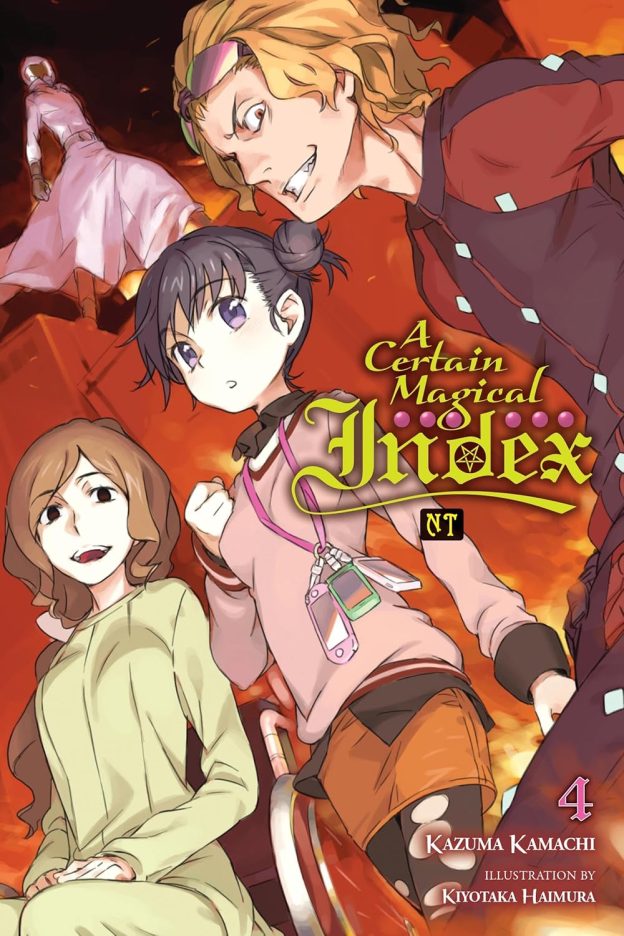
A Certain Magical Index NT, Vol. 4

By Kazumi Kamachi and Kiyotaka Haimura. Released in Japan as “Shinyaku To Aru Majutsu no Index” by Dengeki Bunko. Released in North America by Yen On. Translated by Alice Prowse.

When I reviewed the third volume of New Testament, I said that it was great, after two false stars, to finally have the Index series we remembered back again. Well, guess what, I’m eating my words once more, as this volume features almost none of the main cast, and even Touma, who is technically here, is defined in this book by his absence. And that’s a very deliberate thing. The book this volume reminds me of the most is Vol. 15 of the first Index series, which was a battle royale featuring actual deaths, including people who we (retroactively, after they were fleshed out later) liked.This volume also features a gimmick of pictures of characters that go dark when they’re “killed”, but over the course of the book the lights go on and off on those characters like a pinball. Who’s alive? Who’s dead? It doesn’t matter, because this Index is getting as close as it’s ever gotten to pure horror.

Welcome to Baggage City, located somewhere in Eastern Europe, which is having a fighting tournament that’s bringing all the desperate people with a cool ability and something to prove. Unfortunately for the competitors and all the spectators, this event is being hijacked. Both by GREMLIN, who have planted a few lovely little sociopaths into the event, but also the Kiharas (you may remember Amata Kihara from Book 12-13, where he was turned into a star in the sky by Accelerator). And, yes, Academy City has sent a bunch of soldiers as well, whose sole purpose appears to be providing the “horror” part of the book as one of GREMLIN enjoys doing things like magically changing a guy’s arms to faucets and turning on the taps so blood pours out. There’s also Maria Kumokawa, who we mostly remember as being the maid friend of Tsuchimikado’s maid sister. And there’s Touma… maybe? Boy, there’s not much Touma.

I used to do a breakdown of who the new characters were, as well as where in the timeline this took place. I’ve dropped that, as a) we’re well past the Railgun stories so the timeline is less important (though notably one of the “protagonists” in this book shows up in Railgun years later as an antagonist), and b) it’s hopeless, there’s just too much. Not only are too many characters introduced here, many of whom die before we even get a chance to see who they are, but we also have to deal with the fact that this series is very popular in Japan and not very popular here, so one of the villains we see towards the end, who is introduced as if we know her, turns out to be from one of the Railgun Short Story books. This is actually a pretty strong book, making the point that the reason for all the horror is that Touma is absent from the scene, and the moment he shows up people stop suffering and start getting saved. But unfortunately when Touma arrives there are too many bad guys doing things all at once, two of whom we meet for the first time at that moment, and one of whom, I know from spoiling myself, is VERY important to the whole series going forward. For now, though? Just another bad guy monologuing.

Fortunately, the next two books (yes, it’s a two-parter) seem to get back to more wacky Index shenanigans, possible with actual Index herself. Though I would not count on it. Till then, enjoy the darkness of a world with minimal Touma.
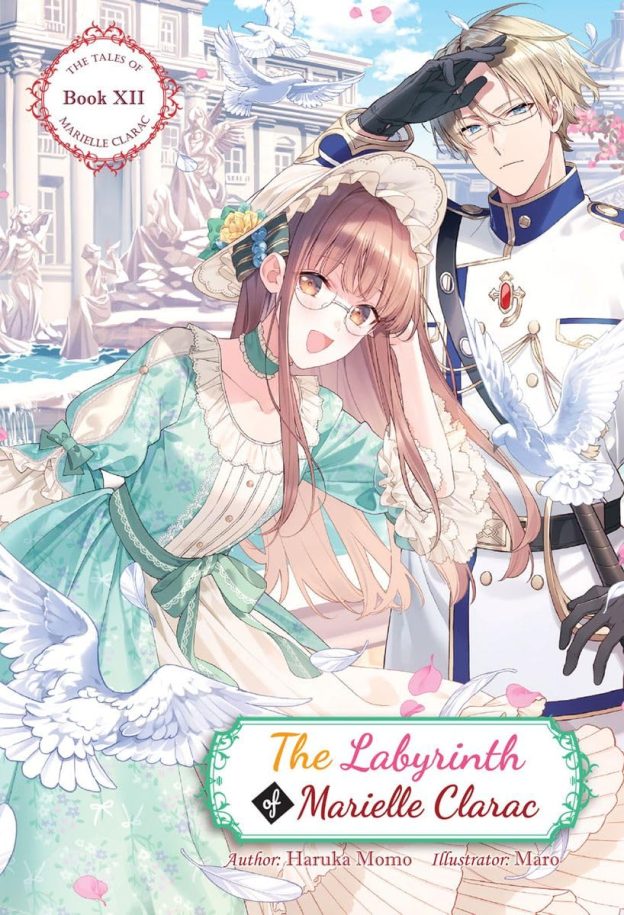
The Labyrinth of Marielle Clarac

By Haruka Momo and Maro. Released in Japan as “Marielle Clarac no Yakusoku” by Ichijinsha Bunko Iris NEO. Released in North America by J-Novel Club. Translated by Jasmin Thairintr.

We’re going to Italy! Or at least its fantasy equivalent, as Marielle is finally leaving her home country and traveling to another one. Unfortunately, her fame precedes her, and by now everyone simply assumes that if she breathes out she will stumble upon a fresh new adventure, similar to Jessica Fletcher. This made me worry that Marielle might have to spend the entire book sidelined, forced by those around her to not go gallivanting around stumbling over sinister plots. I mean, she doesn’t even dress up in a disguise this book! Not to worry, though, because I assure you that she will still be accused of murder here, and there’s at least one kidnapping as well. Because where Marielle goes, trouble follows, and I think even Simeon has learned that if he can’t stop that from happening, the least that he can do is to weaponize it.

It’s time for the wedding of Liberto and Henriette, and the wedding party has arrived in the country of Lavia for that purpose. Unfortunately, the prince’s mother has a huge hate on for him marrying anyone from Lagrange, and has decided to emotionally abuse everyone in the party. Even worse, she and a Viscount are assisting the country’s mafia in destabilizing things, which Liberto is trying hard to stop. All this means that Henriette and Marielle have to put up with poor accommodations, grumpy servants, and a mother-in-law who borders on cartoonishly evil. But worst of all, Liberto really doesn’t seem to care enough about what this is doing to his future wife – this is all part of one of his schemes, of course, and he’s got it in the bag, but whether he’ll be able to show the rest of the cast that he’s a normal person is another matter.

This series has always swung between thriller and comedic scenes, and I appreciated that it combined them towards the end, as a tense confrontation with guns where Marielle and the young Prince Luigi are about to be killed has Marielle break the mood in the best Spy Classroom style by asking how long she has to put up with this farce before she’s rescued. The actual intrigue part of the book goes down pretty well, to be honest. More interesting is the character work, as always. Prince Luigi has to deal with a mother who’s always angry and a brother who has no idea how to show affection to anyone, and worst of all, he’s a teenager, so you can imagine how all this is affecting him. I did appreciate that there was no big, dramatic scene where the prince suddenly realizes that he can be outwardly demonstrative towards his wife after all and he starts to be honest with her, because nope, that’s not how people word. Luigi and Henriette are going to have to try hard to turn this guy into a real human being. I hope they manage it.

It appears this series is going to continue as long as there are fresh new mysteries. I’ll keep going. Oh, right, Lutin’s in this as well. Hi, Lutin!

How a Realist Hero Rebuilt the Kingdom, Vol. 19

By Dojyomaru and Fuyuyuki. Released in Japan as “Genjitsu Shugi Yuusha no Oukoku Saikenki” by Overlap Bunko. Released in North America by J-Novel Club. Translated by Sean McCann.

There are certain long-running light novel series that I review that I consider “grandfathered in”. What that means is I’ve been reading them for years, and I know that they’re not really all that good any more, but I set a lower bar just because… well, I’ve been reading them for years. Now, obviously, sometimes a series doesn’t even clear that low bar, and I drop it some 15-20 volumes in. In Another World with My Smartphone was blessed with an obvious “please stop reading here” volume, whereas The Irregular at Magic High School decided to shove its homophobic right-wing protagonist in my face one too many times. Realist Hero has not hit that low bar. It’s still readable, I feel no desire to stop one volume before the end. That said,. there is a moment here where our heroes are fighting the villain, and get mad at him for still being single and not having married like everyone else in this series, where I wondered if this was written by the ghost of Shinzo Abe.

We left off with Souma having revealed that there’s a whole new world of adventure to be had in the North, thus impacting the morale of all of Fuuga’s troops, as well as Fuuga himself. Unfortunately, that’s not quite enough to stop the battle that’s going to be happening today, and now Fuuga knows he has to deal with everything right now or he’ll lose. What follows is a lot of battle, and Fuuga loses. (I don’t regard this as a spoiler because you have read the previous 18 volumes. Did you think Souma would be killed?) Souma manages to swing the battle in such a way that Fuuga is able to retreat with honor (persuaded to do so by, you guessed it, a pregnant wife), but his dreams are dashed. Unfortunately, he is smarter than some of his generals, who have a “war or nothing” mentality. The fragile peace can’t last forever…

This series, for the most part, does not kill people off, something I joked about last time, when it killed off the two oldest men in the cast who had already lived full lives and didn’t have young wives and children. This penultimate volume can’t QUITE do that, but it does manage to avoid killing off any of the named supporting cast on Souma’s side. The same cannot be said of the enemy, and I spent most of the book wondering if the author actually had the moxie to legitimately kill Fuuga off. (The answer is that they leave it vague, but I’m pretty sure the 20th volume will answer “no, he did not”). That said, Yuriga’s family definitely suffers some deaths, as they’re divided between two warring states, and some of them are simply battle hungry. Of all the “it’s better to have a family” hammers that get dropped on our head by the book, the best is Aisha’s fight with Nata, where she declares him boring because his battle style has nothing he cares about behind it but his own bloodlust. She kills him as an afterthought. That was some actual good writing.

Most of this, though, is Realist Hero writing. It’s ending in the next volume, which the author already says will be “epilogues” about all the characters. It’s long overdue, but I’ll read it when we get it. (And hopefully it won’t come back with After stories. Looking at you, Arifureta.)