Monthly Girls’ Nozaki-kun, Vol. 1

By Izumi Tsubaki. Released in Japan as “Gekkan Shoujo Nozaki-kun” by Square Enix, serialization ongoing in the online magazine Gangan Online. Released in North America by Yen Press.

As my regular readers are aware, I’ve been excited for this title for a long time. I’ve been a fan of Tsubaki ever since The Magic Touch (in fact, I am the only fan of The Magic Touch), and I’ve also loved her other ongoing series right now, Oresama Teacher. Those, however, are normal shoujo series, albeit with a lot of humor in them. Monthly Girls’ Nozaki-kun is a 4-koma gag series. As such, we do not need to worry quite as much about depth of characterization, advancing the plot, and romantic resolution. We just have to worry about 1) Build to a gag, and 2) Have a character react to the gag. This series succeeds admirably at both, but especially the second.
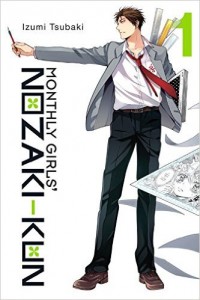
nozaki1

The setup is fairly simple, and ripe for amusing situations. Sakura has fallen for the tall, handsome, stoic Nozaki, and confesses to him in a roundabout way, trying not to use the words “I love you”. Unfortunately, Nozaki is as dense as lead when it comes to matters of the heart, so interprets this as a desire to work with him on the shoujo manga he draws for a monthly magazine under a pseudonym. Luckily for him, Sakura is quite good at art. And Sakura is okay with this if it means she can spend more time with him. Over the course of this volume, though, the cast broadens to include a wide variety of eccentrics, and we also discover that Nozaki’s manga, while popular still has its problems. As such, many of the final panels are Sakura giving a comeback to the ridiculous situation, in typical Japanese tsukkomi style.

Not that Sakura is always the straight man. As with Tsubaki’s other current series, the characters have the ability to alternate between boke and tsukkomi as the situation requires, and so if Sakura is off in Nozaki-kun fantasy land, it will be Mikoshiba or Seo who will boggle at her antics. And Nozaki-kun may be stoic, but this doesn’t mean he’s without emotions, as we see whenever he’s reminded of his prior editor. The 4-koma format serves this series perfectly, as the gags all land dependably right where they should, and have just the right amount of impact. There are no drawn out scenes where half the 4-komas are setup to a final gag – there is humor every 3rd and 4th panel throughout.

Indeed, there’s even humor on the front and back covers, and in extra stories at the back, which might be why the translation notes are awkwardly placed midway through. For those worried, by the way, the presence of the -kun in the title should tell you that this translation is allowed to be a bit more Japanese than other comparable series, and thus “in my heart I call him Mikorin” is present and correct. There are a few adaptations of super obscure things, like the concept of ‘KY’, but honestly, ‘oblivious’ is a pretty accurate translation of that. Fans of the Nozaki-kun anime will definitely enjoy reading the series in its original form, and if you simply like to laugh, this is a great series for it.

Also, there are tanukis.

Durarara!!, Vol. 2

By Ryohgo Narita and Suzuhito Yasuda. Released in Japan by ASCII Mediaworks. Released in North America by Yen On.

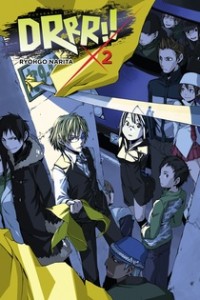
It can sometimes be difficult to review a light novel that is part of a long-running franchise whose fans have already seen variations on it – anime, manga, etc. In Japan, of course, the light novel came first, and thus the manga and anime give artistic attention to plot twists and character beats that the audience knows about through the book. In North America, it’s usually the opposite – we get the anime first, then an associated manga (though that’s switching around lately), and finally if it’s popular we see the light novels it was based on. And honestly, while I’m sure there will be some casual readers of DRRR!!, the primary audience for this 2nd book are people who already knows what’s happened in it. It’s thus more than a little amusing that the primary twist in this book is Anri’s identity, and the book goes to great lengths to keep it a secret from the reader for as long as possible.

drrr2

Just as Mikado and Izaya shared the ‘main character’ stage with Celty in the first novel, so Anri and Shizuo do with her here in the 2nd. The two are not dissimilar, though you wouldn’t guess that at first. Due to past parental abuse and then emotional trauma of their death (oh, and being possessed by a katana with a mind of its own), Anri is naturally repressed emotionally, and usually has no idea whether she should be happy, sad, or angry in any given situation. This is why she became best friends with Mika, and later on with Mikado and Masaomi – she sort of leeches onto their emotions and thus feels a semblance of normality. As for Shizuo, he simply has no limited, and has to repress his own naturally strong rage through sheer force of will – something he’s very bad at. The final fight he gets into is very cathartic, as he goes all out in his violent fury but doesn’t kill anyone, as he delightfully crows at the end. Shizuo is probably the most popular character in the series – Izaya is his equal, but has just as many people who hate him. You see why here.

It’s actually almost one year after the events of the first book, which comes as a bit of a surprise. There won’t be as much of a wait between the second and third, though – if the first book teased hints of future plots to come, the second is blatant about it, leading up to a cliffhanger where we finally see what the amassing Yellow Scarves are trying to do, and who they’re trying to pull in to lead them once again. It’s not all that much of a surprise – given that Mikado turned out to be the creator of the Dollars, and Anri (or at least Saika) being responsible for all the slashings, the identity of the leader of the third major force in this triangle is obvious in a literary way. It’s a nice way to bring in new readers to a third book, though, and as for those who’ve already seen the anime, hey, don’t hate on Saki too much, OK?

A good solid book for DRRR!! fans, who will enjoy the extra depth the narrative gives to the characters, particularly Celty, Shizuo, and Anri. And also for anime fans, Erika loves Shizaya, but it makes everyone around her, including Celty, want to throw up when they hear about it. Hee.

Ranma 1/2, Vols. 21-22

By Rumiko Takahashi. Released in Japan by Shogakukan, serialized in the magazine Shonen Sunday. Released in North America by Viz.

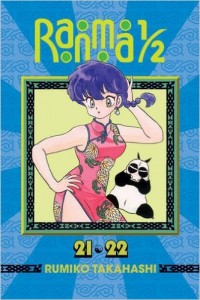
I discussed in my last review that the reader of Ranma 1/2 has to hit that sweet spot of caring enough about the characters to want to read more, while also not caring enough about them to take them too seriously. Nowhere is that more evident in Ranma than with how Takahashi deals with parents. She’s always had issues with parents, especially fathers, being mined for comedy, and even today in Rin-Ne we have one of the worst fathers she’s ever introduced, which is impressive in a career that’s give us Mr. Fujinami and Genma Saotome. So when we have the opening story here, where we’re meant to wonder if Genma really does have deeper emotions and feelings, it doesn’t quite ring true for us, as we’ve seen 20 volumes of him being a gigantic uncaring ass.

ranma 21

And of course that’s exactly what she wants us to think. She’s going for humor, and having the characters believe that Genma might care about his son while having the reader know better is why we’re here. What we’re left with is a fairly standard Ranma comedy arc of about three chapters, but you are reminded that Ranma lived almost his entire life on the road with only Genma to teach him, which explains much. It sets up the best story in this collection, which is the introduction of Ranma’s mother, Nodoka Saotome, who has come to the Tendos in search of her long-lost husband and son. Naturally, they are still long-lost because (say it with me) Genma is an ass, and Ranma is getting dragged into it with him.

Nodoka is a new character, and gets a more serious introduction than what we’ve seen before (witness the introduction of Mariko in the cheerleading arc, which is pure 100% silliness from moment one). There are signs she could be used for comedy, mostly based around her somewhat disturbing tendency to carry around a sword in case she has to decapitate her husband and son for being dishonorable. But for the most part Nodoka herself is treated seriously, and the comedy comes from Genma’s increasing efforts to hide Ranma’s male identity from her. Indeed, Ranma reflects on the fact that he never even knew he had a mother, and Nabiki, of all people, reminds him that the Tendos will never have the ability to see their mother again, so he should reach out more. (Takahashi immediately undercuts this with Nabiki charging him for hiding his identity, but we’re used to that from this author.)

Sadly, this wonderful arc is followed by one of my least favorite. It’s not that it’s poorly written – on the contrary, Ranma is painfully in character. Everything about the ‘reversal jewel’ arc plays into Ranma’s biggest weakness, his pride and his ego, and thus he cannot stop trying to get Shampoo to fall in love with him again, even when everyone else realizes “you idiot, this solves your problem!”. It also has a lot of Mousse, which I also tend to dislike, but at least he’s been dialed back to desperate here, as opposed to madman, and we’ll see more of that in the next volume.

But this is life with reading Takahashi, and Ranma in particular. Every arc you like that shows off the sweet, heartwarming sides of our characters is followed by showing off their petty, vengeful sides. Never grow, never learn. We’ll see if that keeps up with the next omnibus, which features one of the most beloved arcs (by the old 90s Ranma fandom, at least) of the entire series.