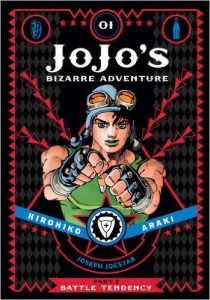
JoJo’s Bizarre Adventure: Battle Tendency, Vol. 1

By Hirohiko Araki. Released in Japan as “Jojo no Kimyou na Bouken” by Shueisha, serialized in the magazine Weekly Shonen Jump. Released in North America by Viz Media.

There was a bit of a worry in the Jump editorial offices when the 2nd part of this series began, Araki tells us, as Jump rarely killed off the hero and then kept going. This is why Joseph Joestar is a clone of his grandfather in terms of looks. Thankfully, he doesn’t act remotely like his grandfather, and we get to enjoy seeing a hero who is far more in the mold we’re used to today: brash, immature, confident, and a bit of a jerk. But he loves his grandma, and when it turns out that an ancient evil is upon them once more, he drops everything and bikes to Mexico to figure out what’s going on. Once again, no one does things in JoJo, they overdo them.
jojo2-1

The first half of this omnibus gives us a lot to work with, as Joseph Joestar arrives in New York City and immediately starts beating up cops, making friends of black pickpockets, and dealing with an old ally from the first series who has now turned evil fifty years later as he seeks to find a way to keep himself young and powerful. Yes, Straizo is our initial villain, as he and Speedwagon are no longer brothers in arms (see what I did there?), but he’s mostly just a teaser to show off that Joseph is starting out this series with an innate knowledge of the things Jonathan had to learn. Not that there won’t be training arcs in this series, but Joseph has an advantage from the start. He’s also cocky, with his tendency to predict the corny lines people will say to him endearingly dickish.

It’s a good thing that he has such a strong personality, as the rest of the cast doesn’t get as much of a chance to shine. Speedwagon and Erina are still around, but their function is the same even as they’ve become elderly: stare in awe at what is going on around them and comment aloud on it. Smokey too doesn’t do much here except be a standard sidekick, and he doesn’t even get to go to Mexico with Joseph. Indeed, the other character who gets the most development is one of the villains, von Stroheim (not named after a band, but a film director this time), who is a Nazi trying to use the newly discovered Pillar Men to help Hitler, but rapidly finds himself in over his head.

Those who enjoyed the first arc of JoJo’s should not be too worried about things being different here. Joseph may be a different personality, but the author isn’t, and there’s lots of things like his using Coca-Cola or cacti as amazing weapons to please the reader who just wants to see… well, bizarre things. This is a manga that can make a line like “How did he stop my Hamon-infused spaghetti al nero?!” into dramatic climaxes, and we wouldn’t have it any other way. The cliffhanger also implies that Jonathan wasn’t the only one to leave badass descendants. Fans of ridiculous Jump manga will find this is more ridiculous than the ones most influenced by it.

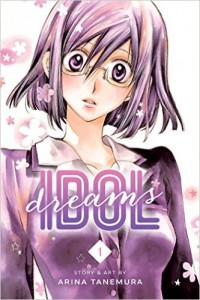
Idol Dreams, Vol. 1

By Arina Tanemura. Released in Japan as “31 Ai Dream” by Hakusensha, serialization ongoing in the magazine Melody. Released in North America by Viz.

There are bits of humor sprinkled throughout the first volume, but in my opinion the funniest part of Idol Dreams comes in the author’s notes afterwards, where Tanemura talks about how she landed this assignment. She’s no longer exclusive to Shueisha, so lots of companies wanted her, and Hakusensha asking her for a magical-girl manga for adults. This intrigued Tanemura, who signed up right away with Melody, Hakusensha’s hybrid josei/shoujo title. And then the editor urged her to get rid of all of the things she’s gotten so used to when working at Ribon – flowery SFX, lots of wacky gags, extensive drawings of clothing – to the point where the editor supposedly said “get rid of everything that makes it a Tanemura series”. I’m with the editor, though – Idol Dreams feels refreshing and new in a way a lot of her recent Ribon work did not.

id1

When I first read the description of the series, I had assumed it was some sort of “Peggy Sue” story, where the heroine would go back in time and try to do her life over again better this time. It’s actually a different genre altogether – as the editor said, it’s a magical-girl story for adults, and will be very familiar to those who recall early series such as Tezuka’s Marvelous Melno or Creamy Mami, which featured little girls taking age pills that magically made them into adult idol singers. Indeed, Tanemura fans may recall Full Moon, which also had a premise like this. In Idol Dreams, though, the lead character, as seen on the cover, is a 31-year-old office worker who’s on the verge of losing it – she’s basically staked everything on a happy high school reunion, only to have everything fall apart when the fact that she’s still a virgin is screamed out loud by a classmate.

It’s startling to see Chikage, after this and a couple of other humiliations, actually trying to kill herself by drowning in the local river. But ultimately it leads to a different kind of fantasy, as another high school friend (who has a crush on her that he still can’t quite blurt out – and a girlfriend, which makes it harder still) has some magical – sorry, unproven scientific – age regressing pills that will make her body like a 15-year-old for a few hours. What are the odds that she would be scouted immediately as a replacement for an idol? Or bond with the troubled young genius singer of a boy band? Or find herself in a forbidden romance (which she really should know better about, we’ll see how future volumes develop yet another of the popular ‘age-difference’ relationships)?

So here we have a magical girl heroine who doesn’t go home and do homework after her battles, but goes out and gets drunk instead. Despite what Tanemura and her editor said, this isn’t totally far off from her usual titles, but it’s taken in a slightly new direction and has that fresh feel to it. I look forward to seeing where she takes us.

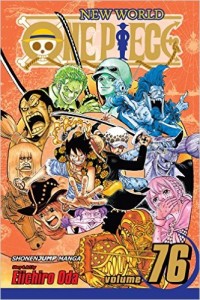
One Piece, Vol. 76

By Eiichiro Oda. Released in Japan by Shueisha, serialization ongoing in the magazine Weekly Shonen Jump. Released in North America by Viz.

Let’s get the bad out of the way right off the bat: Rebecca has not remotely lived up to the hopes I had for her as a character. The reunion with her father, with all the overtones of “you should never have been a fighter, I’m so sorry you had to be strong and not a princess that needs protecting” left a bad taste in my mouth, and I’ve given up on it being subverted at this point. Unfortunately, this is not a sentiment that’s unique to One Piece, as we’ve seen it in countless manga and anime before this. I had hoped Oda might avoid it, but no, there it is. Luckily, it’s a low point in an otherwise excellent volume, so let’s talk about the rest of it.

OnePiece76

I have occasionally wondered if I praise Usopp too much, but then I wander on to forums and see more people talk about how useless he is, and so therefore I think no, there is not enough praise. Because he’s hella awesome here, taking out Sugar AGAIN with the help of a truly weird power from a minor character and what I believe is actual haki, which we haven’t heard much about since right after the timeskip. We’d seen Coby use it before, but it’s still awesome to see that a power that is basically “I am enforcing my will on reality” can be used not just by the brute force heroes but by support folks like Usopp.

Speaking of which, Robin and Usopp both have small speeches in this volume where they talk about their devotion to Luffy, and it’s worth noting how much of being a pirate captain in One Piece is creating a cult of personality around yourself. Luffy doesn’t do this deliberately, of course, but those who follow him know that he is the one, they one they can dedicate everything they have to protect and serve. It’s even given a parody over the last few volumes with Bartolomeo, whose idolization of the entire Straw Hat crew is a takeoff of the typical fanboy. It’s worth noting that Robin does not denigrate this love the way others have, though (and that she calls him rooster, I love that she still tends to give nicknames to everyone), as she’s a convert as well.

Meanwhile, Luffy and Law (finally out of the seastone cuffs) are ready to face off against Doflamingo, which means that we get two things that One Piece is most famous for – chaotic final battles with lots of punching, and flashbacks to explain a character’s tragic past, this time Law’s. Sure, we also get a bit of Doflamingo’s, which has a bit of a ‘fallen angel’ vibe to it, but Law, with his tragic white lead poisoning and massacre of his entire homeland (hmmm, seems familiar… Doflamingo even points this out, saying complete genocide is a standard World Government tactic) is the one we’re meant to feel bad for. This story leads us to the cliffhanger for this volume, and I suspect will take up the majority of the next. When it finishes, will we be finishing the Dressrosa arc? Don’t hold your breath. But keep reading One Piece anyway.