Golden Time, Vol. 1

By Yuyuko Takemiya and Umechazuke. Released in Japan by ASCII Media Works, serialization ongoing in the magazine Dengeki Daioh. Released in North America by Seven Seas.

I’ve talked before about how difficult it can be to introduce an unlikable character early in a series and have their character growth be a part of it, mostly as fandom takes first impressions and encases them in amber forever. This is doubly true if the character is female, and quadrupley true (is this a word?) if it also happens to be a comedy romance, with harem overtones. Golden Time is starting off in a bit of a pickle, though, as its heroine, Kaga, is introduced to us as an obsessed stalker who’s also rich and beautiful, and rubs every single reader the wrong way. Luckily, we have our hero, Tada, who is determined to show that she has hidden depths, even if he can’t quite make them out. And, wonder of wonders, he is not the doormat that most of these series frequently use as male heroes, so as the volume goes on and we learn more about the two of them the good qualities of the series come to life.
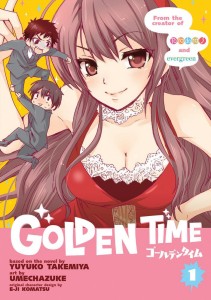
goldentime1

That cover, to be honest, really doesn’t help, and panders to a fanbase that is more Monster Musume than Toradora. Oh yes, this is by the creator of Toradora, based on her light novels, which she started after finishing her other series. Toradora also featured an unusual lead male hero, and Golden Time’s Tada has a very good reason for sometimes acting out of character – he has amnesia of most of his life before the last year, and can’t recall what his character actually is. This is presented in the midst of a truly ridiculous chapter involving a religious cult who have kidnapped several students to indoctrinate them, so it’s no surprise that Kaga does not particularly believe him. As for Kaga, her backstory is more normal, being a lonely rich girl who has no idea how to do affection, so overdoes it to the point where it becomes terrifying.

Most of this volume just involved Tada, Kaga, and Kaga’s unfortunate crush Yanigasawa, who is thoroughly sick of her and horrified that she followed him to college (the fact that this is set in college – and indeed in the law program – is highly unusual for a harem comedy, and I hope more is done with it in future volumes). There’s another girl who gets cameos at the start and end, who I suspect will take on the position of chief rival/alternate heroine choice, but this is mostly a two-hander, relying on the two leads. They bond right away, and Tada is falling for Kaga while also clearly seeing her flaws – he just doesn’t really care, and also her flaws don’t impact *him*, as she’s in love with someone else.

I think fans of Takemiya’s other works will enjoy this, and fans of romantic comedies should give it a try, but be aware this is one of those series where you may need 2-3 volumes to star liking the heroine, and if you’re the sort who rolls out the word ‘psycho’ whenever it suits you, take my advice and don’t get involved.


Oresama Teacher, Vol. 19

By Izumi Tsubaki. Released in Japan by Hakusensha, serialization ongoing in the magazine Hana to Yume. Released in North America by Viz.

In my review of the last volume, I said that Hayasaka’s past was looking more serious than this manga usually gets, but I didn’t think it was going to get that dark. Boy howdy was I wrong. Not that Oresama Teacher has suddenly turned angsty and depressing, but certainly this volume hinges on the fact that Momochi’s mental manipulation of Hayasaka is being helped along naturally by his own traumas, and that he has in fact had this sort of thing happen before. Luckily, he has the Public Morals club to help him this time, and the volume ends on an upbeat note (albeit one with our heroes at the bottom of a cliff – what is it with Hana to Yume series and cliffs?)

oreasma-19-2

Tsubaki enjoys playing with reader preconceptions and that’s certainly the case here, as Hayasaka’s supposed family background is the sort of thing we’ve seen in manga and anime before, with the mistress kept in a locked room away from everyone. Only that turns out not to be the case, and in fact is something that Hayasaka has created to cover up the real tragedy that he refuses to accept. The scene with Hayasaka and his father at the funeral is heartrending, something I never really thought I’d say about Oresama Teacher. And in fact, again contrary to our expectations, Hayasaka’s family turn out to be mostly okay – his hatred of his father stems from something that isn’t happening anywhere but in his head, and his dad, while trying to keep Hayasaka’s past hidden, shows genuine concern for him.

There is some humor in this volume, rest assured, though I wonder if the story turned more serious when Tsubaki was starting off Monthly Girls’ Nozaki-kun. Most of it comes from Mafuyu and Yui, who continue to react in a hilarious way whenever called on to be normal or mature. Mafuyu also gets an emotional arc in her desperation to make Hayasaka recover his memories, though I wonder if that will come back to bite her in the end, as it’s hinted that the main reason that Hayasaka hasn’t realized Mafuyu is Natsuo or Super Bun is his own mental blocks, and those may be coming down. Her emotional tears in the last chapter are well earned, though.

We’re still not quite done with this arc, though, as Momochi is still a threat. We see she’s used her ‘hypnosis’ powers in the past, and has forced several students to withdraw from school – even non-delinquents. There are, of course, nasty rumors about her, and I have a feeling that Hayasaka may not be the only one with a tragic past. (And he has a first name now! Though I can see why he wants to keep it a secret – and an endnote might have helped there, Viz.) Oresama Teacher is still worth reading for the comedy, but as it barrels towards a theoretical conclusion soon, it’s also gaining real depth and heart.

Horimiya, Vol. 1

By HERO and Daisuke Hagiwara. Released in Japan by Square Enix, serialization ongoing in the magazine GFantasy. Released in North America by Yen Press.

There’s been a strong market recently for repurposed web novels and webcomics licensed by major publishers and redone more professionally. Sword Art Online was originally published (fittingly) online. One-Punch Man was based on a webcomic band now has the Eyeshield 21 artist giving it a more manga feel. And then we have Hori-san to Miyamura-kun, a webcomic by HERO, which not only was popular enough to have Square Enix release the comic itself in 10 volumes several years ago, but now has a reboot with a new artist, running in Square Enix’s ‘we don’t have a shoujo magazine, so here it goes’ title GFantasy. And I’m happy that we’re getting it as well, as Horimiya is a delightfully fun and relaxed shoujo series about two people who find they can show each other their true selves, and how they then start falling for each other as well.

horimiya

Fans of Kare Kano may find the premise a bit familiar, but as you dig into it the differences stand out more. Kyouko is a bright, pretty, popular girl at school, but doesn’t hang out with her friends after as much as you’d expect. Izumi is a somewhat otaku-ish guy who always wears long sleeves and long hair no matter what, and who tends to keep to himself. The plot kicks off when Kyouko finds out that outside of school, he’s actually a pretty handsome guy with tattoos and piercings. And Izumi finds that Kyouko is actually a pretty diligent big sister who has to essentially raise her little brother while her mom is away for days at a time at work. Both of these are things they need to hide at school (though admittedly the whole “without my makeup I am plain and don’t want anyone to see this is how I relax” thing made me roll my eyes a bit), and Kyouko’s little brother really bonds with Izumi, so the two of them end up hanging out after school… and possibly more.

There’s no immediate hook to this series the way One-Punch Man had. It’s a standard shoujo with two likeable leads who are clearly going to end up together, it’s just a matter of when, and their friends who are slowly going to learn the terrible secrets contained within. But it’s one of those series that’s just very well told. The two leads are not overly naive and idealistic or sullen and rude, as you find in so many shoujo series these days. They’re just kids. The mood reminds me a bit of Love at Fourteen, only here they’re a couple of years older. The humor arises from the characters and situations, and sometimes made me laugh out loud. There’s even a good cliffhanger where Kyouko realizes that, despite being a nice kid, Izumi is indeed a teenage boy who might (gasp!) be sexually attracted to her.

Horimiya is a strong debut, and I recommend it not only to Yen’s followers but also to any Shojo Beat fans who might miss it because it’s from a different publisher. I eaglerly look forward to the second volume.