No Game No Life Vol. 2

By Yuu Kamiya. Released in Japan by Media Factory. Released in North America by Yen On.

I am starting to come to terms with No Game No Life. All the problems I had with the first volume are still there, with underage nudity, pointless ecchi fetishes, and another token loli added towards the end. But all the strengths are still there as well, this being a world with two strong lead characters, a fascinating premise, and enough humor that doesn’t revolve around panties that I found myself laughing quite a bit. More to the point, all the questions I had at the end of my first review are actually answered, always a plus for a light novel series. And unlike the first book, this one ends on a nasty, if rather sudden, cliffhanger that will leave you wondering what disaster has befallen Shiro and… um, was there someone else?
ngnl2

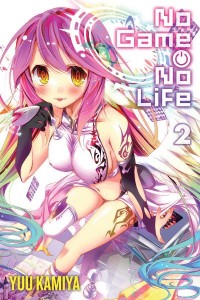
The girl staring saucily at us from the cover is Jibril, who is essentially an Angel, and probably the best addition to the cast this volume. She has a lust for knowledge (pretty much literally), a surprisingly vicious streak (the angels used to do mass slaughter till the ‘game board rules’ were enforced, and she misses killing), and a truly flaky personality that leads to the funniest section of the book, where she greets our heroes in broken gratuitous English. (The translation, by the way, gives this as broken gratuitous Japanese, which works, as well as a Kyoto dialect (Southern US) and ‘l33t-speak’ to convey just how silly and irritating Jibril is being.) The shiritori battle which follows is jaw-dropping, once again showing how smart and forward-thinking [ ] are (Here the translator is forced to simply give the Japanese word right after the translation, as it simply can’t be translated).

Stephanie, as you might expect, is mostly used as a figure of humiliation and humor, though she does get a few chances to shine, as she’s basically running the entire country while Sora and Shiro research how to possibly win against any other race. Speaking of which, we’re introduced to the first big challenge, the Werebeasts, who supposedly can read minds and also have animal attributes that make them scary, but to someone like Sora, that means only one thing – cute girls with animal ears and tails. And that’s exactly what he and Shiro get, as they meet the ‘ambassador’ of the Werebeasts, an 8-year-old with a tendency to swear copiously as she’s not used to the human language and doesn’t know better. She’s such a fetish figure that I almost have to shake my head and laugh, but I hope she gets character development later as the others here do.

I said in my first review that I wish the series could just drop the service and get on with it, but I suspect that part of the reason why No Game No Life is so successful is its ability to balance the two sides equally. The game theory is interesting, the plot twists usually surprising and well-thought out, and Sora as a large ham is fun. Shiro has less to do, but she’s far more introverted, and given the cliffhanger, I suspect a lot of Book 3 will have to feature her taking charge. And the fanservice is truly ridiculous (the chance of something pornographic happening, as with most Japanese ecchi series, is below zero), clearly not taking itself seriously – Sora even gives the naked girls Barbie Doll Anatomy at one point. If it weren’t for the fanservice, I’d happily recommend this to anyone. As it is, I recommend it to people who already know the series.

Durarara!!, Vol. 1

By Ryohgo Narita and Suzuhito Yasuda. Released in Japan by ASCII Mediaworks. Released in North America by Yen On.

As you may have noticed from the ugly 2 at the end of the URL, I’ve reviewed a DRRR!! Vol. 1 before, when the manga first came out in 2012. And now we have the novels, something I was not expecting. Those familiar with the anime and manga won’t find any major changes to what they already know, though there was a character building scene that was deleted from the anime (which actually came back to bite them recently when a girl from said character building scene showed up again). For the most part, though, reading this novel if you’ve already seen the anime or manga gives you greater depth of characterization, as we get inner monologues and narrations that help to flesh out Mikado, Celty, Izaya, and the rest of the cast.

drrr1

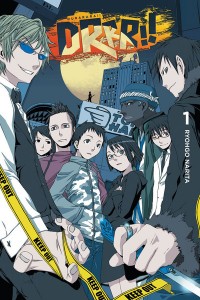
I will warn you in advance: don’t buy this novel for the illustrations. Yasuda-san has improved in the ten years since this was released, as readers of Is It Wrong To Try To Pick Up Girls In A Dungeon? can see. But this first volume of DRRR features some very ugly characters with flat, dead faces staring at you from the front cover. The cover, however, does illustrate one of the main draws of this series (and Narita’s series in general): there is a huge cast of characters, all of whom play some part in the narrative and there is no one ‘main character’, though in this first book I’d argue Mikado comes close. Mikado benefits most from the light novel perspective, as you realize just from watching and listening to him just how much he desperately wants excitement in his life, and what he is willing to go through to achieve it.

As for the rest of the cast who have large roles in this first book, DRRR!! is also known for having no ‘normal’ people in its cast, as everyone ranges from mildly eccentric to flat-out crazy. This is best illustrated by our antagonist for this book, Namie Yagiri, her brother Seiji, and Seiji’s stalker Mika. The three compete to see who can be more messed up and make you want to put the book down in disgust. Namie is incestually attracted to her brother, her brother is in love with a severed head, and Mika wants to eat said severed head so that she can then gain Seiji’s attention. They truly deserve each other, as Mikado says, and give the book a nice frisson of creepy.

Compared to them, folks like Celty, who may be a supernatural headless Dullahan but is possibly the nicest, most normal person in the series, or Izaya, who tries to be a villain but mostly ends up just being an asshole, are more relaxing and easier to take in. It actually may surprise folks how much of the cast don’t get much focus in this first book – Shizuo barely shows up, Anri mostly functions in terms of her relationship with Mika, and Masaomi turns out to be mostly irrelevant except to contrast with Mikado. Of course, this will change – despite Narita hoping the book goes beyond one volume, I’m fairly sure this was commissioned as a 3-volume series to start, and the next book will definitely be focusing on Anri.

Fans of the DRRR!! anime and manga will definitely want to check this out. If you watched it for the Shizaya, there’s a nice fight here for you. If you avoided it because of the Shizaya, they barely interact except for that fight. Something for everyone! Stephen Paul’s translation is also smooth and non-obtrusive, with the narrative being wordy as Narita usually is but lacking that ‘light novel’ feel some other series have had (hi, Index). And the art will improve in a few books time. And it’s out digitally as well, for folks who’ve watched me hammer on about that on Twitter!

Oh yes, sorry, Baccano! fans, Isaac and Miria’s cameo was anime-only. You will see the Nebula Corporation here, though.

Ranma 1/2, Vols. 17-18

By Rumiko Takahashi. Released in Japan by Shogakukan, serialized in the magazine Shonen Sunday. Released in North America by Viz.

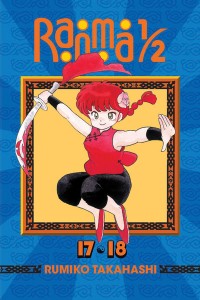
A word of warning here: I love Nabiki Tendo. Love love love her. I don’t deny that if I were ever to meet her in real life I’d run away, but she’s fictional, so I am free to openly admire a confident confidence trickster who decides to mess with Ranma and Akane purely because it amuses her… and also to get some of Ranma’s cash, of course. This volume is the first one where she’s really had an arc focusing on her, and she’ll only have one more after this (about 7 omnibuses from now). So most of what folks consider ‘canon’ comes from the 6-chapter story in this volume, where, after a huge fight – again – Akane decides that Nabiki can be Ranma’s fiancee instead.

ramna17

Of course, like every other story in the series, Nabiki’s presence here is to help show how Ranma and Akane are perfect for each other, while also demonstrating why it’s taking forever to get them to admit that. Akane’s hair-trigger temper is seen here several times, topped only by Ranma’s amazing tendency to say exactly the wrong thing and not understand why anyone would get angry. If you combine this with their mutual innocence and gullibility, it’s no wonder that Nabiki can play them both like fiddles. It helps that Nabiki is one of the few women in the series not attracted to Ranma – at one point she decides to wrap things up, thinking “wouldn’t want him to get TOO attached to me.” I also like that she’s not perfect – her plan to sell Ranma to the highest bidder is done in by Shampoo, Kodachi and Ukyou deciding that killing Nabiki would achieve the same end (yes, Ukyou is also there, just slightly less murderous), and she misreads Ranma as genuinely trying to hit her towards the end. She should know better. She also shows a bit of concern that her plan might genuinely break Ranma and Akane up, which is sweet.

Of course, there’s a lot more in this omnibus than Nabiki, but it’s not quite as interesting. Picolette Charin’s story is wrapped up in a fairly weak way, though the force-feeding was pretty clever. The entire second half of the volume, though, is taken up with a new minor villain, who has the unfortunate name of Pantyhose Taro. In fact, his name drives the plot – he got the name from Happosai, who happened to be at the springs where the young baby had drowned and christened him as if it was a baptism – and his tribe forbids name changes unless it’s the one who gave the name. So Pantyhose Taro has a grudge, and is also possessed of possibly the most ridiculous Jusenkyou curse of all, a yeti riding an ox carrying an eel and a crane spring. This translates to a hideous huge monster, but Pantyhose Taro is fine with that – it’s the name he hates.

Most of this volume is taken up, unfortunately, with a lot of fights and with Akane getting kidnapped and used as bait – again. Luckily, there’s also some sharp humor as well, mostly at Taro’s expense. Pantyhose Taro ends up being the inverse of the usual manga villains – usually they never appear again in the manga, but the anime has them return. Here it’s the anime that didn’t bother to bring Pantyhose Taro back, but we’ll see him again soon. We’re halfway through Ranma 1/2 now, and next time we’ll get a few more amusing one-shots, as well as the development of two new devastating attacks for Ranma and Ryouga.