First Love Monster, Vol. 1

By Akira Hiyoshimaru. Released in Japan as “Hatsukoi Monster” by Kodansha, serialization ongoing in the magazine Aria. Released in North America by Yen Press.

First off, this is another one of those titles where, no matter how good the execution is, recommending it to friends is just going to be problematic. “See, the twist is that the male lead is really 11 years old… STOP CALLING THE COPS, DAMMIT!” Manga and anime romance has skewed young pretty much since inception, but 13-14 used to be the low end, with most of it taking place in high school. Lately, though, we’re seeing more and more series with younger and younger characters, and even if they aren’t getting in relationships they’re sexualized in some way (hi, No Game No Life). And of course this is written for Aria, which has increasingly become Kodansha’s ‘eccentric’ shoujo magazine. Come into this knowing that the premise is questionable.
hatsukoi1

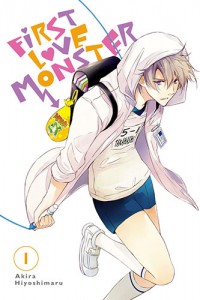
The good news is that the author and the cast also know the premise is questionable, and call it out throughout the entire volume. Our heroine is caught up in the flush of first love based both on looks and the fact that he saved her life in a cool manner, but is aware this is deeply wrong. Everything Kanade does emphasizes that he’s not ‘mature for his age’ in anything but appearance – he’s still playing in sandboxes. If this were a case where she were in college and he was in high school, it would be like any other shoujo romance out there, but the fact that he’s 11 adds a frisson of wrongness that just doesn’t go away. It drives the entire title.

Honestly, I kept expecting this to be creepy and make me stop reading, but it never did. It has so many elements that could have gone badly. If the 11-year-old hero had also been mentally/emotionally mature… if the heroine had not been sheltered and naive herself, as well as starved for affection… even the appearance of the characters, which the author says in a note her editor had her change, as the original was a normal-sized girl with a short guy (she liked the huge difference between then, so when told to make the girl tiny, made him huge to contrast), ends up massively improving the product.

There’s also lots of humor – this doesn’t take itself seriously, and I laughed out loud at the introduction of Kanade’s equally huge classmates, as well as their Detective Conan-eaque leader. The one thing I really disliked was Taga, the college age guy who attempts to sexually assault Kaho because… well, because that’s what happens in these sorts of titles to provide conflict, and I wish it didn’t. Naturally, he gets away with a busted lip and nothing else, and is free to emotionally abuse the heroine later. Luckily, the rest of her roommates are more supporting, but that guy needs to go away.

As with so many titles I’ve reviewed lately, if the premise squicks you, don’t get First Love Monster. But the author actually respects and treats the leads sympathetically, without setting up the heroine for comedic humiliation faces. That means I’m intrigued, and will get the next volume to see where it goes.

Double Dose of Seven Seas: Pandora in the Crimson Shell: Ghost Urn vs. Magika: Swordsman and Summoner

Pandora in the Crimson Shell: Ghost Urn by Shirow Masamune and Rikudou Koushi. Released in Japan as “Koukaku no Pandora – Ghost Urn” by Kadokawa Shoten, serialization ongoing in the magazine Newtype A. Magika: Swordsman and Summoner by Mitsuki Mihara and MonRin. Released in Japan as “Magika no Kenshi to Shoukan Maou” by Media Factory, serialization ongoing in the magazine Comic Alive. Released in North America by Seven Seas.

As I’ve said before, my tendency to give all Volume 1’s a shot even if I suspect they won’t be my thing at all gets me into a lot of difficulties, particularly with Seven Seas, which is very much an all or nothing company with me. They debuted two new titles this month, one of which not only has the amazing writer-artist team of Shirow Masamune and Rikudou Koushi (leaving Viz means he gets his u’s back), but managed to be on SDCC’s worst manga of the year list despite having been out a total of 5 days when the panel ran. The other one is a harem fantasy from my old nemesis, Comic Alive. Two otaku-pandering titles enter, only one can leave – which one did I like more?

ghosturn1

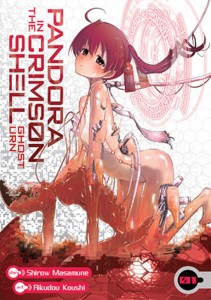
Pandora gets off to a poor start with that cover, featuring our heroine bursting, semi-mude, from some sort of mosaiced plastic casing. We then get color pages of another heroine dressing up in tiny lingerie. This title definitely does not skimp on the fanservice, as we’ll see throughout the volume. The basic premise involves Nene, our heroine, getting involved with a confident young woman who may actually be a supervillain and her cyborg companion. Nene is also a cyborg and highly idealistic, saying that she wants to see world peace. Sadly, she arrives at her island destination to find a robot gone amok, and only she and Clarion (the other cyborg) can hope to stop it.

On pure skeeze factor, Pandora in the Crimson Shell wins hands down. The sequences where Nene has to finger Clarion in her vaginal ‘port’ are risible, though admittedly I wouldn’t put it past Shirow based on past titles. Speaking of which, the credits show quite a committee working on this title. Rikudou is the main artist in charge, but I had felt that I could only see his art style occasionally, and that may be why. His sense of humor, thankfully, is sometimes more apparent, particularly in the Excel-ish intrepid reporter and the dry tones of Uzal Delilah. The action sequences, which make up much of the second half, are… decent. Basically, if it weren’t for the horrible service and constant sexual assault hints, I may actually have enjoyed this. Sadly, the service and assault is all over the book.

msas1

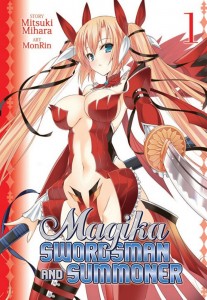
Magika Swordsman and Summoner is our second title, and reads like a modern-day light novel checklist (appropriate, it’s based on a light novel). Our hero is the lowest of his class at magic school, not good for much yet but stirring water around. He’s also the only male in a class of females. He has an adopted sister (older than him, but acts younger as they only found that out recently), who harbors incestuous feelings for him. At the school, he meets a busty airheaded woman who turns out to be student council president, as well as an angry young blonde who seems very upset that he doesn’t recognize her, for some reason. Oh yes, you can also add in a quiet, stoic elf-girl and a shy girl who can’t deal with men. When he summons an amnesiac diva with no powers (which gets him in trouble, as she may be evil), he discovers he has to form a harem of 72 women in order to become the Harem King.

If you started throwing up halfway through that, you may get the feeling I had while reading this title. Everything about it is from Tropes 101, be it the Magic Academy stuff or the Harem stuff, though I admit 72 is aiming high – even Negima didn’t quite go for that many women. (Yes, it’s from reports of the houris that accompany Muslim martyrs after they die.) Seven Seas’ back cover notes that fans of Dragonar Academy and Zero’s Familiar will enjoy it, and I can’t argue with that – it’s certainly more of the same. The one redeeming feature is the hero, who seems a decent sort and is very uncomfortable with the whole harem concept. We’ll see how long that lasts. Or rather, other readers will.

In general, if you’re going to be a bad manga and keep me interested, it’s best to do it with style. Neither of these titles are things I’d recommend to anyone except SS’s core otaku audience. But honestly, Ghost Urn made me wonder how the cliffhanger might be resolved, whereas with S&S I just didn’t care. On balance, I have to give the edge to Shirow, Rikudou and company here.

Alice in Murderland, Vol. 1

By Kaori Yuki. Released in Japan as “Kakei no Alice” by Kodansha, serialization ongoing in the magazine Aria. Released in North America by Yen Press.

I’ll admit that I’ve always found Kaori Yuki titles hard to get into, and even harder to review. There is a certain amount of ‘aesthetics preferred over plot and character’ to her work, which makes it highly entertaining and visceral but leaves a person frustrated when they have to talk about it. There’s also giant piles of corpses in most everything she’s done, usually of the most sympathetic women in the book, and that applies here 100%. And of course the grand guignol horror of it all. Oh, and this is yet another of what has become my least favorite genre, the survival game. Despite all that, this is still a compelling read, and I had no trouble getting to the end of Volume 1, though I’m not exactly sure where it’s going beyond ‘chaos’.

alice1

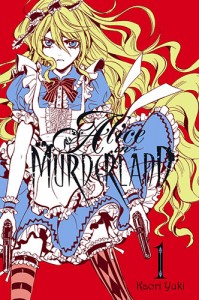
Our heroine is the Alice seen on the cover – except not really. She’s actually Stella, a normal dark-haired high school student who is part of a very eccentric family of orphans who were adopted after a tea party filled with mass child slaughter. Every month the family goes to a tea party that’s held by their amazingly insane mother, who this month tells them that the time has come for them to fight each other to the death to see who gets to be the next family head and have access to a medicine that makes a person young and beautiful even in their old age. Some of them are, of course, reluctant to do this, so each of them has a hostage who will be killed if they don’t comply. To make matters worse, none of them are exactly stable to begin with – certainly not Stella, who snaps in traumatic situations and transforms into the blood-spattered Alice seen on the cover.

If this sounds a bit over the top, welcome to the world of Kaori Yuki. I also forgot to mention Alice’s stalker-cum-protector, Tsukito, who carries around voodoo dolls to curse people and is obsessed with Stella, yet halfway through shows up to become her new bodyguard and who we’re now supposed to feel sympathy for, despite the fact that he was a real creep earlier. As for the rest of the family, the other one who merits mention is Zeno, Stella’s ‘big brother’, who is killed early in the volume but then revived, only for Stella to find his personality is quite a bit different. She should be used to this, though, given how she does a 180 degree turn into murderous grinning killer when faced with horrible situations.

I’m not sure I actually enjoyed this – the horror is really grotesque in places, and there’s a sequence with a toy bunny getting restuffed that should come with a trigger warning. But it’s certainly compelling and gives a visceral thrill. I wouldn’t read it if you want to see what happens next with the plot and characters. But if you enjoy Kaori Yuki’s terrifying manga titles, and want to see lots of action and corpses, Alice in Murderland is right up your alley.