Fragments of Horror

By Junji Ito. Released in Japan by Asahi Shinbunsha, serialized in the magazines Nemuki+ and Shinkan. Released in North America by Viz.

I’ve never read Junji Ito before this volume, believe it or not. I used to say it’s because I don’t like horror, but I think we know that’s pretty much a lie. The truth is that I like horror if I can find an in, such as the characters and humor (Kurosagi CDS), the promise of a happy ending for these sweet kids (Higurashi), and seeing a well-crafted cast be horrible to each other (Umineko). So I never really thought about reading Uzumaki and Gyo. Reading this, though, I can see the appeal – the stories are not so much scary as unnerving, and while I didn’t feel particularly frightened as I read the book, I got more unnerved as I went along, and it sticks with you long after you put it down.
fragments

In an afterword, Ito talks about the fact that he hadn’t done a short story collection in a while, and feels the first one was rather weak. I’m inclined to agree with him, it’s the weakest in the book. In fact, the book almost succeeds in having each story be better than the previous one, though I think its peak for sheer disturbing is Blackbird, the tale of an injured hiker and the creature who helps him survive. And I will admit, there is some grotesque humor to be found here as well, from the woman who loves the house she’s boarding in – literally – to the entirely of Magami Nanakuse, which seems to combine grotesque horror and stand-up comedy in a way I can’t quite explain. Those expecting your typical American slasher story… or even Japanese titles like Ringu… are going to be startled, as this isn’t much like those.

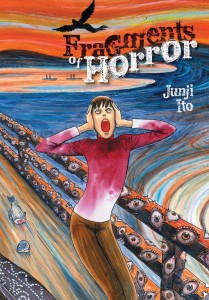
It helps that Ito’s style of drawing faces and expressions hearkens back to a 1980s style rather than the more modern or cute manga styles we see today. Actually, a lot of his work reminded me of Makoto Kobayashi, author of What’s Michael and Club 9, who also enjoyed drawing long-faced, highly expressive men and women doing very, very silly things. I can also see fans of Furuya Usumaru liking this as well – the cover art is very reminiscent of one of his “Short Cuts” collages.

It’s hard to review a short story anthology without giving everything away, but I will note there were a few stories that went more for the melancholy than the creepy. Gentle Goodbye was sweet and sad, and makes you wonder what a world where this is possible would be like. It also has the most likeable viewpoint character of the series. And Whispering Woman was sad in a different, more sinister way, as we see someone desperately trying to deal with an abusive relationship, with tragic results. But really, the best thing to say about this collection is that I think even non-horror fans would get something out of it, though I’d certainly keep it away from young children (there’s also some nudity here, mostly in the story Wooden Spirit). Ito is a master, this book shows you why.

Tokyo Ghoul, Vol. 1

By Sui Ishida. Released in Japan by Shueisha, serialized in the magazine Weekly Young Jump. Released in North America by Viz.

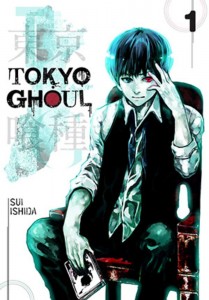
I am highly amused at the cover art for the first volume of this series, designed to draw in readers. It shows our hero, Kaneki, posing artfully on a chair, shirt untucked and collar undone, a hand to his head, a glowing red eye sdtaring at the reader, and a small fake-looking smile on his face. It is a look that says “Ladies, I am undead and hot. Please read my story.” It does not bear any resemblance whatsoever to Kaneki in this entire first volume, who from the moment he is attacked by a ghoul is in a state of panic, hunger or guilt. But then seeing him crying and creaming on the cover wouldn’t give the manga the right image. And while I think it’s a decent start, this manga does seem to be more about looking cool than plot and characters.

ghoul1

The premise is simple and easy to understand. Our hero is a bit of a nerd with a crush on a gorgeous girl who reads the same erudite horror novels he does. On their first date, however, he discovers she is a ghoul out to kill him and eat his flesh. Fortuitously, she is killed by a passing act of God – or possibly some I-beams to the head – and he survives, albeit on the brink of death. The doctor, wanting to save his life and having a convenient corpse handy, replaces some of his organs with those of the ghoul. Thus when he wakes he finds himself a hybrid, not human or ghoul… but still craving the taste of human flesh.

There is some horror here, rest assured, but I’d say it’s far more of a thriller than a horror series, like most of the current zombie genre. I will admit to one pleasant surprise in this first volume. We see a young woman with her hair draped over one eye, who was giving our hero and his love interest/ghoul the stink-eye early on. I was fairly certain he would end up being rescued by her, and that she would turn out to be a ghoul hunter or somesuch, showing him their dark organization and asking if he wants to destroy ghouls with them. Totally wrong, in fact. In fact, Touka is also a ghoul, and the dark organization she belongs to is basically a ghoul halfway house, dedicated to allowing them to live relatively safely without becoming serial killers, like Kaneki’s crush turned out to be. She also (supposedly) wants nothing to do with Kaneki. I’m sure that will change.

This is a solid first volume. The villains we do meet are nicely nasty, and it’s nice to see a damsel in distress be male for once. That said, I didn’t really find much here that would make me want to read past the first volume. If I’m going to be reading horror, I’d like a bit more humor – this is a Very Serious title – or a bit more complexity, a la Umineko. But for those who enjoy zombies – pardon me, ghouls – and action thrillers with seemingly high body counts, you’ll get a kick out of Tokyo Ghoul.

Wandering Son, Vol. 8

By Shimura Takako. Released in Japan by Enterbrain, serialized in the magazine Comic Beam. Released in North America by Fantagraphics.

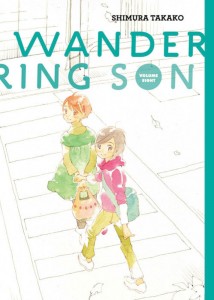
It’s always interesting to see which expectations this series plays into and which ones it subverts. Nitori and Anna are still dating throughout this volume, and it’s really, really cute. I adore them as a couple. And when Nitori confesses about wanting to wear girl’s clothing, Anna is not only seemingly fine with it but by the end of the volume is getting them matching accessories. But the question is, is this where the series is actually going to go? Because I think a lot of folks are expecting that Nitori and Takatsuki will end up together, because they’re the leads, and because that’s the sort of things that happen in romance titles like this. Except Wandering Son isn’t really a romance title.

wanderingson8

Speaking of Takatsuki, after last volume’s explosions with Chiba, it’s interesting to see that they’ve patched things up to a degree, though this does lead to the most awkward foursome ever when they come across Nitori and Anna on a date and everyone ends up at a karaoke booth. Takatsuki is trying to fittle victories this time around. Sarashina is the sort who can wear a boys’ uniform to school and not fear consequences. Takatsuki has to make do with things like wearing a tie rather than the school ribbon. And then there’s the hair, which is starting to grow out and “become more feminine”. Takatsuki’s gender identity has always felt more ambiguous and conflicted than Nitori’s, and that’s evident here, as we’re dealing with a child who’s still trying to decide between two states.

I was surprised to see the addition of Doi, who seems to be starting to move on from his ‘bully’ stage, but it was a nice moment, as it led to a) some very funny business for when he actually meets Yuki, and b) the revelation to him that yes, trans people an be incredibly attractive and are not the stereotypical drag queens with stubble that Japanese entertainment enjoys showing them as (see One Piece as an example of this). Doi and Nitori’s scenes together are filled with awkwardness, but it’s also his desire to see Nitori dressed as a girl, compounded on top of Nitori’s budding relationship with Anna and some well-meant advice from Sarashina, that leads to the cliffhanger ending of this volume.

Last time I wrote a review of this title, I talked about how it was harder for Takatsuki to do this, and now we’re seeing the inverse of that. Takatsuki can, in a pinch, get away with dressing in a boy’s uniform at school and get off with nothing more than mild scoldings. When Nitori goes to school dressed in a girl’s uniform, there’s immediate punishment – Nitori’s parents are called. We don’t see what happens next – we’ll have to wait for the as-yet unscheduled Vol. 9 for that – but I can’t imagine it’s going to be anything good. The first 3/4 of this volume were perhaps the lightest this series has gotten. The next one is, I suspect, going to be deeply unpleasant and yet utterly fascinating. Still highly recommended.