Dorohedoro, Vol. 16

By Q Hayashida. Released in Japan by Shogakukan, serialization ongoing in a Shogakukan magazine to be named later. Released in North America by Viz.

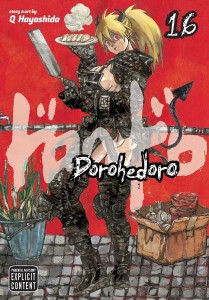
One thing that Dorohedoro is lacking in is traditional romantic love. Very few of the characters do anything in this title because they’re in love with someone else. As a result, you get to think more about their motivations and why they’re going to such lengths, be it Noi’s kohai adoration of Shin, Fujita and Ebisu’s awkward teasing, or everyone’s respect and allegiance to En, even now that he’s dead. And then there’s Nikaido, who certainly seems to be going above and beyond for Caiman, using her “you can only use this a few times” magic in order to go back in time to try to figure out what’s going on with him. Why is Nikaido going to such lengths? As we see here, those lengths may be having side-effects as well – will Nikaido become a full-fledged devil?
dorohedoro16

This does lead to the funniest part of the book, though, where Nikaido uses her newfound devil powers to become MASTER GYOZA CHEF. Dorohedoro’s sense of humor has always been a bit skewed and violent, but it’s also been based heavily around gyoza, and it’s the same here. Sadly, it doesn’t last long, as Nikaido wakes from her massive food preparation unable to even remember what she was doing. (We also get a lot of fanservice from her this volume, as turning devil means a lot of exposed skin). But again, Nikaido’s motivation for Caiman seems to be based on their true friendship, rather than any romantic feelings.

The same goes for Fujita, who gets the bulk of the drama in the second half of this book. His non-presence has been a joke throughout the series, and now he’s using it in order to find out how to revive En. But he’s also young and impetuous – it’s just he’s been with people like Shin and Noi, so comparatively he’s looked meek. When he discovers the one behind En’s death, he cannot resist trying to get revenge. He’s pretty awesome about it as well, even if it does mean losing an arm and possibly dying – that’s the danger of cliffhangers. You can tell that it’s serious business as we see him without his mask – unlike Shin, Noi or Ebisu, he’s had his mask on almost the entire series. Oddly, he looks a lot like many other male characters. (Drawing different faces is not Hayashida’s strong suit.)

Meanwhile, of course, there’s the main plot, which as always is the most diffuse part of the book. What’s going on with the various factions fighting for power? Will we get to see En resurrected? Will Risu be able to control his desire to kill caiman? Is Caiman even good or evil anymore? I want to find out the answers to these things, but don’t really mind that it’s taking a while. In a series that’s all about the mood, the fact that the plot meanders is by no means an impediment. Dorohedoro remains a fascinating manga.

Lucifer and the Biscuit Hammer, Vols. 7-8

By Satoshi Mizukami. Released in Japan by Shonen Gahosha, serialized in the magazine Young King Ours. Released in North America by Seven Seas.

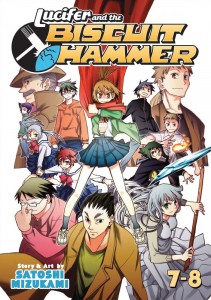
Akane is the one Beast Knight we’ve never really focused on, so it makes sense that he gets a lot to do in this new omnibus. As we expected, he’s introverted, sullen, and insular due to a poor home life. As is perhaps less expected, he’s also siding with the enemy, though as the book goes on it becomes clear that this isn’t really due to anything but misplaced anger, and that when genuine heroism and compassion are shown to him, he can’t find it in himself to keep up the facade. Like all the other characters in the series, time is taken to explore him in depth, and it’s worth it. Though we still remain puzzled as to what Animus and Anima are doing – are they enemies, rivals, relatives? Is Animus even trying to win? Is Anima even trying to fight? Or does she just love food?

lucifer7-8

Despite one of the most obvious couples in the series being torpedoed in the last omnibus by virtue of death, these are still mostly teenagers and young adults, so love still drives a lot of the plot. I’ll leave Yuuhi aside for now, but there’s also Yuki and Subaru, who are the two nicest, most innocent characters in the series, so get the most selfless wishes in exchange for becoming knights. Yes, OK, it’s not going in a romantic direction (Subaru’s crush on Mikazuki is so obvious it can be seen from space), but their friendship is amazing when you’re in a series that’s playing with cynicism like this one does.

That brings me to Yuuji. He’s the main character, and thus gets the bulk of the character progression. We see his desire to grow stronger in order to fight by Samidare’s side. But we also see how he uses that strength to grow emotionally as well. The death of his grandfather, after all that he did in order to prevent it at the start, is a shocker, though honestly its the lizard that shows all the outrage that Yuuhi won’t. Anima, though, allows him to achieve closure, both with his grandfather (who let’s remember abused him horribly as a child, something I think might be a bit glossed over here), and with Hangetsu, whose death Yuuhi also needs to move past.

So now that we’ve seen all this, the question remains: are he and Samidare still going to destroy the world? I think the other knights would have something to say about that, particularly Yayoi. And honestly, Samidare needs a bit more development before I can say whether or not she will. But with the final omnibus coming soon, I don’t think Yuuhi is going to be helping her anymore – though that may come as a surprise to him. We’ll see how it wraps up, but I want to say again how much I’ve enjoyed this poor-selling series, and I wish it did better.

Hayate the Combat Butler, Vol. 26

By Kenjiro Hata. Released in Japan as “Hayate no Gotoku!” by Shogakukan, serialization ongoing in the magazine Shonen Sunday. Released in North America by Viz.

I’ve talked about Hayate’s parents before, and the sheer loathsome level of evil they produce. What’s worth mentioning is that they aren’t really alone, though they do stand at the top. Hina’s birth parents also left their children with an enormous debt, though it’s implied this wasn’t out of sheer malice. We also meet Chiharu’s parents here, who are having rough times and not selling their child yet, but do set their house on fire by accident. Even Ayumu’s relatively stable parents are not above giving her a gift certificate of $30 for her birthday and saying nit’s from both of them, so don’t go asking Dad for more gifts. In this title, though, being a jerk to your child is almost loving. The only reason Rumiko Takahashi’s parents are worse than Hata’s is that she actually has them ruin her children’s lives in person.

hayate26

That said, this volume of Hayate is a lot more lighthearted than the past few have been, with Athena mostly removed from the picture (she does answer reader questions at the end, which goes badly as they’re all about her chest). The cast is starting to get tenants for the apartment complex they now live in, with the ‘complex has butler!’ advertisement winning Chiharu over. It helps that Hayate is a cut above… well, everyone. His natural charm and ‘gigolo’ nature (meaning he gets every girl he meets to fall for him without trying) comes up more than once here, and it’s not something that’s easily duplicated. Of course, like many harem protagonists who have all the girls, it’s balanced by a heaping dose of bad luck – this is even lampshaded here.

As for our supposed heroine, Nagi’s growth as always is somewhat fitful. Being an apartment landlord is something of a lazy way to keep earning money while she’s in exile, and we again see her skipping anything that involves physical exertion. But she is developing relationships outside of just Hayate and Maria. Chiharu’s addition to the apartments allows Nagi to have a fellow otaku to bounce things off of (though a horrified Chiharu reminds us several times how young Nagi really is), and in one of the sweetest chapters of the volume, confesses her loneliness to Ayumu in order to trick her back to a surprise party being held for her. She’s never going to be #1 in fan’s hearts, but she is slowly improving.

It is somewhat odd being back to 1-2 chapter long silly gag stories after the epicness of the Athena arc, but that is Hayate’s stock in trade, and the main reason why the manga is so popular. (Indeed, the anime has never animated Athena’s arc – and made it really obvious they’re deliberately avoiding it – likely as it would be too distracting in a ‘gag’ anime.) But those gags are still strong, and for those who are still hanging out for their twice-a-yeaar fix of Hayate, this volume will serve nicely.