JoJo’s Bizarre Adventure: Phantom Blood, Vol. 2

By Hirohiko Araki. Released in Japan as “Jojo no Kimyou na Bouken” by Shueisha, serialized in the magazine Weekly Shonen Jump. Released in North America by Viz Media.

It is possible, I suppose, that someone out there read the first volume of this series, featuring grandiose over the top histrionics galore, and felt “well that was OK, but it was just far too sedate and naturalistic. What would really make the series take off is if one of the characters came back as an immortal vampire”. Well have I got news for you! Araki ups his game here, turning the amp from 11 to 12 and delivering more action, more histrionics, and a whole lot more death and violence, while also adding a few trickster mentors and loathsome underlings. It’s still not a parody, honest: JoJo’s Bizarre Adventure just is.

jojo2

The highlight of the book may very well be the beginning, where Dio cuts loose and starts to not only kill people and steal their lifeforce but bring them back to life as hideous zombies. JoJo’s still looks up to Fist of the North Star after all, so there’s lots of heads exploding and eyes popping in slow motion here. That said, probably the most grotesque moment of violence comes later on, when Jack the Ripper (yes, that one – Dio takes him on as a disciple) attack the horse and wagon our heroes are in, kills the horses (and driver) by cutting their heads off, and then hides inside a horse corpse so that he can emerge, womb-like, from the neck like your worst nightmare. It’s around that time that you realize how “Tom Brown’s Schooldays” the first volume really was.

If there is any break from the nonstop action and hysteria, it comes in the form of Erina Pendleton, who went to India for several years to study nursing and attend the Tsukasa Hojo School of Heroine Design, and arrives just in time to attend to a dying Jonathan’s wounds. We see once again the steel that’s underneath her soft exterior, and even Speedwagon is forced to withdraw coolly (yes, Viz kept that, thank goodness) in her presence. Sadly, when he starts training and getting attacked by evil minions, Jonathan thinks he can’t let Erina get involved in this, and she vanishes once more. The same cannot be said for Speedwagon, who is both the ‘normal guy’ and Greek Chorus in this series – although how normal someone is when they use the power of their flaming hot abs to heal Zeppeli’s arm is a debate for another time.

I should also probably mention the narrative voice here, or rather the multiple ones. Araki has third person narration drop in from time to time, telling us how glorious everything is in full! blown! CAPSLOCK! But then Jonathan, Speedwagon and Dio also seem to have their own inner monologue, functioning as a narrative voice as well, and just as dramatic. It’s as if you took all the characters and gave them microphones so they could turn to the audience and soliloquize for a while. Honestly, the only normal thing in this entire volume is Zeppeli, whose attitude towards training has been used over and over in so many shonen manga (and yes, he probably got it from Ashita no Joe or something) that you don’t even bat an eye when he threatens Jonathan. But that’s OK, Speedwagon is there to bat them for you.

You can’t really casually read a title like this – you have to leap in full body and drown yourself in it. If you do, not only do you get top notch action and horror, but you also get things like Elizabeth I’s evil face as she condemns two nights to their deaths, where she looks like a yanki punk. I can’t wait for the conclusion of this arc.

Umineko: When They Cry, Vol. 10

Story by Ryukishi07; Art by Akitaka. Released in Japan in two separate volumes as “Umineko no Naku Koro ni: End of the Golden Witch” by Square Enix, serialized in the magazine Gangan Joker. Released in North America by Yen Press.

While Higurashi was divided into four Question Arcs and four Answer Arcs, Umineko plays it cagier, saying that the last four arcs are ‘Core Arcs’. Getting closer to the truth, but you’ll still have to dig for most of the answers. The first of these arcs, End of the Golden Witch, lives up to that name, as we skip most of the fluff and romance we’ve gotten in earlier arcs and go straight to what’s important: the Epitaph, the Gold, and the Murders. That said, there is one big difference: Lambdadelta and Bernkastel are in charge now, not Beatrice. And, as a result, everything is a bit twisted.

umineko10

Ronove and Virgilia helpfully explain that our replacement game masters can’t do things impossible for Beatrice to do, but they can do things Beatrice WOULDN’T do. We see a bit of that in the scene with Natsuhi and Beatrice having tea together while reminiscing about her honeymoon with Krauss. It’s the sweetest scene in the whole volume, and has absolutely nothing whatsoever to do with solving the game or defeating Beatrice. Yet Bernkastel takes delight in telling us, in Red Truth, that Natsuhi is simply having tea by herself, the conversation never happened. Beatrice used the Red truth to stop Battler going down false paths, or lead him closer to where she wanted him to go. Bern uses the Red Truth to be mean because she finds it hilarious.

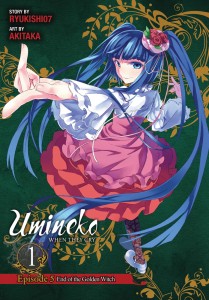
This leads me to the new character that enters the series at this point. That’s her on the cover, Erika Furudo. No, not Rika Furude. No, not Frederica Bernkastel. Ryukishi said in a recent interview that he regards Rika looking like Bern to be similar to Tezuka’s ‘star system’, where Rock or Lamp might show up in any work as a “different” but similar character. Fans of Rika were already a bit surprised that Bern turned out to be a heartless villain (though honestly, they can’t have been TOO surprised… go read Higurashi’s darker moments again). Erika, though, is written entirely to irritate, to annoy, and to make the reader hate her.

I was wondering how Yen Press would handle translation for the scene where Erika sums herself up best, and I am very pleased it’s 100% as fans of the game will remember: Erika, fantasizing about seeing Jessica in tears after the epitaph is solved, leers as she describes herself as an “intellectual rapist” who enjoys wreaking havoc for the sake of it. Which makes sense, given that she’s basically Bernkastel imposing herself on the island as a self-insert. Even when Erika tries to make nice and simply be a goofy, slightly off-kilter young girl, it looks calculated and wrong.

There is another new character we see here, of course, which is the mysterious “man from 19 years ago” who keeps calling Natsuhi on the phone and driving her into hysterics. Natsuhi is accused of the murders by Erika in a sort of flashforward at the start of the book, so we know she’s in for a terrible arc. And indeed, as we’ll see in the next omnibus in September, she is not without horrible crimes in her past. But honestly, Krauss, Natsuhi and Jessica are probably my favorite of the four families, if only as they all clearly love each other and they’re all so BAD at showing it. (Krauss’ foray into Moon Tourism also doesn’t help.) Taking Natsuhi, who has trouble communicating even the most basic feelings of love and affection, and putting her through this is vicious.

We end this volume with what appears to be the First Twilight, so let me briefly discuss the manga adaptation here: it’s excellent. As with all other adaptations, things have been removed and shuffled around, but more than any other this one takes care to include everything important and show how important it is (such as the maid and baby being “lured” off a cliff to their death by golden butterflies and witches). The faces are also nicely done, particularly when Erika, Lambda or Bern is going creepy and horrible on us. And the cliffhangers are well-timed, driving you forward to see what happens next. As far as I can tell, the artist hasn’t really done much other manga, which is a shame; they do a bang up job here.

Umineko is still a wonderfully tense and intricate read, if you can get past the fact that everyone in it is a horrible person. We’ll see how things go once Erika gets to play The Detective next time.

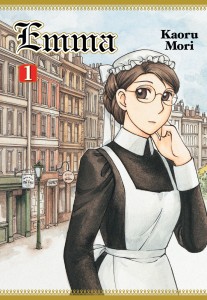
Emma, Vol. 1

By Kaoru Mori. Released in Japan in two separate volumes by Enterbrain, serialized in the magazine Comic Beam. Released in North America by Yen Press.

I wasn’t reviewing manga online when Emma first came out via CMX back in the day, and I’ll be honest: I never did finish the series. I think at the time I found it a bit too slow-moving and tedious. Which, to be fair, it is at times. But as the years have gone by, I’ve come to appreciate what Kaoru Mori does a bit more, and I now see the mood she was trying to evoke with this story of romance and class drama. Indeed, the heroine, Emma, reminds me very much of the heroine of A Bride’s Story, in that I find it very difficult to get a handle on what she’s thinking at all. Her love for William is so subtle that it creeps up on you.

emma1

William’s love does not creep up on anyone, being very much a love at first sight sort of thing. William is perhaps the most difficult thing to like about this series so far; he’s reserved when compared to the rest of Emma’s suitors, but still has a tendency to seem like a lovesick puppy compared to the rest of the Victorian era cast. This makes it a bit easier to understand his strict father, who is 100% against his son marrying a common maid, despite the fact that the Joneses are fairly new money themselves – they’re merchants, and have to keep up appearances far more than inherited money would. Indeed, the rest of William’s siblings look like they’ll make things more chaotic as the series goes on, particularly tomboy Vivian, who is quite happy to climb up roofs and run down halls to make her opinions knows.

For the most part, though, the best moments of Emma are the quiet, slow ones, sometimes not even needing dialogue. Emma cleaning the house after her mistress has passed away is one of the more heartbreaking things I’ve seen in some time, as if the cliffhanger ending for this omnibus, showing Emma leaving London to move North, with William just missing her. There’s also a sad and bittersweet element to Eleanor, a young woman who is arranged to be married to William and is clearly smitten with him, but I suspect she’s going to be very unhappy down the road. Even the past is tinged with menancholy – Kelly Stowner’s marriage to her husband being tragically cut short, leaving her a widow at twenty. You can see why romance is so hard to pin down, and why it would take getting locked in the Crystal Palace overnight to even kiss.

It’s not all stiffness and decorum, though – Mori still loves the East, and that’s apparent with the introduction of Hakim, a childhood friend of William’s who comes visiting with his harem of dancing girls/servants and his elephants in the garden. Hakim is briefly shown as a rival to Emma’s affections, but in reality he’s here partly to add an air of lightness and exoticism to this series, and partly as the author really likes this sort of thing – which is also why she’s drawing Victorian England, for that matter. This sort of creative freedom on a debut series is something that surprised me, but then Comic Beam is sort of a ‘5th genre’ magazine, known for experimentation and freedom. It allows for well-crafted storytelling, which is the main reason why everyone should be happy to see this back in print, and want to see where it goes next.