Black Bullet: Those Who Would Be Gods

By Shiden Kanzaki and Saki Ukai. Released in Japan by ASCII Mediaworks. Released in North America by Yen Press.

One of the more difficult things about reading modern Japanese manga and light novels is a certain tendency to follow what’s popular and throw things in that appeal to a certain audience – even if they may not actually be appropriate for the book that’s being written. As an example, Fujino Omori wanted to call their new fantasy novel series Familia Myth, but editorial convinced them to use the ever popular ‘long long title’ in order to get readers, resulting in Is It Wrong To Try To Pick Up Girls In A Dungeon?. Which works OK, because there are other elements of that sort of genre in the books – harems, etc. But when you have a dark, brutal corpse-filled dystopian series about child soldiers, somehow populating it with lolicon jokes and tsundere grumbling seems even more jarring than it normally is.
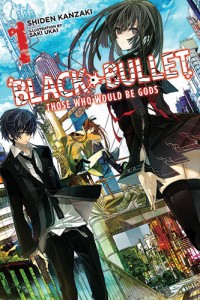
bb1

There’s a very good dark action thriller in here as well. Rentaro spends most of the book talking about how useless he is, but this makes sense in terms of his characters and allows a genuinely surprising reveal towards the end of the book. Enju, like the other Cursed Children, is a giant bucket of adorable, and unlike most of the other cursed children she generally tends to be happy and upbeat – provided Rentaro is around. The relationship between them when she’s not going on about marrying him or trying to show off her prepubescent body is heartwarming. They’re contrasted well with Rentaro’s dark mirror and the villain of this first novel, Kagetane and his child Kohina. If Rentaro tries to be a big brother to Enju, Kohina sees Kagetane as her father, and he’s raised her, sadly, to be a sociopath. The fights between them are the high points of the volume.

I’d mention Kisara – that’s her on the cover, with a far bigger picture than Enju – except she really has a smaller part in this volume than you’d expect. Indeed, there were points, especially when she arrived in the middle of the council meeting with evidence of a conspiracy, that I really wish the book had a double narrative so that I could see what makes her tick. She seems to be driven by a white-hot anger against her grandfather, but what that is I’m guessing will have to wait till future books. As it is, so far she’s all potential. Oh yes, and Sumire is the classic eccentric weirdo scientist, complete with suggestions of necrophilia and a major role in Rentaro’s past.

If you removed all the elements that appeal to the typical Japanese otaku, this would not be out of place in Viz’s Haikasoru imprint. I know I’ve talked about this sort of thing earlier while reviewing No Game No Life, but that at least is fairly light-hearted and comedic with the occasional dramatic cliffhanger. Black Bullet is a brutal world where all that the heroes can hope for is making the world happy for the Cursed Children in the brief time they have available, and the last couple of pages show that even this rarely works, and that death is all that awaits. I really don’t need “tee hee, Rentaro is a pedophile’ jokes on top of it.

Assassination Classroom, Vol. 5

By Yusei Matsui. Released in Japan by Shueisha, serialization ongoing in the magazine Weekly Shonen Jump. Released in North America by Viz.

One of the things that makes this such an interesting manga is the tension between the standard cliched ‘teacher takes a class filled with losers abandoned by teachers and makes them care about learning and themselves’ cliche and the actual plotline that they are trying to kill their teacher to save the world by learning assassination. Koro-sensei is too straightforward and strange to really swell on this, and Irina is not at a point yet where she really particularly cares (she’s still mostly here for breast jokes and to get humiliated). But Karasuma is normal enough, even if he is a tactical military guy trained in dozens of methods of killing a person, to be aware of what they’re actually doing to these children. And to be disturbed when one of them shows signs of being really really GOOD at killing.

assclass5

Naturally, it’s Nagisa, who is the closest we have to a ‘main character’ amongst the students. We’ve already seen how he has a talent for research and tends to try to think his way to a better assassination. Now we see that he doesn’t even need to use strength and power to be able to achieve this – he can rely on his natural unassuming, slightly feminine personality (there are several jokes here about him looking like a girl) and go right for the kill. And thank goodness for that, because he’s up against the government’s replacement for Karasuma, who gets results by being a complete psycho, and thinks nothing about belting a 14-year-old girl across the chops.

This leads to the other interesting thing about this book, which is the school principal. He’s clearly the main antagonist of the series, and we’ve seen how his method of teaching requires Class E to be at the bottom of the heap for everyone to bully. I was, honestly, surprised at the ending of the baseball story – not necessarily because our heroes won, but more because the principal didn’t punish the main baseball team in retaliation. That said, as an antagonist he’s great, being able to almost hypnotize his students into doing what he wants, and sticking to his principles even if they are twisted. That’s why his appearance at the end of the arc with Takaoka is wonderful, as he strolls up to and casually talks about how dull and boring his class was. Not even worth sticking around like Irina does, he’s terminated right there and then.

Koro-sensei actually doesn’t have much to do in this volume – the main story is all Karasuma, with Koro-sensei merely commenting occasionally, and the revelation that he can’t swim will carry us into the next book, but doesn’t do much good now. Still, the series has now gotten to the point where we don’t need to have killing Koro-sensei being the focus of every chapter. There’s a lot going on here, and as the series hits Vol. 5 you can tell that Matsui has realized he’s not on the verge of cancellation and is drawing out a larger plotline. I look forward to seeing where it goes.

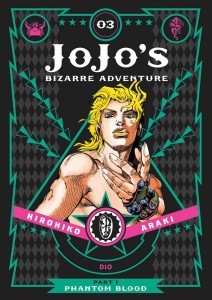
JoJo’s Bizarre Adventure: Phantom Blood, Vol. 3

By Hirohiko Araki. Released in Japan as “Jojo no Kimyou na Bouken” by Shueisha, serialized in the magazine Weekly Shonen Jump. Released in North America by Viz Media.

It’s striking how much of JoJo’s, particularly this first arc, has been embedded in anime fandom in general. I was unfamiliar with the arc till reading Viz’s version, but when Dio, about 3/4 of the way through this volume, begins screaming “WRRRRYYYYYYY!!!”, I laughed, finally knowing where another meme came from. One of the great joys of reading this series is seeing how easily it can get turned into memes – and that’s not a knock on its quality, it’s a sign that people are able to take the musing, exciting and horrifying that is JJBA and make it their own. Not every series is able to do that.

jjba3

That’s Dio on the cover, but for most of the first half he sits out the battle, content to sit on a throne and do evil things like having a mother beg for her child’s life, then zombifying the mother so she kills the child herself. In Volume 1 a token effort was made to give Dio a reason to be evil, but it was just token – Dio is the villain because he really really loves doing evil things, and adding ‘immortal vampire’ to the list only made it easier for him to be MORE evil. Once Bill Bruford and Tarkus – or however they’re spelled – are taken out, Dio finally manages to fight with JoJo and show off how he really is from the dark side – pure attacks don’t even affect him.

This is the last volume of the first arc, and you can tell by how much the violence steps up. This was already a very violent series – I’d mentioned the debt it owed to Fist of the North Star before – but it really amps it up here, with the aforementioned mother and child, with one of Dire Straits (I love the naming in this series, and it reminds me I miss Bastard!!) getting flash frozen and then shattered, with JoJo’s mentor remembering at a convenient time the prophecy that said he had to die, and finally with the apocalyptic ending where Dio, now just a head, finds a way to kill off Jonathan Joestar once and for all.

The ending shows off how much JoJo’s is also immersed in the tropes of tragedy, though I’d argue it’s not really pure tragedy as JoJo doesn’t have a fatal flaw like Hamlet or Lear. He just can’t escape Dio, not even after he gets to marry Erina and go off on a honeymoon. The last 30-40 pages are awash in corpses, and indeed the story ends with (seemingly) Erina the only one still alive. Somehow, though, I doubt Dio is dead. The author clearly planned to move on right after this – there are no breaks between this arc and the next one in the series, so it’s not like many modern manga where a reboot takes place after a break of several months/years. Instead, it shows off how all of this – the histrionics, the shouting, the battles and the tears – was a prelude, working p to something even bigger.

What will that be? Well, we’ll find out in November. Or now, if you like reading digitally.