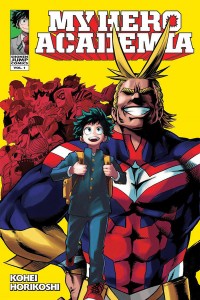
My Hero Academia, Vol. 1

By Kohei Horikoshi. Released in Japan by Shueisha, serialization ongoing in the magazine Weekly Shonen Jump. Released in North America by Viz.

It has to be said, if you’re looking to succeed in Weekly Shonen Jump, ‘write the same thing as everyone else, only your way’ is a pretty good description of how to go about doing it. And to a degree, that’s what the author does with this new series. Even though the front cover parodies Marvel and DC Comics, and the kids are ‘superheroes’ in a Western sense, this is very much in the classic Jump mold – indeed, some of the amusing yet insane superpowers reminded me of the late lamented Medaka Box. Our hero as well is a sweet kid, the Naruto sort who starts off weak and bullied but will improve by leaps and bounds because he tries hard and refuses to back down when his principles tell him it’s wrong.
academia1

Our hero Izuku (abbreviated to ‘Deku’ for reasons that Viz won’t explain because Jump titles don’t have endnotes) is the small guy on the cover, as you no doubt guessed. The world about 25-30 years ago evolved superpowers in about 80 percent of the population. And Izuku really, really loves superheroes – he’s pretty much an otaku. Sadly, he’s in the 20% that doesn’t have powers. This, naturally, leads to bullying on the part of all his school classmates, particularly Katsugi, who plays the role of the selfish ass quite well in this volume, though I suspect he will gain greater depth as the title goes on, particularly give his childhood past with Izuku.

Luckily, Izuku gets a superpower transferred to him from the other guy on the cover. Even more luckily, the power does not just magically make him a superhero – he has to go through an amusing and heartwarming training montage, complete with the usual ‘drag a refrigerator across the beach’ stuff, till he’s no longer a wimpy kid but rather a wimpy kid with a muscular build. And he doesn’t really get a chance to train with his powers, either – which means he’s in trouble when he applies to Superhero School, where the goal is to be awesome immediately.

Nothing here is really original, but also nothing here is really poorly done, either. The author has learned from Barrage, his previous series. Izuku is a bit of a shy coward without being unlikeable, All Might’s secret allows him to be hilarious as well as inspiring, and his new friend Ochako is cute, and not Shiemi from Blue Exorcist despite all appearances saying she is. The fight scenes look smooth and non-confusing, and there is actual tension as you wonder how this will get resolved – it also allows Izuku to be clever, which is the best way to advance when you also have cool superpowers. Add on a reluctant mentor and some random giant woman fanservice, and you can see exactly why this became a bit hit while Barrage was cancelled after 2 volumes.

If you want something you’ve never seen in Jump before… why do you read Jump, exactly? But if you want something light and fun, with potential for more, My Hero Academia may be right up your alley.

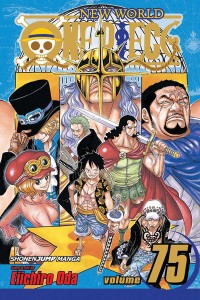
One Piece, Vol. 75

By Eiichiro Oda. Released in Japan by Shueisha, serialization ongoing in the magazine Weekly Shonen Jump. Released in North America by Viz.

The Dressrosa arc has gone on for a long time, and it’s got a long, long way to go. This can be a bit exhausting, especially given that this volume takes an already chaotic situation and threatens to turn it into incoherency. Thanks to Usopp, the toys are all turning back into people, and those left behind have regained their memory of them – including Violet and Rebecca. But Doflamingo is not going to let this stop him, as he deploys several body doubles and puts bounties on everyone who has opposed him – including Usopp, who gets the highest bounty of all, possibly the funniest moment in the book. There’s a lot going on, and One Piece is always enjoyable, but I always feel like I should reread the previous few volumes before I start this new one.

op75

At least I’m finally able to talk about some revelations, even though the reappearance of Sabo has been the most obvious plot twist since Sogeking turned out to be Usopp. He and Koala are here representing the Revolutionary Army, who have to stop Doflamingo, but in reality he seems to mostly be here to help Luffy. This now means we have every major force on the island – pirates, marines, revolutionaries, actual residents, Tontattas… and it makes for a giant melee, as there’s just no way Dressrosa can contain this. At least Robin’s not a toy anymore. Oh yes, adn the tournament is over, as the Flame-Flame fruit is claimed by the victor. Somehow I don’t think Luffy will object too much.

Speaking of Luffy, he and Law make for an amusing comedy team throughout. Law is still cuffed with seastone, so literally all he can do is lay there and whine, and boy howdy does he. It’s always wonderful in One Piece to see the incredibly cool characters show off how nobody is ever that cool all the time, and Law’s frustration with Luffy’s ‘whatever, just go with it’ attitude is simply always funny. That said, I do hope he gets unlocked soon, as I’m fairly certain Doflamingo is not going to be as easy to defeat as Caesar Clown.

I’d say there are a few weaknesses. Rebecca continues to not be as strong a character as I’d expected, though to be fair to her she’s really going through a bunch of traumas that would make anyone break down. The huge cast and need to switch to a different part of the city every 2-3 pages does not make for easy reading, and I also miss Sanji, Nami, and other major Straw Hats, who have been shuffled off the page till this is all over. And I will admit, I thought everyone making fun of Pica’s voice was a bit mean. That said, it’s One Piece. If you read it, you’ll love it. If you don’t, you aren’t going to pick up Vol. 75.

Also, Sabo and Koala are totally Luffy and Nami, right? She even carries his hat!

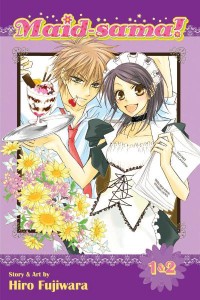
Maid-sama!, Vols. 1 & 2

By Hiro Fujiwara. Released in Japan as “Kaichō wa Maid-sama!” by Hakusensha, serialized in the magazine LaLa. Released in North America by Viz Media.

It’s hard when things that you enjoyed in the past suddenly seem more problematic to you. That hilarious maid from the old sitcom turns out to be a pretty bad stereotype. The running gag in the old British radio show is basically sexist as hell. That heartwarming childhood movie is teaching messages that are disempowering and stultifying. And yes, it even applies to license rescues, as Maid-sama!, the portrait of a gung-ho Type-A high school girl and the stalkerish guy who loves her and keeps saving her from various types of sexual assault… isn’t as funny as it used to be.

maid1

To be fair, looking back over my past reviews of this title back when Tokyopop was releasing it, I wasn’t too wild about Usui then either. But in six short years he’s gotten less tolerable, mostly because the narrative frames him as correct all the time. Part of this is the comedic conceit that he’s perfect at everything – to the point where Misaki begins to wonder if he’s actually human. But part of this is because the narrative enjoys having Misaki be strong, smart and try to rescue herself from danger but also can’t help put her in danger all the time in order to get rescued by the guy who likes her. It simply can’t avoid the standard cliches, and they’re not cliches for a good reason (and yes, there will be more sexual assault attempts as the series goes on.)

Luckily, the title has one big plus going for it, and that is Misaki herself. She’s loud, angry all the time, and can’t understand why boys exist, but at her core is a good heart and a girl who wants to help everyone – which is why she became Student Council President. She’s of a type I personally am very fond of, one that comes up often in Hakusensha titles – see also Special A and I Hate You More Than Anyone. And I do agree with Usui on one thing – teasing her and seeing her blush is adorable, and we will be seeing more and more of that blush as the series goes on. She’s stubborn as a mule (the “keep my job secret” thing isn’t even due to the traditional “no part time jobs” school rule – they’re allowed, she’s just embarrassed), but that’s also presented as a positive.

As for the rest of the cast, we still haven’t seen enough of them to really get an impression. Misaki’s trio of lovestruck idiots are pure comic relief, and the less said about the arrogant rich rapist from the rival school the better. I seem to recall when I first read the series that I liked it more when it was telling stories revolving around the maid cafe more than the school, so I look forward to reminding myself why – particularly Honoka. In the meantime, I am pleased that Viz picked this up, as I do want to see how it ends. But man, Usui is a lot harder to take in 2015 than he was in 2009 – particularly when the author agrees with him.