A Certain Scientific Railgun, Vol. 10

By Kazuma Kamachi and Motoi Fuyukawa. Released in Japan as “Toaru Kagaku no Railgun” by ASCII Media Works, serialization ongoing in the magazine Dengeki Daioh. Released in North America by Seven Seas.

I have to be careful not to repeat myself too much here, as the third Index novel is out in a couple of weeks and covers similar themes. But Academy City, as we’ve seen, breeds superheroes. Which is fine, except that you’re left wondering what they want an entire city of superheroes for. And when you get to the Level 5s, and the quest to get one of them to Level 6, be it Accelerator, Misaka, or what have you, it’s no longer about superheroes but about nuclear weapons testing. Many of the scientists we’ve seen in Index and Railgun regard morality and ethics as something that gets in the way of results – in fact, Yoshikawa may be the only nice scientist we’ve met to date (in Index), and she ends up almost dying for her sins. Gensei, on the other hand, is perfectly happy to wipe out the entire city in the name of science.
railgun10

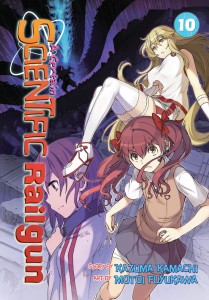
You’ll note that Misaka’s in the background of the cover art, while Misaki and Kuroko take center stage. That’s a somewhat accurate look at the volume itself – given that she is the weapon being tested, Misaka doesn’t get much to do here except be used. That said, the other two end up carrying the “women in this series are awesome” load very well, and Uiharu also provides assistance with her amazing hacking skills. Kuroko in particular is impressive, and reminds us how brilliant she can be when she’s not scheming to get into Misaka’s pants. Misaki outgambits not only the villain, but also herself. And then there’s Mitori, the main miniboss of this arc, who may be trying to help Gensei but is still, like the rest of the weapons being created in Academy City, just being manipulated herself. So after a mammoth beatdown we see her bonding with Misaki, and the two of them reuniting with their past.

I should also mention Touma, as he’s here as well, though doesn’t do as much as expected. (For Railgun readers wondering why Touma’s arm can turn into a dragon, the 2nd Index novel can help with that.) The author is quite fond of the grand gesture of “saving the girl”, and it’s not going to go away – the only way to keep it out of this title is to have him not appear. A better appearance here was Gunha, another Level 5 who had barely appeared in either series till this point. He’s even more of a shonen hero than Touma is, dealing with problems by punching them and insisting that “guts” is the solution to absolutely everything. He’s a nice light-hearted moment in what is otherwise a very serious book.

The arc wraps up here with almost a sitcom ending – Misaka is forced to dance with Touma at the conclusion of the athletics festival and Kuroko naturally kicks her way in between then – but overall this arc with Misaki and Misaka was one of the most satisfying of the entire series. Which is good, as it may be at least another year before we see a new volume here.

Log Horizon: The Beginning of Another World

By Mamare Touno and Kazuhiro Hara. Released in Japan by Enterbrain. Released in North America by Yen Press.

As I’ve said in a few Manga the Week of posts before this, the first I ever heard of Log Horizon was when I was researching Sword Art Online after reading that series, and TVTropes saying that the two series had a “fandom rivalry”. This is unsurprising, given that the two series essentially share a very similar plot – gamers suddenly find themselves trapped inside a game and have to find ways to deal with it. That said, once you get past that there’s a lot that’s different. In SAO you have “if you die in the game, you die in real life” lending an air of tension and menace to everything. Log Horizon, on the other hand, generates its tension from the opposite: even death merely has you regenerated at your start point, so there’s no point to anything at all.

loghorizon1

Our hero is a quiet, thoughtful, introverted sort, who has those “mean eyes” that fans of Toradora! might recognize, and a tendency to see everything in a cynical way. He’s partnered with a big, outgoing guy who enjoys making perverted jokes as a way of breaking the ice (though, as we later see, he can’t take it when it’s dished out to him), and a quiet, even more introverted assassin who, once she’s in her proper body, proves that Ayanami Rei expies are still alive and well in the world of anime and manga. Much of the novel has them figuring out what the rules of this new-yet-familiar world are, realizing that a lot of combat techniques they did in their sleep seated at a computer are much harder when a genuine threat is speeding towards you, and trying to rescue a young girl trapped in a faraway city that has fallen into lawlessness as some people realize that since there’s no real consequence to death except that you get to loot their stuff, that that’s a great way to pass the time.

This is very much a novel for experienced MMORPG players, and has a lot more mechanics in it than SAO did. Given that I’m not a gamer, I found myself skimming the explanations at times. The characters fared much better – Shiroe and Akatsuki I especially liked, and I enjoy that the two suggested couples (though nothing’s likely to happen for at least 10 volumes is my guess) are both similar types – there’s no “opposites attract” cliche here. It’s actually refreshing seeing two introverts driving an action series at all, and that also came across very well. And the series’ worldbuilding is excellent, taking its time and showing us what you can and cannot do – the food problem is particularly frustrating for all involved.

I would say that I find Sword Art Online more exciting and gripping – Log Horizon has a certain dry tone that matches that of its hero. But it’s a very good start to a series, and I look forward to seeing how things go, and if “returning to the real world” even becomes a plot point at all – it’s mentioned very little here, with a lot of folks just assuming they’re trapped forever. In any case, between this, No Game No Life, DanMachi, and SAO, gamers certainly have their hands full of Yen On titles right now.

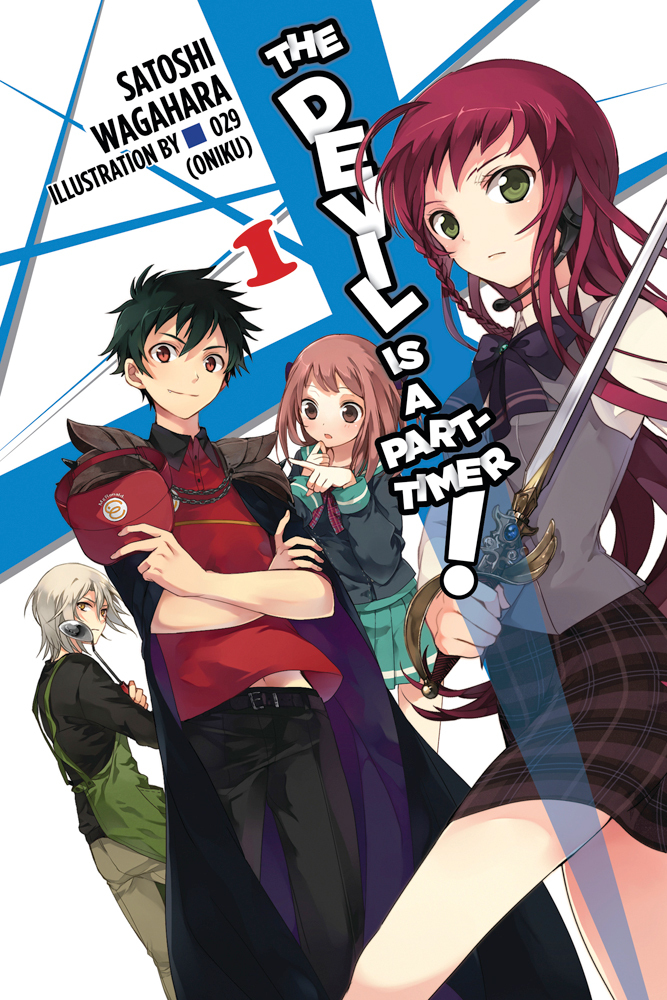
The Devil Is A Part-Timer!, Vol. 1

By Satoshi Wagahara and 029. Released in Japan by ASCII Mediaworks. Released in North America by Yen Press.

Of the five titles I’m reading in April from Yen On, this is the odd one out, as it’s the only one that does not involve gaming in some way, shape or form. Instead this is a straight up fantasy/comedy, and reads as the most “traditional” of the lot. Our hero is our villain, who is forced to come to Japan and abandon his fantasy world, pursued by his nemesis, the hero, who seeks to destroy him. That said, Japan is not as laced with magic as they would like, so our hero is forced to bide his time and save his strength, instead deciding to try to use his part-time job as a stepping stone to world domination. Which is fine, except his part-time job is with McDonald’s… sorry, McRonald’s.

parttimer1

The main reason to read this title is the comedy – it’s very funny, in ways that come out of the personalities of the characters, which is one of the best kinds of humor. Maou is intelligent and capable, but has taken to life as a lowly paid wage slave in Japan a little *too* well, as everyone immediately notices. His Demon General/Househusband Ashiya is in turns nagging him about eating properly and returning to their world, but can also be an emotional drama queen at the worst time. Chiho is a normal lovestruck girl you’d see in any anime romance series, which is why it’s so funny that she’s stuck in the middle of all this. As for Emi, when doing research on this title I found a TVTropes quote about her that noted “She’s generally hated on /a”, which is always a true sign that I will love a character. She was wonderfully fun and emotional.

We do not get too many flashbacks to Maou’s time as the demon lord, notably. This is deliberate, I imagine, given that he is supposed to be the destroyer of many, many lives… including Emi’s father. We do see a bit pf her past, mostly as she is forged into a weapon used to take out the Demon King… and then tossed aside so that the real evil guy can get on with his behind the scenes manipulation. When she confronts Maou with his deeds, his response is to half-heartedly apologize, indicating he hadn’t really thought much about what he was doing. This is really dissonant, and I’m not sure how much of it is deliberate. We’ll see if it comes up again in future books.

There’s also many cool battles, and our hero and villain show that they’re definitely a force to be reckoned with if they team up and if the hero can stop screaming at him for long enough. I don’t expect Emi’s essential tsundere character to end anytime soon, as that’s her type, but I do think that a lot of her rage in the latter half of the book is more due to finding out that the entire life she lived was based on a lie than anything else… it will be interesting to see how she handles her black-and-white morality getting grey tones.

Mostly, though, this book is just plain fun. If you like comedic fantasy/romance, and don’t mind that some of the characters (everyone but Maou, basically) are stereotypes, this is definitely a book to pick up.