Sword Art Online, Vol. 4: Fairy Dance

By Reki Kawahara and abec. Released in Japan by ASCII Mediaworks. Released in North America by Yen Press.

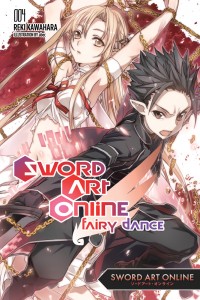
So yeah, I know a lot of people were taking bets to see when I would stop being a raving fanboy about this series. This is not to say that there weren’t parts of this novel I greatly enjoyed, but there’s simply a lot of things wrong with the climax of the book, and they take away from a suspension of disbelief that has already been in danger of snapping since SAO began. I am rather happy that things are resolved, everyone’s back in the real world, and if this weren’t a franchise I’d be mostly satisfied with the ending here, but… your villains need work, Kawahara-san.
fairydance2

Let’s start with what I liked. The first 60 pages or so were completely skipped in the manga adaptation I read, and are a terrific look at Kirito and Leafa’s similarities and differences, where choosing to save a monster from being attacked by another monster, and later on defending it from a party trying to kill it, even if it means losing all forward progress, is greatly rewarded. It’s just a nice sequence that shows why people still want to play these games even after the deathtrap that was SAO, and really shows off Leafa’s compassion. She’s only human, though, and still a teenager – her relationship with Recon is not one of equals, and I think she needs to sit the boy down and tell him she’s not going to be returning his feelings.

The whole Suguha falls for Kazuto/Kirito plotline was handled better than I thought given that its existence is enough to provoke a groan these days – I remind myself it was originally written as a web story around 2004-2005, when “pseudo-incest” was not overwhelming the market like it is now. Her anguish on discovering Kirito’s true identity is very well written, as is the duel that eventually follows. I also liked the epilogue set in the “SAO survivors” school, which not only gets to see our lead couple be extremely cute, but also gives us cameos of the rest of the cast, particularly Lisbeth adn Silica, who it was great to see.

All right, let’s talk Sugou, and by extension his conspirators, who we see in the form of slavering tentacle insects. First off, there was no reason to include those guys in that form for any reason other than to titillate a certain segment of fandom which is not remotely me. I’ve hated it in the manga, and hate it here, though thankfully there aren’t explicit illustrations. Secondly, Sugou is insane, and thus dull – you’re just waiting for him to get his just desserts, and the fact that he’s so over the top means there’s no real suspense that he’ll achieve anything. But probably the thing that irritated me most was the “return” of Kayaba as a ghost in the machine, who gives Kirito magical GM powers to finally be the godlike cheat character everyone accuses him of being. It’s a deus ex machina of the worst kind, and comes out of nowhere. I also think that the writing was a bit too sympathetic towards a man who murdered thousands of people for a thought experiment. Kazuto thinking he was similar to both Kayaba AND Sugou also didn’t help.

So not as good as the first couple of books, but hey, it’s finished, and I’m still invested in the franchise. Next time we’ll meet a new heroine, a new gameworld, and Kirito will get in touch with his feminine side.

Is It Wrong To Try To Pick Up Girls In A Dungeon?, Vol. 2

By Fujino Omori and Suzuhito Yasuda. Released in Japan as “Dungeon ni Deai o Motomeru no wa Machigatte Iru Darou ka?” by Softbank Creative. Released in North America by Yen On.

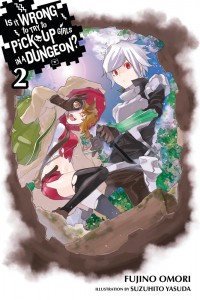
My initial review of this title was a bit lukewarm, mostly expressing surprise that I didn’t immediately hate it given the premise and ‘light novels with long titles’ cliches. After reading the second volume, I’ve had to change my mind. This isn’t merely adequate, it’s quite good. Yes, there are still a few issues with Bell as the typical harem hero, and Hestia can be a bit annoying at times, as you’d expect from a series like this. Yet as with the first book, both seem to recognize their flaws and try to grow from them. Actually, I’d argue Hestia’s biggest issue is how little she’s been in these books given she’s the heroine, and also apparently the next big meme now that the anime is appearing in Japan.

dungeon2

Instead, this volume has as its main female lead Lilly, who is a hobbit (yes, I know it’s translated differently, but come on, she’s a hobbit) with a tragic backstory, who fills the role of supporter in Bell’s party, since this is not one of those worlds where you have infinite inventory. This also serves as another look at how this ‘game world’ would work in a semi-real-life setting, as supporters are basically the lower class poor here, sneered at and abused by adventurers who regard them as little better than pack mules. Needless to say, Bell is different, but Lilly is so beaten down by the cruelty of everyone else in her sphere that it takes her the entire book to realize that.

I did have issues with Bell’s response to “Why did you save Lilly?” at the end. “Because you’re a girl,” was the first thing that came to mind, which is annoying, as “Because I felt empathy for your situation and could have been like you if things had gone a different way” is far more accurate. There *is* still a major harem aspect to this book, don’t get me wrong. Lilly clearly falls for Bell a bit here; Hestia is going on “dates” with him; Eina admits to herself that she has feelings for Bell; Aiz, the object of his intense adoration, spends much of the book in a depressed funk as he ran away from her in a panic; and of course Freya wants to hug him and squeeze him and call him George. Indeed, the other issue I think I have with the book is that the nature of Bell’s ‘skill’ makes him get far too good at things too fast. This is lampshaded by others, but still, I’d like to have seen more actual work put into it given we already have a glut of perfect fantasy heroes at the moment (hi, Kirito).

The main reason I think this works as a novel is that you don’t get the sense, as you often do with series like these, that the world vanishes once Bell walks out of the picture. These characters have lives and ambitions that don’t all revolve around Bell, and certain teases from the first book are followed up on here. (I was very happy that a character who I thought was a red herring in the first book turned out to be me being right here in the second.) When I finished the first I thought “Well, I guess I might as well get the second volume.” After finishing the second, I’m really looking forward to the third. Though I’d still pitch this more to fans of fantasy than fans of harems.

No Game No Life, Vol. 1

By Yuu Kamiya. Released in Japan by Media Factory. Released in North America by Yen On.

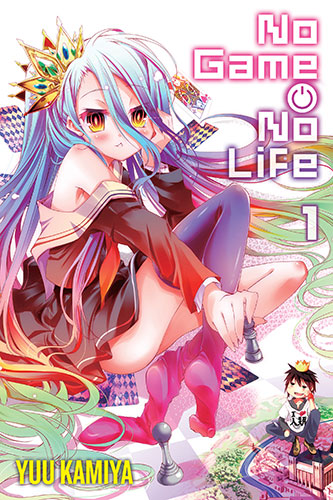
I can only imagine that being someone who wants to read No Game No Life for the plotting, characterization, worldbuilding and excellent sense of dialogue is sort of like being someone who genuinely does read Playboy only for the articles. There’s that realization that you’re sort of enjoying something except for that one thing, but that you can’t actually tell people about it or recommend it to anyone, and it’s intensely frustrating. This is particularly the case with NGNL because the fanservice is so… unimportant. Yes, having Sora be a bit of a loser pervert allows Stephanie to feel conflicted so that she doesn’t simply give in and start crushing on him right away, but as for Shiro… there’s just no need for naked 11-year-old bath fanservice here.

ngnl1

Luckily, in prose format, this is a bit easier to gloss over. Ignoring the art (provided, unusually, by the author, who got his start as an artist for light novels, which perhaps also explains a lot of the service), I’m still really drawn into this world and these two broken losers who are brought into it. I had reviewed Seven Seas’ manga adaptation a while back, which covers about the first third of the book, and it applies here as well. Sora and Shiro have glorious overconfidence that’s really a mask for their crippling social issues, which can only be resolved when they aren’t separated from each other. This even extends to relationships, as Sora, while he does say “fall in love with me” to Stephanie (before, I think, he really grasps how things work here), points out straight away that nothing can happen for the next seven years as he literally can’t have Shiro not in the room so is waiting till she’s 18.

Much of the second half of the book is devoted to a chess match which has an excellent premise – the pieces move based on your determination, and won’t sacrifice themselves if they don’t want to. This is disastrous for genuine logical minds like Shiro’s who see every scenario provided the rules are correct, but Sora is familiar enough with warfare and dynamic speaking (seriously, Sora’s speeches are amazing in this novel… love the JoJo’s reference) to get the whole board on his side. It’s a great way of showing how [ ] works as a team. Likewise, I loved their discussion with Tet at the end, where it’s revealed he’d never lost before he met them, and they point out they’ve both lost many, many times… to each other. They know how to use that feeling to win again.

There’s a lot left unspoken here that I want to read more volumes to find out about. Actually seeing some of the other races, whether Sora or Shiro will actually bother to rule or just push everything onto Stephanie, whether Stephanie actually does have feelings for Sora or if it’s just the mechanics of that world at work… I’m likely going to read on, because of a keenly developed ability over years of reading questionable material to put my fingers in my ears and say la-la-la. But sadly, in the end this is another series, even in novel form, I can only recommend to the ‘otaku’ demographic it’s going after. And honestly, I suspect most of those people will be screaming ‘boycott, deal breaker!’ because she’s spelled Chlammy anyway.