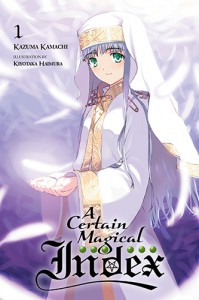
A Certain Magical Index, Vol. 1

By Kazumi Kamachi and Kiyotaka Haimura. Released in Japan as “To Aru Majutsu no Index” by ASCII Mediaworks. Released in North America by Yen Press.

I’ll be honest with you, I’ve read this one in fan translation. Twice. This was before it was licensed, and there was a very good reason for that: I never, ever thought this would be licensed. The main series is 22 volumes + two short story volumes, and the ‘sequel’ is 11 volumes and counting. And while I knew Yen On was starting, I hadn’t suspected this. But here we are, with certainly one of the most demanded light novel series of all, now out in the West to supplement the already popular Railgun series that spun off from it. What’s it like to read, particularly for a fan who’s already possibly seen the anime it’s based on?
index1

First off, I want to try an amusing experiment, based on the fact that this has one of the casts from Hell.

Introduced in this volume: Touma Kamijou, Index Librorum Prohibitorum, Mikoto Misaka, Stiyl Magnus, Kaori Kanzaki, Komoe Tsukiyomi, “blue-haired guy”, “frog-faced doctor” (the latter two have no official names). For Railgun readers, this takes place during the “Level Upper” arc.

There’s no question that this volume is absolutely tailor-fit to be a franchise. This volume wastes no time in stripping Index naked, there’s a typical “everyman” hero who’s actually super amazing but has fairly low self-worth (though compared to Hiroyuki from Accel World, Touma is an egotist). There’s a grumpy tsundere who shouts at the hero, though due to his nature she doesn’t hit him; instead the job of physical abuse goes to Index. Oh, and there’s a 35-year-old teacher who looks 12, chain smokes, and wears bunny footy pajamas. If you can get past the cliches, what you have here is a novel that examines the different “rules” of magic and science, and what would happen if they crossed paths. If your answer was “lots of cool fights and near-death experiences”, step to the top of the class.

It’s worth noting that when I first read the fan translation, I felt the style was overly complex and verbose, but put it down to translation issues. No, as the Yen Press version makes clear, Kamachi’s style is overly complex and verbose. Certain phrases are bolded, which appears to not signify anyone is shouting, but merely to note that something important has just been said or revealed. There’s also some expletives, which surprised me, but fit the emotions of the speaker. As you’d expect for a first novel, some of the characterization is still forming. Index is quite snarky in her first scene, and doesn’t really become the Index we know till she is healed after her injuries (specifically, as they walk to the baths, she seems to spontaneously become Index in front of our eyes). Even for someone who is “pretending to be a villain for her sake”, Stiyl is over the top in his attempts to kill Touma. And given how insanely popular she became, it’s surprising how little Mikoto appears in this first book, serving merely as a plot device to show off Touma’s abilities.

It’s hard for me to judge how well this would read to a new reader, since I’m so familiar with it. I think the translation reads as smoothly as it can given the author, and that fans of anime will certainly enjoy it. That said, it’s a slow start, despite all the battles, and you really need to be prepared for a lot of talking and explaining – yes, even more than the average. If you’re interested in seeing why the series really took off, I’d wait till the third volume, but this is certainly a solid beginning.

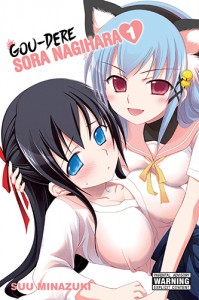
Gou-dere Sora Nagihara, Vol. 1

By Suu Minazuki. Released in Japan as “Gou-dere Bishoujo Sora Nagihara” by Hakusensha, serialized in various Young Animal spinoffs. Released in North America by Yen Press.

I tend to try to read a lot of Volume 1s that are released by manga companies, even if the premise makes me sort of rear back a bit. Sometimes I find I’m pleasantly surprised, such as, say, Haganai. Sometimes I can’t quite make it through the volume, as happened with Monster Musume. And then there’s this title, where I made it through the volume out of sheer morbid fascination at how appalling it was going to get, and whether it could keep up its pace of sexual assault jokes with no breathing space. Unfortunately, the answer is “not really”, but it made a valiant effort, at least.

gou-dere1

The creator is better known over here for a series called Sora no Otoshimono, and I’ve no doubt fans would rather be seeing that series, but it’s 20 volumes, while this is four. This particular series revolves around a young nebbish man who spends most of his life being sexually attracted to the girls in his bishoujo magazines, particularly the star of Tama x Kiss (a thinly veiled parody of Kimi x Kiss and all those other ecchi visual novels), Sora Nagihara. Then suddenly, for reasons that are still not particularly clear, Sora comes out of the magazine and appears in his lap. Only this is not the cute, shy, soon to die heroine he’s familiar with. She’s a Gou-dere, which I think is a tsundere-esque word that means she’s crude and appalling (with a hidden depressive side, which we see towards the end of this volume). She desires to have her new “master” rule the world by sleeping with every girl around him.

And here’s where the part of this book that’s an over the top parody and satire comes in, as she proceeds to kidnap, strip, and sexually assault young women for her so-called master (who then gets the blame, arrested, and beaten half to death by the police officers in town). The assault *is* the point of the manga – the heroine is constantly carrying around little packages of milk in order to allow her to create “facial’ shots as she finds a new victim. There is a childhood friend of the hero’s, naturally, who is appalled at what’s happening but mostly just yells and screams at the hero to stop Sora. The other girl on the cover is the president of the boxing club, who is assigned to destroy our hero (he has a name, but makes so little an impression I feel reluctant to use it), and who Sora ends up magically giving huge breasts, because of course she does.

As I said, the key here is over the top. This is not particularly meant to be titillating, it’s meant to make your jaw drop. When it’s at its most appalling, I admit I had to admire its sheer effort. Unfortunately, it also tries to have a typical harem plot while also parodying it, and that’s a high wire act it can’t quite achieve. I don’t buy that all these girls are in love with this guy for any reason other than “the plot says so.” There’s also a hint towards the end that even Sora herself may have a more serious storyline in her, and I don’t really want serious stories in this series. It makes the service harder to take.

If you’re a young man, and want to see what a parody of the typical “ecchi Japanese harem” series is like (and most North American examples we’ve seen over here are far less explicit than this), then you may want to pick this up. For people who really like fanservice no matter what, definitely pick this up. For everyone else… I don’t think the parody is good enough to justify buying it.

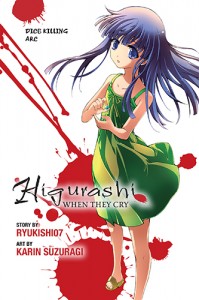
Higurashi: When They Cry, Vol. 26

Story by Ryukishi07; Art by Karin Suzuragi. Released in Japan as “Higurashi no Naku Koro ni: Saikoroshi-hen” by Square Enix, serialized in the magazine Gangan Joker. Released in North America by Yen Press.

As the readers of Higurashi plowed their way through the series, they gradually began to notice that the protagonist was changing before their eyes. At the start, this looked like a typical datesim variant, albeit a dark one, and therefore Keiichi Maebara was clearly the hero. After all, in the visual novels he didn’t even have a sprite. But as we got deeper into the plot, we realized who was really the driving forced behind this: Rika Furude, the young shrine maiden who was the only person who could remember all the past worlds. Indeed, she seemed at times to be much older than her unstated tween age, having lived her life till getting killed June 1983 over and over again. The main series, being more concerned with figuring out why this was happening and how to stop it, rarely stopped to consider the psychological implications of this. This epilogue, the “Dice-Killing Arc”, is here to do that.

higurashi26

The basic premise is simple enough: Rika, who is no longer threatened by impending death, becomes too careless when biking down a seldom-used hill and is struck by a truck. She wakes up in a world unlike all the others she’d been reliving over and over again. Keiichi isn’t here, Satoshi is alive, and so are her parents. In this new world, all the horrible things that happened in everyone’s pasts seem to have been avoided. It’s a “sinless world”… but is there a place for Rika in it? Can she return to the Higurashi world we know and love? And who is Rika Furude anyway?

As Ryukishi07 wrote this, he was also writing and planning his next series, Umineko: When They Cry, so it’s unsurprising that elements of that are seen in this. Most obvious is Rika feeling disassociated with her child self – she’s lived so many lives by now that she doesn’t feel like Rika Furude anymore, and when she makes the transition into this world she feels like she’s possessed the real Rika Furude. In a drunken stupor (we’ve seen Rika dilute wine and get drunk on it before, and she does here as well – be warned) she stares at the label on her father’s wine bottle and declares that her alternate self is actually Frederica Bernkastel.

As if this wasn’t disturbing enough, Rika’s mental state really takes a nosedive in this world. Satoko supposedly hates her and the others are mostly indifferent to her. Her parents are alive, but this doesn’t cheer her up – she simply regards them as nuisances. It all comes to a head when she’s sitting in class trying to work out how to return to her own world and Satoko decides to bully her a little too much – she snaps and punched Satoko, then starts to beat her over and over with a chair. “Fans” of Higurashi who saw this in the anime tended to be a little too happy over this scene, feeling Satoko “got what she deserved”. First of all, if you feel anyone in Higurashi gets what they deserved, stop following the series. Secondly, this scene is meant to be HORRIBLE. It’s preceded by a scene where Hanyuu (communicating with Rika via a relic) states that she may have to kill someone to get back to her world, and Rika hopes it’s her parents, as she has no attachment to them. It’s truly chilling.

What ends up happening, thankfully, is that Rika slowly understands this isn’t just her correct world and a “wrong” world, but two unique worlds with their own virtues. She starts to rebuild a relationship with her mother, who had always been upset at Rika seemingly knowing how to do things (due to the loops) and showing little affection; Rika also tries to remember what being a child who loves her parents was like in the first place. Likewise, Satoshi, Reina and the others help her to realize she can forge new bonds here, and maybe try to be friends with Satoko again. In the end, Rika makes the decision to stay in this world and not kill her mother…

A decision that turns out to perhaps be irrelevant, as she wakes up (after being in a coma for a month) back in the Higurashi world we know and love, with everything seemingly having been a “dream”. This ending is somewhat debated in Higurashi fandom, mostly as it’s implied it was a dream Hanyuu deliberately forced on Rika in order to get her to properly remember and grieve for her parents (and also possibly remind her not to bike into traffic). This would probably read better if Hanyuu had been better characterized throughout the series – we’re not even sure why she’s incorporeal again.

So not without its faults – there’s also a long expodump between Reina (who kept the i in this world) and Rika explaining the differences that’s almost painful – but it’s a story I’m happy we got, as it reminds us that even if there is a happy ending for everyone, lives still go on, and Rika has to make the decision to go forward at last, and not let herself be bound by her repeated loops and assumptions. I’m not sure if we’ll see more Higurashi manga after this (Daybreak and Bus Stop are still out there if Yen is interested), but as epilogues go, this is a fitting ending for the series.