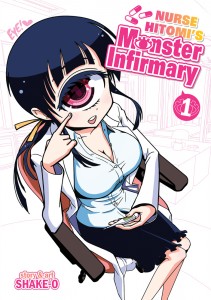
Nurse Hitomi’s Monster Infirmary, Vol. 1

By Shake-O. Released in Japan as “Hitomi-sensei no Hokenshitsu” by Tokuma Shoten, serialization ongoing in the magazine Comic Ryu. Released in North America by Seven Seas.

As longtime readers will know, I pay far more attention to which company is releasing a manga and what magazine it runs in, for good and ill. Sometimes this can give me a feeling of great anticipation (Love at Fourteen is a good example), and sometimes it can inspire a feeling of dread, such as with this title, which runs in Comic Ryu, home of Monster Musume, which is very, very popular in North America and I simply can’t stand. Luckily, even though it does feature a degree of fanservice and boob jokes, Nurse Hitomi is a far more palatable title, mostly as the fanservice is a distant fourth to its other aims: amusing comedy, amusing drawings of weird creatures, and monsters as a metaphor for teenagers.
hitomi1

This actually puts it closer to its other Comic Ryu neighbor, A Centaur’s Life. But whereas that’s more of a slice-of-life title that takes great pains in its worldbuilding, Shake-O is not particularly interested in why the world of Nurse Hitomi is filled with mythological people hybrids, or for that matter how a bear can father a cyclops. This is a manga that wants to have fun and be silly. And it certainly succeeds there. Hitomi is a nice teacher who genuinely wants to help her kids, but she has no depth perception, making her clumsy, and she tends to try to do everything herself, something pointed out by fellow teacher and childhood friend Kenjiro (you’d think they would have some unresolved tension between them, but sadly Ken is a lolicon, the final joke in the volume and a lousy one to go out on).

Rather than Hitomi, probably the best reason to read this title would be the kids who come to her with unusual problems, some of which are couched in subtle metaphor but most of which are as unsubtle as they come. One girl is horrified that as she gets older her tongue is getting longer and longer, and she can’t control when it comes out anymore. Two childhood friends are going in opposite directions – one is now a giant while the other has shrunk to the size of a 5-year-old. And a shy girl who has trouble speaking up has now found herself literally turning invisible. (To comedic effect – if you want Translucent, go bother Dark Horse.) As you can see, monster teens = puberty. Most of these titles try to have a heartwarming lesson in them, but the lesson is secondary to the humor, and that’s just fine.

There’s other things going on here – Hitomi’s assistant, Itsuki, seems to be gender-ambiguous, though Itsuki mostly exists to poke gentle fun at Hitomi. The story of the giant girl and her small friend has an undercurrent of yuri – though only an undercurrent – and I hear future chapters may do the same thing. For the most part, though, despite the occasional ‘this looks like tentacles but it’s really not’ art and ‘why are people staring at my large breasts’ jokes, this is a fairly cute and innocent look at teens and their problems, couched in monster language. It’s not essential, but if you like unusual comedies, give it a try.

Nura: Rise of the Yokai Clan, Vol. 25

By Hiroshi Shiibashi. Released in Japan as “Nurarihyon No Mago” by Shueisha, serialized in the magazine Weekly Shonen Jump. Released in North America by Viz.

We’ve come to the final volume of this Shonen Jump series, and as it turns out I had not done a full review of it since the very first. That first review is sort of retroactively hilarious, talking about what was mostly a high school comedy about Rikuo trying to hide his yokai heritage from his friends while dealing with a minor love triangle. Now here we are at the end, and I don’t think we’ve had a volume that wasn’t basically either a giant battle or preparations for a giant battle since around the early teens. When you have a hero that can transform into a handsome badass, and a large cast filled with eccentric but fascinating supernatural creatures, no one cares about your human childhood friend. Sorry, Kana.

nura25

But of course the tradeoff is that, while I’ve basically enjoyed myself throughout the series, there’s been very little to talk about with each individual volume, hence why I’ve kept my comments to the Bookshelf Briefs. Even here, the first half of the book is basically the climax of the final battle, which is as you’d expect – the villain is convinced he’s won, but with the help of all his yokai companion, as well as a reformed villain or two, our hero pulls it out despite risking death (as does his grandfather, who actually meets his wife in “heaven” before returning as his time is not yet over). With everything won, we return to the (somewhat beat up) clan house, where a giant party proceeds to end the volume. Well, except for several side-stories to pad it out to a proper length – by the end of the series, Nura was running in ‘Jump Next’, a side-magazine, which allowed it to have its 80-page finales but also hinted it was being put out to pasture.

And it’s for the best, really, as I’m not sure how much more Nura had to give. It’s always been one of those series that was good but not great, and you can’t see the ‘Final Volume!’ at the back cover without thinking “Oh good”. As ever with Jump series, we’d had an escalating scale of villains, but with the last one basically being a creation of absolute evil, there’s nowhere else to go after that. As for the romance, it was the typical non-romance you get in Jump titles like these. There’s enough tease to keep Tsurara fans happy, and it’s implied Rikuo returns her feelings, but nothing really happens. In a world where we recently saw Naruto trying to pair people up and fail so miserably (I actually do like Naruto/Hinata, but there’s no denying that rushed ‘epilogue’ was pretty miserable), and where Bleach fans await the end of their series with dread and prepared outrage, this seems quite satisfying.

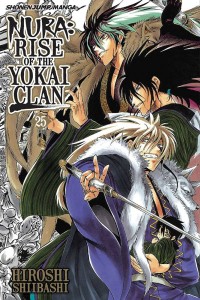
The cover shows us three generations of Nuras, which is good as honestly in black and white I can’t tell them apart, and they’re all smiling and showing off their badass poses. It’s a good cover for a series that has never been amazing or addictive, but more solid and dependable. I enjoyed reading you, Nura. Now… GET OUT!

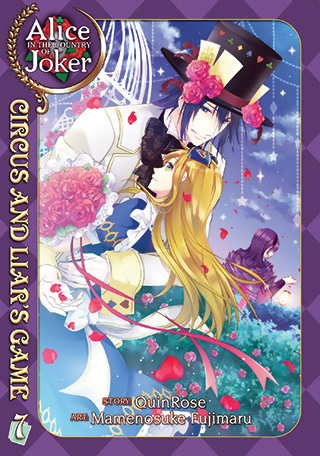
Alice in the Country of Joker: Circus and Liar’s Game, Vol. 7

By Quin Rose and Mamenosuke Fujimaru, based on the game by Quin Rose. Released in Japan as “Joker no Kuni no Alice – Circus to Usotsuki Game” by Ichijinsha, serialized in the magazine Comic Zero-Sum. Released in North America by Seven Seas.

This review contains spoilers for the “Bad End” of the visual novels.

Of all the Alice spinoffs, this one is clearly my favorite, and I’ve said why in previous reviews I did for Bookshelf Briefs. The romance between Alice and Blood doesn’t overwhelm the story. There isn’t as much painful filler the way some of the lower-tier Alice spinoffs have, where you can find yourself in Crimson Empire at the drop of a Hatter subplot. But mostly I think I like it as the main plot is very much dedicated to psychological trauma, Alice’s in particular but also everyone else. Time after time in Circus and Liar’s Game we see her back in the prison, with her sister Lorina sitting in a cell that only Alice can open. Joker is taunting her, trying to get her to face up to the memories of her past that she avoids. And the entire rest of the cast tries to stop her, and get her to stay there and not remember.

alice7

We’re never going to get a ‘bad end’ in these spinoffs, and I think it’s a shame, because the more I read of this series the more I think I really want to see it. Alice remembers that her sister is dead, and wakes up back in the real world, clearly older than the franchise has been portraying her, and having apparently been completely devastated by the loss. Thus staying in Wonderland – kept in that “Sunday Afternoon” that Peter White represents – is denial of reality, and the inability to grieve and move on with her life. And it’s clear that the series, in almost all its endings, really wants you to pick ‘denial’. Throughout Circus and Liar’s Game, Alice is tempted by Joker, and we do cheer when Blood confronts Joker and even takes a wound in order to stop her giving in. In the end, she even marries Blood. But is it really a “happy ending”?

There are two reasons I ask this. The first is the epilogue of this volume, where Alice ends up in the Country of Diamonds after a fight with Blood, and is horrified to find that every relationship she’s had is lost. Blood in particular is not the one she knows, even though he’s still willing to protect her if need be. The best part of this is that it’s not Joker tempting Alice to return to reality in this world, but Ace. Ace has always functioned as the most dangerous protagonist, the one who only loves Alice when she’s upset, fretting or struggling. Here she’s his ideal (and it’s worth noting that we see “adult” Ace here, not the teenage one from the Diamonds VN). That said, the epilogue can’t bring itself to destroy its happy ending, and she chooses to return to her Blood, who she wakes up with.

The other interesting thing is what Alice chooses to become, and how it ties into Blood and Vivaldi. As with the main Alice series, their relationship is a key aspect of the plot here. We get flashback hints (which I suspect I’d understand more if I played the game, but that machine translation drives me up the wall) that they aren’t just brother and sister, but were once like Alice herself. And that’s what makes the ending extra disturbing, as Alice’s ‘Outsider’ status is now considered a Role, one she willingly takes on. Does this mean that she has a clock in her chest now? It’s possible I’m reading too much into this, but I think in the end I’m like Ace. I like the Alice series best when it’s troubled, disturbing, and has nasty implications. Even if Alice is getting great sex with Blood and happy endings. This Circus and Liar’s Game has been a terrific look at the psychology of the series.

(Also, Alice looks fantastic in that Negotiator outfit. She should wear it more often.)