No Game No Life, Vol. 1

By Yuu Kamiya and Mashiro Hiiragi. Released in Japan by Media Factory, serialized in the magazine Comic Alive. Released in North America by Seven Seas.

Ah, Comic Alive, my old nemesis. We meet again. I see this time you’ve brought a title that I would probably find quite interesting were it not for the grotesque fanservice that is sprinkled throughout and unavoidable. Again. In fact, that seems to be your only weapon, really, though I was pleased by your one victory in the ‘yuri’ genre. Can’t we have more like Whispered Words and less like this? And so as ever, I’m left to figure out if there’s enough remaining in the title to pull me in, or if I’m going to be driven off by an excess of panty flashing, underage nudity, and boob groping. All of which No Game No Life has plenty of.
ngnl1

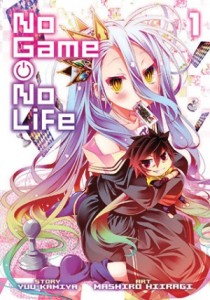
This is another in the increasingly popular genre of ‘gamers suddenly find themselves in a game world’, but with a slight twist. Our brother/sister heroes don’t find themselves in the game they were playing (and crushing everyone – they’re master gamers), but in a fantasy world where war has been replaced by games – any games, and the stakes can be quite high. As they struggle to figure out the history and rules of this new world, they meet the story’s designated victim, Princess Stephanie, who has just lost her kingdom due to being too naive, honest, and tsundere. Luckily for her, they’re not only master gamers, but total savants – with a few minor quirks.

Let’s break down the quirks, which are really the best and worst reasons to pick up this title. Sora is another overly perverse virgin whose first thought on winning a ‘ask anything of the pretty girl’ game is to ask the girl to fall in love with him. Shiro, while occasionally playing the jealous sister card, seems OK with him groping and assaulting said girl as long as it goes through her first. They are supposedly siblings (I will be very unsurprised if this turns out not to be true later on) but Sora professes he has no sexual desire towards Shiro… but that doesn’t stop them being all over each other anyway, thus gaining the best of both worlds for those who like that fetish.

So where’s the good? For all their smug confidence, much of which is justified, Sora and Shiro are two very broken teens (Shiro is 11, but whatever). If they’re apart from each other at all, they both have crippling breakdowns – we saw at the start they were a NEET (him) and a truant (her). Indeed, Shiro may actually have some sort of disorder – I’m not sure if her broken speech is meant to be a cute affectation or something more basic. And Ias I said earlier, they really do seem to be as good as they say they are – Shiro memorized a book almost instantly, and Sora, while not as good as that, is still said to be able to pick it up in a few hours.

So the question remains, what will the story do with these two? If it develops as a tale of how they deal with this world and its inhabitants while working to get over their social phobias, that’s quite a good possibility. That said, I expect the service is not going away and may even get worse. There is a light novel coming this spring, too. In the end, I suppose if you read Comic Alive stuff, you’ll enjoy this. If not, it might be interesting for the siblings, but I’d wait a few volumes to see if that pans out.

Manga Dogs, Vol. 1

By Ema Toyama. Released in Japan as “GDGD-DOGS” by Kodansha, serialized in the magazine Aria. Released in North America by Kodansha Comics.

Ema Toyama’s career over here in North America has been a bit slow to build. Pixie Pop came out back in the Tokyopop days, and if I recall had a heroine who was a bit flat. Del Rey then brought over I Am Here!, whose heroine, while slightly better, was still not quite there. Then came Missions of Love, which introduced us to the love quadrangle from hell. Yukina is on a whole other level from her other heroines, and even though some fans are grumping about her losing her ‘snow princess’ facade as she falls in love, there’s no doubt she’s fascinating. And now we have Kanna, the heroine of Manga Dogs, a high school girl who’s also an active manga artist with a story in the back end of a shoujo magazine. What will her character development be like?

mangadogs1

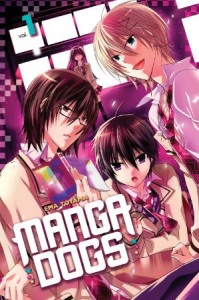
As it turns out, any character developemnt is completely irrelevant! Because Manga Dogs is not another shoujo romantic comedy. Toyama has said in the past how Kumeta Koji is one of her favorite authors, particularly Sayonara, Zetsubou-sensei and Katteni Kaizo. It shows here. Manga Dogs is an episodic gag manga mocking the manga industry, with Kanna surrounded by three pretty but vapid young men who are determined to become rich and famous drawing manga. The goal here is not to see which young man in the reverse harem Kanna will end up with, but to see if she can keep her sanity and health (already somewhat iffy given her weekly deadlines).

I’d joked on Twitter that, like Missions of Love, Manga Dogs had a main cast who were basically horrible, but Kanna is the Tsukkomi here, which makes a difference. By now the Western audience should be used to this type of humor, but I will say that if you dislike jokes that are framed as “Character A says something stupid, character B shouts at them that the thing they said is stupid”, with optional table flip, this isn’t the title for you. Kanna is mostly the straight man, though even she backslides at times, such as when she’s gathering reference photographs, or forgets she’s not drawing a BL manga.

Toyama jokes in her endnotes about Bakuman, and there is the occasional nod at showing what the life of a manga author is like, but it always takes a backseat to the gags. There are also many little references that fans of manga will get interspersed throughout – my favorite was the gentle mocking of the magazine Manga Dogs runs in, Aria. Aria is a smallish, cult shoujo magazine (though the Levi manga may have changed that), and the boys comparing it to Shonen Jump and Shonen Sunday is ridiculous (we do, at last, get a new guy who mentions Magazine – but he turns out to be a villain).

There’s not much to this manga in the end – so far the emotional depth is zero – but no one’s going to read it for that anyway. They have Missions of Love for that. This is 100% stupid comedy, and it does it quite well. It’s also only 3 volumes long, so won’t risk going on long past what folks expected, like… well, also like Missions of Love.

Magical Girl Apocalypse, Vol. 1

By Kentaro Sato. Released in Japan as “Mahou Shoujo Of The End” by Akita Shoten, serialized in the magazine Bessatsu Shonen Champion. Released in North America by Seven Seas.

Those who know my usual reviewing patterns and preferences may be surprised to see that I’m reviewing this title at all, and you’re mostly right. I picked this one up expecting that it wasn’t going to be my cup of tea, but wondering if it was some sort of magical girl deconstruction along the lines of Madoka Magica (which, ironically, I also don’t like). Unfortunately, at least in this volume, the ‘magical girl’ part is mostly irrelevant. The monsters here could be demons, angels, or clowns for all that it matters. They are a massive force of death and gore, who just happen to be magical girls. They certainly do bring the apocalypse, though. That said, I did want to review this title, as it’s a classic example of a title that I personally dislike but where I recognize its good qualities that other readers will greatly appreciate.

mga1

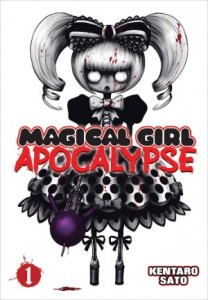
The buildup to said apocalypse is short, only taking up the first few pages. Our hero, Kii, is (sigh) an average everyday high school student, who wants to get through his school days peacefully. Sometimes this means ogling the class beauty from afar, sometimes it means turning away when his childhood friend is getting viciously bullied in a nearby bathroom. As he takes a test, he looks outside and notices his teacher stopping a young girl who is dressed quite oddly. That’s her on the cover. The girl then proceeds to blow his head off with her ‘wand’, then goes after the rest of the school. As the slaughter commences, it turns out that the entire world is being invaded by so-called magical girls, who are also able to reanimate the dead to do their bidding.

That last sentence is the most telling. This is, at heart, a zombie manga. There’s a lot of lovingly detailed horror and gore, and much of the second half involves escaping the school and winnowing down our already small cast. Our hero survives, of course, along with his bullied childhood friend (they would appear to have the closest thing this title has to a possible romance) and a busty upperclassman. They make it out into the city, and find that it’s no better out there. Is there anything to do besides wait for everyone to die?

The author certainly has a sense of style in the way he depicts the mass slaughter. The gore is almost artistic in places, as well as finding new levels of sadism, especially in the scene where a magical girl crumples up about 200 people into a living ball, hefts them high into the air, then lets them drop to their death. The combination of gore and fanservice (busty upperclassman is VERY busty, and we’re not allowed to forget it) makes this a fantastic series for young men who would be reading anything in Shonen Champion, the magazine where this runs. Indeed, in some ways it reminds me of a less silly version of Franken Fran, the cult horror manga from the same publisher.

It’s totally not a series I’ll be continuing, but don’t let that stop you. If you like survival manga, zombie manga, horror manga, or just lovingly detailed depictions of cute high school kids getting their heads blown off, this title will not disappoint you, as it does all those things very well.