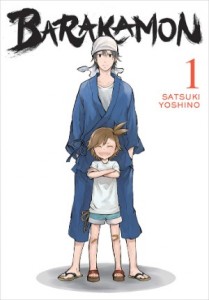
Barakamon, Vol. 1

By Satsuki Yoshino. Released in Japan by Square Enix, serialization ongoing in the magazine Gangan Online. Released in North America by Yen Press.

The genre of ‘Fish out of water city boy moves to the country and is slowly won over by the laid-back, charming ways of the locals’ is so well known in Japan that it’s become a bit of a cliche, but we don’t see it too often over here in North America, likely as it’s almost always filled with hard-to-translate dialect humor, lacks a big, eventful plot, and relies essentially on being heartwarming. The series Yotsuba&! has a similar feel, but whereas that’s all about the child, Barakamon is definitely about the young man, Seishuu Handa, and his reactions to his new neighbors and attempts to deal with the mess he’s made of his life.
barakamon1

The thing I like best about Handa is that he’s got a lot of decent guy underneath him, he just tends to stress out a lot and overreact to things. I have issues with this myself, so can identify. His constant admission of hating children does not really mean that he’s bad at dealing with them – at times he proves to be even better than their local teacher, and certainly bonds straight away with young Naru, the first-grade girl who practically moves in with him from day one. But he’s at a crossroads in life after one very ill-advised tantrum (he had to move from the city as everyone thought of him as ‘the guy who punched an old man with a cane’), and worse, he’s starting to see the old man’s point about his calligraphy.

Calligraphy is Handa’s profession, but trust me, you don’t need to be an expert to enjoy this – god knows I’m not. I did smile when I saw Handa’s efforts to have fun while writing characters, and later on seeing the calligraphy filling a room that he called his failures. He understands his problem but is unsure how to fix it – somewhere we’ve all been. The basic cure is likely “stop being so serious”, something I expect the rest of the cast will take care of before too long.

Other than young Naru, the rest of the cast get introduced fast and furious, but haven’t stuck around as long. She has a shy friend, Hina, and a young boy who has a crush on her and doesn’t know what to do. There’s also Hiroshi, a young high schooler whose idea of effort, and what everyone else expects of him, is frustrating to both him and the reader. This was probably my favorite chapter in the volume, as Hiroshi gradually comes to realize that he may THINK he’s giving effort, but compared to others he really does deserve all the average grades he gets. It also shows off our hero’s tenacity.

The presentation is good – there’s a final page explaining the title and some of the dialect jokes. The dialect itself is translated as ‘vaguely Southern’, but not enough to really jar the way some other publications have done (I’m thinking Osaka from Azumanga here). The plot reminds me of Yotsuba&! combined with Sayonara, Zetsubou-sensei, and how can you go wrong with that? Anyone who enjoys slice-of-life mangas should enjoy this one, and given it’s 10+ volumes in Japan, Yen has fast-tracked it, so expect another volume in 2 months.
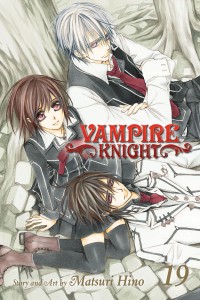
Vampire Knight, Vol. 19

By Matsuri Hino. Released in Japan by Hakusensha, serialized in the magazine LaLa. Released in North America by Viz.

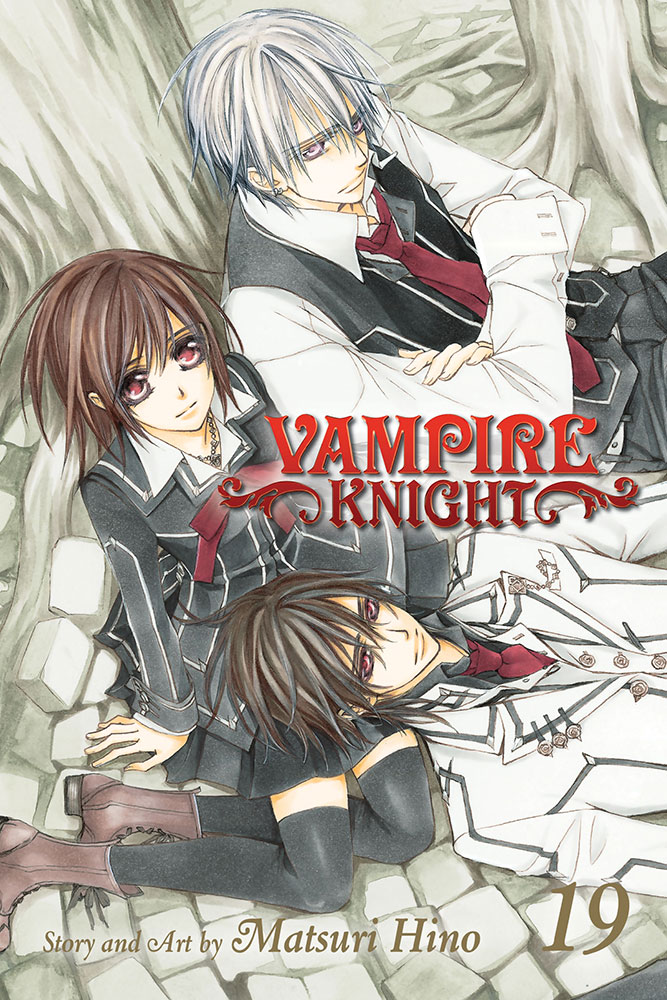
And so after 19 volumes, we come to the end of this particular journey. Yes, there’s a novel due out next month, but for the main manga, this is it. There’s even a limited edition, which has (in my opinion) a better cover art picture and a limited edition hardcover artbook, which features some lovely character pieces. Vampire Knight has always been a series that I’ve found to be of the moment. I may forget what’s actually going on the moment I put down the book, but while I’m reading the book, I’m swept along by the drama and emotions going on within. This last volume takes that and amps it up even further, as Yuki and Kaname compete to see who can out-self-sacrifice each other.

vknight19

This is not to say there aren’t some issues. The incestuous subtext that’s been bubbling under the entire series becomes text early in this volume, and while it’s not dwelled on, I can’t say I was all that happy with it. Most of the supporting players who had large roles earlier in the series are reduced to little more than cameos here, though again it was excellent to see Yuki’s human best friend, Sayori, pop up to remind us that the world isn’t entirely vampires. (Nice flashforward as well.) And of course the entirely of this volume seems to feature both Kaname and Zero trying their best to protect Yuki by removing any agency she might have to strike off on her own, which usually makes me growl, but…

Yuki isn’t having any of it. The series has balanced a knife edge as to whether Yuki will finally slip and become a princess who needs to be protected and rescued or a knight who does the rescuing, and it’s to Hino’s credit that the final decision is Yuki’s, and it’s to live up to the title. Possibly the best panel in the entire volume shows Yuki, in her school uniform and sword in hand, dragging Aido (who is literally flapping in the wind” while shouting “We’ve got an academy to protect!” It does a heart good to see this.

As for Kaname’s master plan, well, in the end there’s not much they can do about it, but they do manage to find a sort of deus ex machina that can be fired off after a thousand years. The epilogue shows that all of the hatred and political intrigue that has dominated vampire life (and the series in general) seems to have dissipated. And Yuki and Zero are together, though this is given really short shrift – in the end, it’s not about whether Yuki ends up with her brother or her classmate, it’s about Yuki working with others to save both vampires and humans. Romance is an afterthought.

Vampire Knight’s pleasures may be fleeting, but that doesn’t make them any less enjoyable. A lot of Vampire Knight’s covers have featured the main characters looking out at the reader, and the limited edition one does the same, with Yuki, Zero and Kaname lying exhausted yet satisfied (yes, yes, OT3), and saying to the reader, “We’re done. Is this enough?” It’s a very good conclusion.

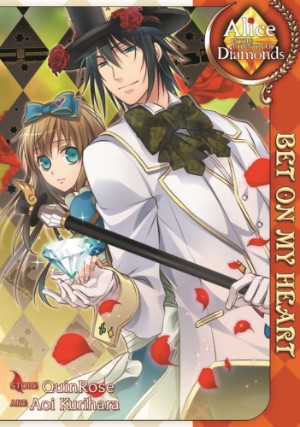
Alice in the Country of Diamonds: Bet on My Heart

By Sana Shirakawa, Quin Rose, and Nana Fumitsuki, based on the game by Quin Rose. Released in Japan by Ichijinsha. Released in North America by Seven Seas.

The Alice spinoffs, which is to say everything but the 6 main books that Tokyopop/Yen Press put out, have always had an issue to deal with which is to say that they’re made for readers in Japan who have played the original games that the series is based on. North America hasn’t really had that luxury, even though we do now have a somewhat machine-translated tablet version of the Hearts game. So there’s always a risk that you read something that requires, if not prior knowledge, at least passing familiarity with the game world you’re in. Or, as in the case of this light novel, you have a product that lots of times seems to read like an advertisement for a game you can’t get over here.

diamonds

That isn’t to say this isn’t a good novel, it’s quite well-written. The prose flows well (excellent translation by William Flanagan), and Alice and Blood, the main stars, sound like themselves. The premise, as you may have guessed, has Alice dropped in another world, a la Clover or Joker. But whereas Hearts had Alice looking for a passionate love, and Clover had Alice develop a relationship based on friendship turning to love, here she’s further in the past of Wonderland, no one knows who she is, and everyone starts out disliking her intensely. (Hence “Diamonds”.) Alice has her hands full trying to deal with this, and it’s not helped by ending up at Hatter Mansion with a Blood Dupre who’s far less adept at being aloof yet teasing than she remembers.

This book is drenched in the Blood/Alice ship, and fans of other ships won’t get much here. Eliot fans should particularly stay away, as he’s abused and beaten by Blood throughout, usually when he’s trying to shoot Alice. As for new characters, the White Queen and her Black Rabbit barely get a look, so most of what we get is Jericho Bermuda, the Gravekeeper, who seems to be based on Carroll’s dodo bird. He’s Alice’s oasis of calm in the excitement of dealing with Hatter mobster wars, and it’s frustrating that most of the hints we get about him being a “walking dead man” are not answered here.

There aren’t the sharp edges I like in some of the other Alice spinoffs – Alice doesn’t think of Lorina once, and most of her worries once she’s fallen in love come from a fear that she’ll switch countries again. The Hatter family are more battle ready and drenched in blood than the earlier games, as they’re still gaining power. But mostly I think this is a good book that makes a reader yearn to play the game. We want to see what’s up with the White Queen switching between child and adult form, like the Twins used to do. (They’re just adults here.) We’d like to see why the Black Rabbit seems to hate Alice (inverse of Peter, I expect.) Joker was mentioned to be here as well, but remains unseen. Jericho looks to be the author rewriting Mary Gowland to be less irritating, but who knows?

So this is a very good novel for Alice fans who want to dip into prose, or Alice/Blood shippers. But it also frustrated me, as it offers many questions without answers as well.