Noragami: Stray God, Vol. 1

By Adachitoka. Released in Japan by Kodansha, serialization ongoing in the magazine Monthly Shonen Magazine. Released in North America by Kodansha Comics.

It’s rare to see the word ‘Monthly’ next to Shonen Magazine in North American licenses. Between the licenses from the regular Weekly publication (Fairy Tail, UQ Holder, etc.) and the ‘cool’ alternative of Bessatsu (Attack on Titan, Sankarea, Flowers of Evil), Monthly doesn’t really get much of a look. It tends towards longer series, which may be a primary reason, and there’s also a lot of sports titles, including long-runner Dear Boys. Del Rey tried out Pumpkin Scissors, but it fell victim to The Great Del Rey Cull of 2010 (as seen in all good history books). But now we have Noragami: Stray God, a fantasy featuring a god who’s somewhat full of himself and a young girl who struggles to deal with her new-found brush with death.
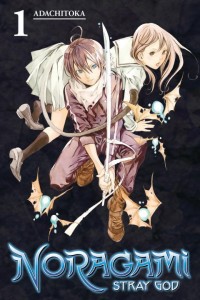
noragami1

As I read Noragami, I was struck by its similarity to another title I follow, Rin-Ne. Another spiritual odd jobs man who helps out people in need, even if they may turn out to not really deserve the help they get, and does so despite being on the edge of poverty. Takahashui’s series, though, has fairly mild characters in the lead roles. That’s not the cast with Noragami. I was struck after finishing the first chapter how hard it was to latch onto anything, which makes it a relief that it was a sort of prologue. A victim of class bullying, Mutsumi comes across as somewhat passive and shallow, and even though I am not fond of ‘it’s the victim’s fault for not standing up for herself’ plotlines, you can see Yato’s point.

As for Yato, he’s a very quirky sort of hero, coming across as a bit of a jerk, to the extent that his old Shinki, the only one in the first chapter who seemed like a decent person, abandons him. Of course, this is not the end. Yato is a decent person at heart, it’s just he keeps up a shell of over-the-top dramatics and uncaring dialogue. Things perk up when we meet Hiyori, who does end up taking the role of the audience identification character. She’s a little weird herself (her obsession with pro wrestling is her character introduction), but comes across as nice and sympathetic, and attempts to figure out what to do after an impulsive attempt to save Yato from a care crash leaves her in the realm between life and death (complete with tail for added service).

At the end of the series we meet Yato’s supposed new ShinkiYukine… who seems very ungrateful to be in this position, and whose discussion of Yato’s faults reminds me a lot of the original Shinki we met. Will he stick around long enough to see Volume 3? More to the point, will I? This is an intriguing new series, but it’s hard to really bond with anyone in it, and its plot is being done elsewhere as well. Those who enjoy fantasy comedies should like Noragami, but it can be as hard to take as its hero most of the time.

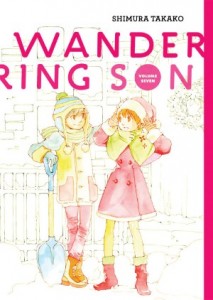
Wandering Son, Vol. 7

By Shimura Takako. Released in Japan by Enterbrain, serialized in the magazine Comic Beam. Released in North America by Fantagraphics.

Childhood and growing up is all about making big mistakes and then trying to deal with them, or make up for them, or (most often) realize that you can’t really make up for some things. This volume of Wandering Son definitely feels like that’s what’s happening with Takatsuki, who lets a secret blurt out in an impetuous moment and then has to deal with the fallout. Meanwhile, Nitori seems to have moved on from Takatsuki himself, as he’s started to date – and no big surprise who it is. This may be a heartwarming cutting edge coming of age manga, but if a girl says she hates a guy in Book 4, she’s going to be dating him in Book 7.

wandering7

We’ve focused mainly on Nitori and his desires, but Takatsuki is the other half of this story, and her gender issues have not gone away. It’s harder for her to accomplish what she wants, though. There are little victories, such as leaving her ribbon off at school or binding her chest to hide her growing breasts. But there’s also Chiba, who proclaims her dislike of Takatsuki but can’t stop dealing with her. Takatsuki is not helping things either. Her revelation that Nitori is dating Anna is pure spite, and she knows how Chiba feels, so should not be surprised at the devastation that follows. It ends up forcing the two of them to deal with each other more directly, though. I wonder if Takatsuki will follow Chiba’s suggestion towards the end of the volume.

Meanwhile, as noted, Nitori and Anna have started going out. They’re very cute together, though Nitori’s gender issues have not yet really come between them, and it’s critical to note that he goes out with her and confesses to her as a male. He’s really come a long way, though, and I feel happy for him. All is not sunshine and rainbows, of course; puberty brings its own problems, in this case acne, and the fact that some cleansers simply work differently for different types of faces. And there’s Seya, forced together with Nitori on a skiing trip, who’s still having issues with how cute Nitori is and dealing with the reaction to that.

And I keep coming back to Chiba. She actually stays home for a considerable period after the Anna revelation, and is considering dropping out entirely. All of Nitori and Takatsuki’s friends seem to grate on her these days, and I am reminded what a difficult thing it is to get everyone in a young peer group to get along, or even communicate with each other properly. Things are looking up as she goes with the class on the ski trip, but even there she can’t really stop trying to influence people to change the way she wants them to change, something I think she has regretted before and will regret again. She’s a giant mess, and still my favorite character in the series.

Wandering Son is a nostalgic look back at what it was like to go through childhood, and if that sounds painful and discomfiting, it’s probably meant to be. But there’s a lot of warmth and affection here as well, and we long to see the cast struggle, make more mistakes, and continue to move forward. Highly recommended.

Sword Art Online, Vol. 2

By Reki Kawahara and abec. Released in Japan by ASCII Mediaworks. Released in North America by Yen Press.

The author of this novel admits in his afterword that the first book was an excellent stand alone, but did not really make for much of an ongoing series. So, in order to fix that, he’s going back and adding a few elements that might a) expand the cast and draw in a few more fans of those ‘types’, b) expand the world of Aincrad a bit more before everyone is free of it, and c) give a bit more depth to Kirito’s mental and emotional issues while continuing to show off how amazing he is (really, if Kirito bothers you as a super awesome guy, you should probably find some other series to read. I’ve no real issues with it.)

sao2

This novel consists of four short stories, and while they all achieve something, I’d have to see it’s the last two that hold more emotional weight and are better written. In the first story we meet Silica, a young girl who has a rare beast and has let it go to her head, with potentially tragic circumstances. Kirito straight up admits (though later he reveals that part of this was a ploy) that he’s helping her as she reminds him of his younger sister. Having read Fairy Dance’s manga, I don’t really see it, but again, ploy. We see a bit of how criminal activity works in the world of SAO, and also how a young girl on her own would have to deal with creepers – Silica is well-known, popular, and underage, a dangerous combination even in a MMORPG.

Next we meet Lisbeth, a blacksmith who is friends with Asuna and indeed shares many of her qualities. Kirito comes to her looking for a second sword, and so they have to go on a quest for the mystery metal that can make it. I found this the weakest story in a few ways, but it does manage to highlight what it must be like for an outsider on coming across the relationship between Kirito and Asuna. The author may be adding more cute girls to fall for Kirito (we get three in this book alone), but never lets us forget that Kirito and Asuna are THE couple, and Lisbeth, much as it hurts, can’t bring herself to try to come between them. (She also gets first person narration, the first we’ve seen that isn’t Kirito’s.)

The third story was my favorite, and not coincidentally focused on Kirito and Asuna right after they get married, when they come across a young girl in the forest. The manga adapted this, but I hadn’t realized how much it was compressed – here we meet several more cast, and it’s revealed that most of the young kids in the game are not leveling up like Silica, but just wanting to survive. Sasha corralling them is a definite good thing. It’s also nice seeing a romantic couple that isn’t the main one – Yuriel attempts to frame Thinker as her commanding officer, but it becomes clear early on she’s deeply in love with him. Mostly, though, this is the heartbreaking story of an AI who overcomes mental blocks to help her parents, and a coulpe that experience the exquisite pain of losing their child.

The last short story is the shortest, and is the only story in first-person Kirito narration. It expands on the story he’d told us in the first book about the guild he joined that was wiped out – in particular Sachi, the young woman he reassures but can’t quite save. This is Kirito at his darkest and most driven, and it’s stated several times that he’s in a suicidal state. It’s stark and emotional, though the actual guild and their fate is more of a catalyst than anything else – this is not about them, it’s about how Kirito can get over his grief and start to recover.

As you’d expect, this was a lot more uneven than the first book, but I enjoy its leads, and I like the expanded worldbuilding. Now that we’ve done that, hopefully Book 3 will show us Kirito and Asuna happily reuniting in the real world. Well, unless something goes horribly wrong…