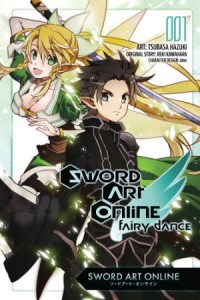
Sword Art Online: Fairy Dance, Vol. 1

By Reki Kawahara, abec, and Tsubasa Haduki. Released in Japan by ASCII Mediaworks, serialized in the magazine Dengeki Bunko. Released in North America by Yen Press.

As I’ve mentioned a couple of times before, after my highly positive reviews of the first Sword Art Online manga, several people told me that the series took a big nosedive with the next arc. I was therefore quite interested to see what happened here, and how exactly the series lost all of the goodwill it gained. I initially though I might have to wait until the arc finished to get the full story, but no, that’s not the issue here. Everything that I suspect people hated about this arc is laid out right at the beginning of the story, to the point where I wonder if the author did this deliberately to tweak fans a little bit. After all, he is having to come up with a way to continue what was a fairly self-contained story.
fairydance1

Let’s run through the basic problems, which I think fall into three big categories. First, there is the introduction of Suguha, the younger sister of Kazuto/Kirito, our hero. As we hear from her angsty narration, she was told that she and Kirito were not really siblings, but cousins, while he was trapped in SAO. This allows her to have ‘legal in Japan’ feelings for Kazuto, which given that the reader spent the last two volumes marveling at Kirito and Asuna’s relatively quick and happy relationship can be a bit grating. Moreover, we discover she’s also playing an MMO to see what Kazuto found so amazing about them, and is now teaming up with him – without either one knowing that they’re really teaming up with their real-life sibling. Wackiness, as they say, ensues. (Oh yes, and there’s fanservice of Suguha’s naked, buxom form in the shower.)

Secondly we get introduced to the villain of the piece, Sugou, aka Oberon. I feel that it’s OK to spoil that he is the villain given that the story does so immediately after his first appearance. His entire personality is designed to be evil, which means he gets all the usual evil attributes, including gloating about his evil plans (which he explains in great detail to both Kazuto and Asuna), and openly discussing sexually assaulting a girl who openly hates him without her content. He’s a loathsome prick, and one wishes he had a bit of the subtlety of SAO’s first villain, who at least had better justification in his head for mass murder.

Lastly, after expecting a tearful reunion of Kirito and Asuna in the real world, we find that not only has Asuna not woken up, not only is she trapped in another MMO designed by her evil fiancee, but she is literally being kept in a BIRDCAGE and tormented by Sugou/Oberon, unable to even escape (though she may be trying to change that at the end of this volume). Seeing our favorite action girl as a prize to be won, passive and caged, is possibly the one thing that grated on me the most here, if only as her role is then handed over to Leafa/Suguha.

That said, there are things I did greatly enjoy here. The basic premise is still solid, if ridiculous. (The fact that these VR MMOs weren’t banned after SAO’s mass deaths came out is totally ludicrous.) Kirito is a very likeable hero, and I admired his resolve and willingness to use his cheat skills to get ahead in order to save the one he loves. The reunion with Yui was too short for my liking, but still very heartwarming, and I’d love to see her reunite with her mother as well. The narrative flows smoothly, with the battles being interesting and not taking over the entire book. The new game is sufficiently different from the first to add new depth. We have a new artist here, who seems to mostly be an artist-for-hire on light novels, and the artwork is pretty decent. And I did enjoy the brief glimpses we got to see of the real world – I wish we’d seen a bit more. (I wonder if the novel, due out in December, has some of the missing depth here.)

So overall, no, I didn’t loe this as much as the first series, for the reasons I mentioned above. It’s clearly retooling itself to attract new readers, and in order to do that burning a few of its bridges. That said, it’s still a lot of fun, and I would really like to see what happens next, so I’d call it a success overall. Let’s not lock up our heroines for the entire story in the future, though.

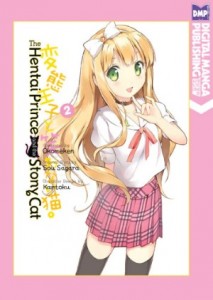
The Hentai Prince and the Stony Cat, Vol. 2

By Sou Sagara and Okomeken. Released in Japan as “Hentai Ouji to Warawanai Neko” by Media Factory, serialization ongoing in the magazine Comic Alive. Released in North America by Digital Manga Publishing.

I was a bit ‘meh’ about the first volume of Stony Cat, which I felt showed promise but also had several flaws. The second volume is for the most part better, even though it has many of the same flaws, because the flaws are starting to look like they’re built into the work as a whole. This is not a manga about easy fixes – its very premise shows off the dangers of trying to fix your personality quirks with mere wishes – and we delve deeper into that here, as Yoto’s attempt to cheer Azusa up fail on a spectacular level, partly due to his being unable to avoid telling the truth but mostly due to his misconception about how deep her issues run.

hentaiprince2

There is a certain awkwardness that permeates the entire volume – indeed, the adaptation helps it along with some translation quirks that I’m not certain are deliberate. Azusa’s two old ‘friends’ from middle school, in the aftermath of the botched ‘date’, speak in a sort of stilted robotic tone, ending everything in ‘I did’ or ‘we did’. Indeed, everyone seems to talk a bit more formally in this series. It’s likely just a case of ‘how can I deal with this regional dialect’, but it helps to add an additional disconnect to what’s going on in the series.

Azusa is merely the most obvious example of someone whose ruined self-image is causing great pain in her life (even her mother, who seems to be one of those standard ditzy anime moms, is not really helping her). Tsukiko is pretty unhappy with Yuto’s plan, but of course can barely express it thanks to her wished-for stoicism (unlike Yuto, who is able to get his wish reversed halfway through this book, she’s still stuck with her face being the way it is.) Yuto himself is the typical well-meaning but overzealous teen guy, deciding that he knows how to fix things without really thinking about how they’ll affect the person he’s trying to fix. Getting his ability to lie back allows him to defuse things with Tsukiko’s sister (who turns out to be the “Iron King” track star we saw in Vol. 1), but I suspect his basic personality flaws will continue to plague him.

Aside from that, this series has most of what you’d expect from a harem romance based on a light novel that runs in Comic Alive. There’s lots of comedic violence, misunderstandings, some blatant nudity at the end of the book. The aforementioned Iron King gets to show off her physical prowess, but also shows off how little she understands the human brain (similar to the rest of the cast) when she accepts Yoto’s ‘that was my evil twin brother’ story at face value. Despite the added depth revealed in this volume, it’s still filled with flaws, and I wouldn’t recommend it except to those who like its genre to begin with. But for those people, there’s things to like here, or at least things to muse upon in the hope that future volumes will run with them further.

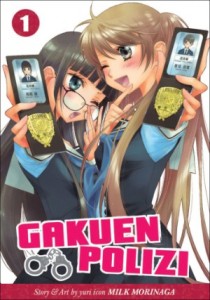
Gakuen Polizi, Vol. 1

By Milk Morinaga. Released in Japan by Futabasha, serialized in the magazine Comic High!. Released in North America by Seven Seas.

First off, this is clearly a series meant to be marketed to the same group that loved reading Girl Friends, and is touted as a top new yuri series. All I can say is, unless things progress a whole lot in Vol. 2, some folks might wonder what the fuss is all about. Midori occasionally blushes or wonders why she feels a need to connect with Aoba despite everything, Aoba sometimes reflects on her overly touchy-feely hijinx, but honestly, this is a high school comedy far more than it’s a yuri series. That said, everything ELSE people liked about Morinaga Milk’s manga is here – cute art, over the top characters reacting in funny ways, and a core of serious story underneath it.

gakuen1

Our hero is Aoba, a naive yet vibrant girl who grew up wanting to be a defender of justice and, since magical girls and sentai warriors are hard to come by in real life, has joined the police while still in high school to still defend what’s right. For her first assignment, however, she’s sent to a school that seemingly has no issues – the most that happens here is girls fighting over a diet. She runs into the seemingly stoic Midori, a stoic girl whose stoicness lasts about five seconds in the face of the overwhelmingness of Aoba. Midori has a tragic past where her partner was hurt because of her actions, and has been sent to this school to sit tight until she graduates (her dad is chief of police, so they can’t just fire her). Naturally, she’s a bit sour on justice, and wants nothing more but to sit quietly and draw her yaoi manga. Hands up, who thinks that’s going to happen?

There’s no real attempt to move these characters beyond their obvious stereotypes – Aoba in particular is cheerful, naive, acts before she thinks, mood swings wildly, etc. But that’s OK here, really, as this is a series where you want to watch Aoba do dumb stuff and slowly bring Midori out of her shell of tragic past. They’re supposed to be secret police – the school doesn’t acknowledge their jobs exist – which of course leads to Aoba whipping out her badge at the slightest provocation. It also allows the series to touch on the difficulties of reporting things to the *real* police – discussion of a train groper notes that since all the girls say the groper is a “ghost”, the cops wouldn’t do anything, and in a later story involving a stalker, Aoba feels that he got let off far too lightly. It’s noted that different officers respond to cases differently, and that’s certainly the case with our heroines.

By the end of this fist volume Midori seems to have taken it upon herself to ensure that Aoba maintains her idealistic demeanor, something that may be disrupted by the cliffhanger, which shows us that her old partner is returning to the school to reunite. (Please don’t be evil, please don’t be evil… she’s gonna be evil, isn’t she?) Gakuen Polizi is not going to win any awards for depth of yuri feelings. But it has more depth of character than I was expecting, and I hope its second volume continues to touch on how Aoba and Midori can bring out the best in each other as partners.