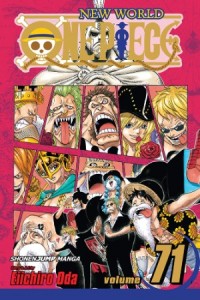
One Piece, Vol. 71

By Eiichiro Oda. Released in Japan by Shueisha, serialization ongoing in the magazine Weekly Shonen Jump. Released in North America by Viz.

One Piece may go beyond the typical shonen manga most of the time, but that doesn’t mean it’s above many of the standard cliches. Being a Jump Manga, it is firmly in the cliche of “Friendship, training, Victory”. Oda is not above fanservice for fanservice’s sake either, as we see in the Gulliver’s Travels parody with Robin and the Tontattas. That said, when you read this volume and realize that Oda is beginning a Tournament Arc, it’s somewhat surprising to see that he waited this long. Technically, I suppose the Davy Back Fight may count as well, but no one really thinks of that anymore except to remember Afro Luffy. This one is clearly in it for the long haul, with dozens of named contestants, many of whom look to actually be important so we will have to try to remember them. Oh dear.
op71

Most major arcs in One Piece start with a lot of stuff all happening at once, but Dressrosa’s arc manages to top that, as we’re also dealing with fallout from the last arc. Law is bringing Caesar Clown to Donflamingo for a hostage negotiation, and decides the best way to do this is for the Straw Hats to split up. Naturally, it takes about two seconds for everyone to go off and do their own thing, but hey, he tried. By the end of the volume Zoro is running through town with a Tontatta, getting lost as usual; Sanji has hooked up with a gorgeous woman who will no doubt take advantage of him but I suspect he doesn’t care; Franky is busy actually findning out about the plot and backstory needed for this arc (there’s something very odd about this being an Island of Toys, some of whom seem far too human); Nami, Chopper and brook are back on the ship having little to do (I hope more happens next time)…

And then we have the other two groups, who get the lion’s share of what’s going on. Law, Robin, Usopp and Caesar are headed for the rendezvous point, and increasingly are becoming aware this is a trap. They get split off even more when Usopp and Robin are captured by Tontattas, the One Piece version of Liliputians, who actually manage to achieve something major by forcing Robin to have pop-eyed reactions at their naivete. It’s still within the realm of human normal, but for Robin it’s the most emotive we’ve ever seen her, I think. As for Luffy, he’s disguised (poorly) as Lucy, a gladiator taking part in the tournament. As I said, we meet dozens of competitors (I suspect the gorgeous female fighter will be relevant later), but the most interesting is the return of one of Luffy’s earlier enemies. Remember that jerk that Luffy one-shot KO’d in Volume 25? Yes, Bellamy the Hyena is back, and he’s matured – Luffy even roots for him! He doesn’t win, but it’s always nice to see characters at least go from villainous to less villainous.

If there’s a drawback to this volume, it’s that there’s almost too much going on – I suspect I will enjoy it more when the arc is over and I can go back and find all the foreshadowing that I’m not picking up right now. But even a chaotic overcomplicated One Piece is still one of the best titles out there. Don’t stop yourself from picking this up.

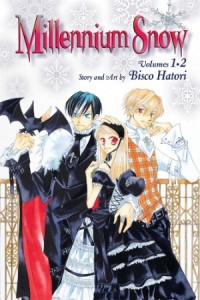
Millennium Snow, Vols. 1-3

By Bisco Hatori. Released in Japan by Hakusensha, serialized in the magazine LaLa DX. Released in North America by Viz Media.

This release of the third volume of Millennium Snow, along with an omnibus re-release of the first two volumes, gives us a unique glimpse into the world of manga publishing. Here we have a small series by an author which, halfway through, stopped for 10 years as suddenly a one-shot by the author blew up into a much MORE popular series (Ouran High School Host Club). After Ouran finished, the author returned to Millennium Snow, but brought with her ten extra years of talent and experience. What’s more, Viz has a similar arc – the first two volumes of this series came out seven years ago, but that was all there was until just last year, and it’s been long enough that they can’t rely on the buyer having the old volumes. So how does the older half of this supernatural shoujo series match up with the new volume?

millennium

Hatori admitted that she had a great deal of difficulty re-reading the old volumes to refamiliarize herself with the plot and characters, as she was taken aback by how poor it seemed to her now. I can see her point, though it’s certainly readable enough. The differences between the first chapter and one of the chapters in the third volume are startling. This can even be seen on the omnibus covers, as the three leads are drawn in a very sharp, angular style with wide mouths that is also typical of early Ouran, but which she gradually softened over the years. The cover to the third volume, with Toya lying on the ground being tortured and gorgeous, is far more mature – and also far prettier.

The changes don’t just limit themselves to the art, though. The first two volumes of this series are pretty good – I really love the heroine, Chiyuki, particularly after she recovers and starts to act like the energetic, snarky girl she’s always wanted to be. but you get the sense that Hatori wasn’t quite sure where she wanted to go with this series. Clearly it will end next volume with Toya and Chiyuki together for the next thousand years, as is fairly blatantly signposted from the start. However, the first half reads like a shoujo romance, with various young men coming into (or returning to) Chiyuki’s life to make things difficult for her and Toya. It’s told fairly well, but it’s pretty standard.

The third volumes switches gears, turning more towards an examination of Toya himself, as well as the supernatural world around him. Instead of potential boyfriends swarming around Chiyuki, we how have almost a yokai series, as Toya and Chiyuki investigate various supernatural events. Toya is also opening up his worldview, not just to Chiyuki but in general, and becoming less lonely as a result. It’s no coincidence that Satsuki, the werewolf boy who’s introduced as the main rival for Chiyuki in the early parts of the series, has a much smaller role in the third volume – there’s no real need for him to be there anymore.

Millennium Snow is a good read if you’re a fan of Hatori’s Host Club series, or like supernatural romances. But it’s also a great read because you see an artist return to a work she had to abandon for so long and not only pick up seamlessly where she left off, but raise it to a higher level. It’s not perfect (I just didn’t care for Yamimaru, whose cutesy accent didn’t help things), but it’s still above-average shoujo.

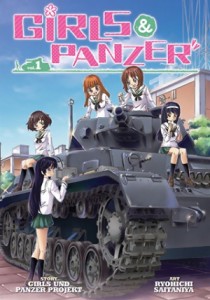
Girls Und Panzer, Vol. 1

By Girls Und Panzer Project and Ryohichi Saitaniya. Released in Japan by Media Factory, serialization ongoing in the magazine Comic Flapper. Released in North America by Seven Seas.

I wasn’t sure what to think of this title when I first saw it. It’s based off of an anime, though the fact that the story is by a ‘Prroject’ team clearly says they had multimedia franchise planned from the start. It’s also a moe manga about tanks, and I had assumed it would be similar to Strike Witches, a moe anime about fighter planes. This time, though, the girls are not anthropomorphic personifications, there’s no horribly gratuitous fanservice, and the cuteness actually welds itself into the story with no great effort. By the end of Volume 1, I was surprised to see how much I had enjoyed reading it.

panzer1

This is not to say that the premise is not inherently RIDICULOUS. In fact, its very ridiculousness was one of the things that appealed to me before I read it. It takes place in a world much like ours except that, similar to flower arranging and tea ceremony, tank driving is a feminine art that all proper young ladies must know. Our heroines form a tank team at their high school and engage in mock combats, all the while extolling the virtues of tanks. If you can’t buy into this premise, this is definitely not the manga for you. It’s also not shy about its fetishing of tanks – there’s minimal fanservice of the girls here, but that’s possibly due to the long, lingering shots of treads and turret guns we see here – for once, we may have a moe manga where the cute girls doing cute things is just a spice.

I understand that the anime follows Miho, the shy but determined girl who seems to have some sort of tragic tank backstory. In the manga, however, she’s more of the cool and awesome sempai of the group. The manga’s viewpoint character is Yukari, who likes tanks a WHOOOOOLE lot, to the point where she’s alienated all of her old classmates. Thus she is over the moon to be attending a school where she can gush about tanks and not be shunned (though the others do think she goes a bit overboard). Yukari is fun, a loud, energetic tank otaku who gets to react a lot, just what you like in a typical cute heroine. The rest of the main cast includes Saori, who is on the lookout for cute boyfriends; Hana, who is the yamato nadesico of the group, and Mako, who seems to be combining the emotionless stoic and the odd weirdo into one cast member. I like her best, probably.

As I said before, what I think I like most about this manga adaptation is that it doesn’t do what I expected (note: this is Volume 1. Future volumes may make me eat my words). There are no long nude bath scenes, no one is groping everyone else’s boobs, no one trips and falls over all the time. It’s just girls and tanks, and mock battles (with hopefully mock ammo – it’s never made clear how injury is avoided). More to the point, the fact that it’s not focusing on the obvious lead character – Miho – gives it a sort of off-kilter perspective I enjoyed quite a bit. It may become more cliched later on, but for now, if you like a gonzo premise, girls being pretty awesome, and don’t mind a lot of tank warfare, this is a title for you.