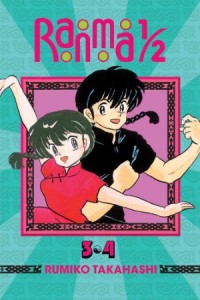
By Rumiko Takahashi. Released in Japan by Shogakukan, serialized in the magazine Shonen Sunday. Released in North America by Viz.
(Warning: This is Ranma 1/2 For Experts, basically – I do refer to future volumes a bit here, mostly the next one.)
As we get deeper into the Ranma 1/2 story, it’s starting to separate itself more and more from its predecessor, Urusei Yatsura. This despite adding two characters who are very much ‘based on’ similar UY characters in these two volumes. But while UY ran on escalation – take a situation, put people in it, and watch it expand till it explodes in comedic chaos – Ranma 1/2 almost seems driven by delusion. So many of the characters have a fixed idea of who someone is, what their goal is, or how people feel about them, and that fixed idea drives the comedy. So we have Kuno’s love for the ‘Pig-Tailed Girl’, Kodachi’s similar obsession with Ranma (and inability to tell that he and his girl side are the same person), Mikado’s ladykiller instincts, and even Ryouga’s delusion that all he has to do is defeat Ranma once and suddenly he’ll get Akane and be happy. Everyone in Ranma is deluded for the sake of comedy.
We start off with Kodachi, who we already know likes to win her matches by disabling her opponent before they begin. Akane isn’t so easily dispatched (in fact, it’s her own misstep that forces her out of the match), so Kodachi resorts to her backup plan – cheating her way through the entire match. Throughout, she bears a strong resemblance to Ryouko Mendou from UY, something that is helped along when we find out that Tatewaki Kuno is in fact her older brother. (Yes, yes, mix and match the romanji. Leave me my bad habits.) Kodachi likewise has a flair for the overdramatic. She’ll stick around, but is probably the least important of the major Ranma harem girls – and the only one who never gets a ‘softer side’, even once we find out about her family situation (we’ve got a few more omnibuses to go there).
Martial Arts Gymnastics in the Kodachi story is followed by Martial Arts Ice Skating with Mikado and Azusa, and I advise the reader to get used to “Martial Arts _______” throughout the entire Ranma series. It’s a useful way to incorporate any silly situation Takahashi wants into the series, and it also serves as an obvious motivator for Ranma, who can’t resist a fight and whose ego says that he’ll always win in any martial arts situation – even if he can’t skate.
Mikado and Azusa are the first ‘arc villains’ we have who won’t be returning, though I think the anime adaptation brought them back a few times. They’re a lot of fun, but there’s not much you can really do with them, and neither of them have either the likeability or over the top madness that tends to bring back the best of Ranma’s recurring characters. I was quite pleased to see that, though they perform as a couple, they don’t actually seem to like each other at all. Azusa (who is Ran in UY with the anger replaced by more cute) also seems to get away with most of the antics she inspires here. Mikado, who sexually assaults Ranma by “stealing her lips”, is a Grade-A creep, however, and he gets the majority of the violence dealt out here.
Ryouga still features heavily here, and his anger remains, but we’re also starting to see his swirling pool of depression, something that will come to define his character for a long time to come. Ryouga is at his strongest when his mood is blackest, but this means that we rarely get to see him be happy. It’s probably not helped that, throughout both of these arcs, Ranma and Akane are still looking quite couple-y. Sure, they grump sat each other, but that seems almost friendly now, and Ranma is quick to whip out the ‘my fiancee’ card. It’s really quite cute.
…and then Shampoo hits the series, literally smashing through a wall and attempting to kill Ranma’s female half. My old memories of this point in the series made me think that it was Shampoo who was a catalyst for what Ranma and Akane will eventually become after this, but to be honest she doesn’t really play all that big a part. Akane’s hair-trigger temper and jealousy just seem to increase naturally, and we see Ranma having to restore her memories later by firing a volley of insults at her, as if all he’s been doing is calling her uncute for the past 3 1/2 volumes. Which isn’t true, as we’ve seen, but it’s another canon rewrite as we read. Ranma and Akane will have their moments from now on, certainly, but there’s a certain tension between them after this arc. Ranma turns to insults more swiftly and loses his ‘I will observe first, then act’ persona. And Akane will distrust Ranma unless proven otherwise… and sometimes even then.
Back to Shampoo, and I will bring up Urusei Yatsura again, sorry. She is clearly meant to be Lum, only here Ranma and Akane have had some time together to make the readers like them, and Shampoo gets a lot fewer ‘cute and likeable’ points. Many have seen this as Takahashi trying to ‘fix’ UY, where she originally wanted Ataru and Shinobu as the couple, but fans and editors made her change it to Lum. The thing is, fans and editors were correct, and I’m sure she realized that very fast. Ataru was the sort of person who worked much better with Lum. But as I’ve noted, Ataru and Ranma are NOT all that alike, and thus the Ranma/Shampoo pairing feels as out of place as Ataru/Shinobu did. He needs someone like Akane, who brings out who he really is – for good and ill.
I was going to discuss Shampoo’s accent, and how it’s dealt with both in the original Japanese and in the English release, but it may be better to save that till Cologne and Mousse show up.
Some random observations… Tofu has already become a one-gag character, and it’s an annoying gag. Kasumi and Nabiki barely appear, though notably when they do they’re trying to fix things up between Ranma and Akane – Nabiki still doesn’t quite have that aura of ‘only out for myself’ she’ll gain later. I quite liked Ranma trying to explain that the tribe’s ‘rule’ that Shampoo had to marry the man who defeated her was ‘from the Stone age’ – he’s absolutely correct, though it does also point out how steeped in ancient traditions Shampoo’s tribe is. And yes, Formula 911 was Formula 119 in the Japanese, but they basically are the same gag – it’s the phone # for emergencies.
By the way, for all that Shampoo is supposedly trying to kill Ranma, she never even gets close. And notably, when she gives the ‘kiss of death’ to Akane, who she’s clearly a superior fighter to, she just wipes Akane’s memories rather than, as Ranma fears, leaving her corpse on the outside of the school. In other words, she doesn’t really look like she’s able to go through with actually killing anyone. We see that again at the end, where Ranma leaves herself open and Shampoo can’t do it – she leaves in tears. It’s a rare serious moment in Ranma 1/2, and sad, because we know that this is the end, and we’ll never see Shampoo again – as she states, and the others imply.
Next time we’ll cover Volumes 5 and 6, where we see Shampoo again. We also get a few more introductions, two major – Cologne and Mousse from Shampoo’s Amazon village – and one minor, Gosunkugi, who is so sad the anime actually wrote him out for several seasons. In the meantime, this was a very enjoyable Ranma volume, and I look forward to gushing more words at you some July.