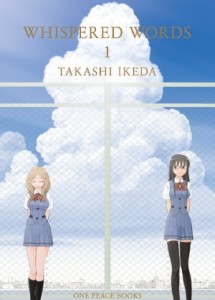
Whispered Words, Vol. 1

By Takashi Ikeda. Released in Japan in three separate volumes as “Sasameki Koto” by Media Factory, serialized in the magazine Comic Alive. Released in North America by One Peace Books.

This was one of those licenses I’d been waiting for for quite some time. Along with Aoi Hana, Sasameki Koto (released here as Whispered Words) was one of the big yuri manga of the last few years or so. It will seem quite familiar to those who read the genre. The tall, strong, dark-haired girl who does karate and her smaller, more feminine and gorgeous friend. Unrequited love out the wazoo. A cast of eccentric side characters there to help the main couple grow and change. And piles and piles of angst. Does it read well as an omnibus?
whispered1

Actually, I’d argue that the omnibus format was the best way for this series to succeed, as there are a lot of issues with it as it starts off. It’s clearly meant to be more comedic, with Sumika’s crush being portrayed as genuine but subordinate to getting her into awkward situations. More to the point, Ushio can be very hard to like in the first part of this series. And then there’s Akemiya, who’s nice enough, but whose plotline feels like it belongs in another manga, and whose sister is easily the most aggravating character in the series. Were this not an omnibus, I can see a lot of folks giving up after Vol. 2 (which is also where the anime ended, as it didn’t want to overtake the manga).

About halfway through the third section, though, you sense the manga starting to take a more serious and character driven turn. I suspect the writer might have ended things with the folk dance, but was told the series was popular enough to continue, and so started to think about how to take things in a deeper, more fulfilling direction. This starts off oddly, with the addition of Lotte, a tiny German foreign exchange student who idolizes Sumika. But it really points out Sumika’s issues with who she is, and how Ushio has been unthinkingly making those issues harder and harder to overcome. The emotional high point to this volume is really high – Ushio getting upset at Sumika for allowing Lotte to push herself too hard in karate training, and Sumika just losing it and screaming how Lotte likes her for being big and strong – unlike Ushio, the subtext says.

And Ushio gets this, to be fair. A lot of the setup of Whispered Words is of a somewhat shallow, ditzy girl who gloms onto anything cute. A flashback at the end shows that this is pretty much a mask, and Ushio, caring for Sumika after running outside in the rain makes her get a cold (never let it be said this manga doesn’t use manga cliches 100%), starts to wonder what her feelings for her best friend are really like. Is this going to be the moment when the two of them finally get together?

Highly unlikely, we’ve got 6 more volumes (2 more omnibuses) to go. In the meantime, this is a decently translated volume with good reproduction. Sadly, the publisher is tiny, and apparently their budget could not stretch to a copy editor, as there are some bad, BAD typos. They will make you cringe. But I hope that doesn’t stop you from getting this series. The tone is changing to a more serious work by the end of this first omnibus, and I hope that it continues along those lines and we continue to see Sumika and Ushio suffer for their love (in a good way, of course.)

Also, this manga has Kyori, who is perfect. That is all.

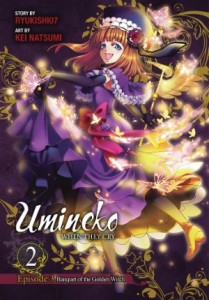
Umineko: When They Cry, Vol. 6

Story by Ryukishi07; Art by Kei Natsumi. Released in Japan in two and 1/2 separate volumes as “Umineko no Naku Koro ni: Banquet of the Golden Witch” by Square Enix, serialized in the magazine Gangan Joker. Released in North America by Yen Press.

In general, I find that the Umineko manga does a bang-up job of adapting the original source. It can’t possibly have all the verbiage that the visual novels have, but it usually manages to include all the important points (something the anime adaptation was very good at avoiding), and it plays fair with the reader in regards to the mystery (something the anime didn’t even bother to try). Where the manga can truly stand up is when it dramatizes those moments in the VN where you really wish you could see more than just sprites on a screen, where you want some action and heartbreak.

umineko6

Say what you will about Kei Natsumi’s love of exaggerated faces twisted to the extreme (Beatrice and Virgilia in the Golden Land comes to mind), she’s very good at laying out a page. There are lots of two-page spreads here designed to rivet the reader and keep them on the edge of their seats, the best of which is the moment when the fourth wall shatters. The last few Umineko ‘worlds’ have involved a meta world where Battler and Beatrice debate how things are being carried out while, on the island, the murders actually occur. The same thing is going on here, only Eva-Beatrice has ‘hijacked’ Beatrice’s game and is going around merrily torturing everyone.

Beatrice, at a low ebb after being yelled at by Battler for being uncaring and cruel, has been doing her best to stop the worst of these excesses, and when that fails she just straight up helps George and Jessica get a final moment with their loved ones, even at the cost of her life. It’s quite a character building moment for the Endless Witch, and Battler knows it. (Most of the shipping that exists in fandom started with this arc.) So, in the meta world, Beatrice asks if she’s redeemed herself enough to be Battler’s opponent. He notes she has, but that he’s not her opponent in this case… then reaches out, smashes into the island world, and grabs Eva-Beatrice by the scruff of her neck and drags her to him. It is *the* most badass moment in this volume, and beautifully handled.

(By the way, for those who enjoy being spoiled, Page 516 makes it clear that Kei Natsumi knows what’s really going on.)

Meanwhile, it becomes clear through most of this volume that Eva-Beatrice = Eva Ushiromiya, using the ‘witch’ identity to help commit murder. Why? DID YOU SEE ALL THAT GOLD? Some fans have trouble with ‘all that money’ as a motivating factor, to them, I recommend Higurashi, which is a lot more idealistic than this series. That said, some of the murders clearly are NOT the work of Eva, as her witch self points out to Battler – Eva couldn’t have killed Nanjo. In fact, none of them could have. So who did? Beatrice? Well, if Eva-Beatrice was Eva, then who is our Beatrice?

In the end, Battler (though he has improved greatly in his analysis) can’t get past this, and Beatrice sacrifices herself in order to stop Eva-Beatrice from winning the game. Thus they both end up in the Golden Land, which is essentially heaven. And it really points out all the difficulties with an idealized heaven that many people have if they look at it closely. In particular, Natsuhi and Eva hugging each other while despairing over their offspring marrying the servants is so horribly WRONG in every way you almost recoil at the change in their personalities. And sure enough, the Golden Land *is* false, a trap designed to make Battler accept witches. (How much Beatrice actually wants to go through with this trap is perhaps apparent in her faces right before she starts to cackle, which show someone desperately sad.)

Luckily, we have Ange coming to the rescue. Ignored in other arcs because she stayed home with a cold, almost forgotten by readers, Ange is older now and ready to kick Battler’s ass. And Beatrice’s as well, but most of this seems driven by a sense of jealousy and being left behind, which makes perfect sense. We do see the Ange of 1998 interacting with a dying Eva (who survived!), and she is at a point where she is the perfect pawn for Bernkastel to bring in to stop Beatrice. Of course, one wonders how much Bern is on anyone’s side…

By the end of this volume, I think even the most unspoiled should have a pretty good idea about the concept of Beatrice, if not the actual identity. And, just as Higurashi abandoned Keiichi in its 4th arc to focus on a new protagonist, so Umineko does the same, with Ange driving much of the next arc. Of course, that arc brings us full circle. At the start of this review, I raved about what a great manga adaptation can add to the source. With Alliance of the Golden Witch, we’ll find out what happens when a manga adaptation adds things you REALLY don’t want added to the source.

Dorohedoro, Vol. 12

By Q Hayashida. Released in Japan by Shogakukan, serialization ongoing in the magazine Ikki. Released in North America by Viz.

This volume of Dorohedoro is particularly good at showing off all the myriad reasons why it’s become one of the more addicting seinen manga out there. There are some amazingly violent fight scenes, some hysterical humor, a dose of complete insane weirdness, and some truly visceral horror – and not body horror this time around. I had wondered at first how long the series could keep its premise up, now I worry that with the series ending in Japan soon it won’t have time to tell me everything that I need to know.

dorohedoro12

Let’s start with the violence, which spirals out after En’s death. And En definitely appears to be dead this time, though there’s a suggestion they can reverse it if they find Judas’ Ear, who is missing. En’s people are somewhat gutted by this – even Noi, who notes that she hated En for forcing her into all of this, but still feels at a loss. As for Fujita, he’s absolutely devastated, having flashbacks and trauma from finding the body. Luckily, Shin knows that everything will be solved by finding the parties responsible and killing them. Finding the cross-eyes is the next step, and killing them mostly goes well, at least until the climax. Hayashida knows just how to choreograph fights, and also that her audience does not mind seeing splattered limbs.

Her audience also wants a healthy does of humor and weirdness, both of which dovetail nicely with the creation of a living En doll to try to lead them to the location of the real En, assuming he is alive. This involves baking a giant pizza, out of which the doll En them rises. If you can’t quite understand what I’m talking about, that’s because it makes no sense unless you see it. Any time Turkey appears things are odd, but this one takes the biscuit. We then get a very amusing chase scene, as the Doll En has a mind of its own and is not interested in letting Shin and Noi keep up with it. If you combine this with the ongoing humiliation of Natsuki (involving nudity this time, natch), we’ve got a lot of laughs in here.

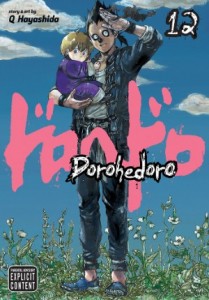
But what I suspect folks will take away from this volume is the flashback that explains Nikaido’s past, who she’s so reluctant to do magic, and the horrors of time travel. Some lessons, particularly when you’re a child, need to be learned firsthand, and this is a particularly horrifying and bitter one for Nikaido, whose friend is lost forever thanks to her own folly about time magic. It contrasts with the cover art with Asu and a child Nikaido, with a blue sky and blooming flowers belie the serious contents within.

And so, in the end, we have something for everyone, a little bit of plot advancement, a lot of weird humor, and some terrifying existential terror. In other words, all the reasons to read Dorohedoro, encapsulated in one book. At least until the next volume, when I assume we’ll find more. We even see the gyoza fairy again!