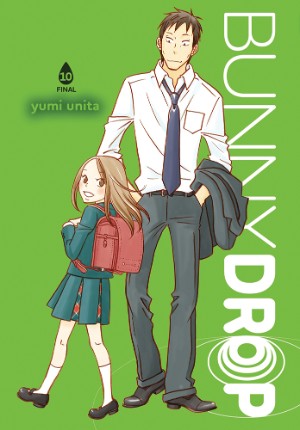
Bunny Drop, Vol. 10

By Yumi Unita. Released in Japan as “Usagi Drop” by Shodensha, serialized in the magazine Feel Young. Released in North America by Yen Press.

Yen Press very helpfully published an interview with Yumi Unita at the end of this final volume of Bunny Drop. In it she states that she had planned what happened in Bunny Drop from the start, and that she wanted to contrast it with the manga she was writing for rival publisher Takeshobo, Yoningurashi. A quick Google search led me to learn that Yoningurashi, aka The Four of Us, was a series about a couple raising two young children. And suddenly a lot of what happened in Bunny Drop makes more sense. Or more accurately, what didn’t happen.
bunnydrop10

See, I had expectations when I started reading Bunny Drop, before *those* spoilers came out. I expected what we got for the first four volumes, aka Daikichi’s learning how to be a parent and raising Rin in adorably heartwarming ways. But I also expected that he’d end up hooking up with Kouki’s mother, and that they’d raise Rin and Kouski as a family. Sure, I expected Rin and Kouki to hook up later in life, but honestly, I’ve been reading about ‘but we’re not really siblings’ love since the days of Marmalade Boy, so it didn’t really bother me.

Of course, we did not get that. Instead, Unita contrasted Bunny Drop with her other series by subverting every expectation we had. And I’ve got to hand it to her, it certainly worked, though in the end I’m still left with a feeling of massive frustration. This is not helped by the stories in this last volume, which go back and fill in some blanks from earlier in Rin’s life. We see heartwarming and amusing parenting as Daikichi tries to explain ‘why we don’t always kill bugs’ to young Rin. We get a tortuous ship teasing scene between Daikichi and Kouki’s mother after Kouki gets in an accident and Daikichi has to take care of things, where by the end you are screaming at the two of them to just kiss already. (Spoilers: they don’t.) We get some backstory explaining how Rin’s mother ended up with her manga assistant/lover, and how Kouki fell into delinquency (and then out of it) in middle school. Honestly, they’re all well-written and pretty fun.

And then we get a final story showing Rin and Daikichi, who have now been a couple for several months. And really, seriously, nothing has changed. I approve of Unita not showing us their sex life, but honestly without that you’re left wondering why any of this happened at all. (Things are not helped by adding a girl who not only Kouki but also the reader had forgotten, and seeing about hooking him up with her at the VERY last minute.) Unita noted that she tried to avoid Rin’s inner monologue in the ‘pre-timeskip’ period, and avoid Daikichi’s afterwards, but honestly all this has done is made us wonder about how any of this came about, particularly with Daikichi, whose love for Rin and desire to let her do this seems to come down to ‘well, OK, I guess.’

So in the end I liked individual parts of this story, but am very dissatisfied with how it came together as a whole. Particularly as there was a story that was being made really obvious and heartwarming that wasn’t told here. Now, part of that may be me as a reader projecting out on what wasn’t really intended, but given the general negative reception Bunny Drop has had post-timeskip, I don’t really think it’s just me. I’d suggest someone write some fixfics, but I’m not sure the series has enough of a fandom. In the end, Bunny Drop was an interesting, fascinating, and uniquely annoying series that amazingly I still think is worth reading anyway, provided your dentist doesn’t mind the loss of enamel you’ll have from grinding your teeth.


Sword Art Online, Vol. 1

By Reki Kawahara and abec. Released in Japan by ASCII Mediaworks. Released in North America by Yen Press.

So I greatly enjoyed the manga omnibus of Sword Art Online, and said so in my earlier review. However, I had not actually read the novels or seen the anime, as I noted. Most folks who had said the manga was rushed and poorly paced. So I looked forward to reading the first Aincrad novel, and wondered how it would handle things and what new feelings I would get out of it.

saonovel1

The most obvious is that this is written in first person from the POV of our hero, Kirito. This is very common in Japanese novels, with Haruhi Suzumiya being another obvious example. It works particularly well with Kirito as he’s normally an aloof character to begin with, so this allows us to see how he frames things and deals with people. Kirito and Asuna are not Mary Sues (I’m trying to avoid using that term at all these days), but I will agree they are both hypercompetent to a degree that may annoy some readers who are used to modern-day flawed heroes. I grew up reading Heinlein, so this sort of characterization is no problem for me. Besides, Kirito’s narration shows he has a bit of PTSD after being in the game and dealing with his first guild, so it’s not all ‘showing off his awesomeness’ here.

Another thing that’s added is the description of the game world and gaming functionality itself. I’m not much of a gamer, so feared this would bore me, but it’s handled smoothly and fluidly, showing off how things work in Aincrad without seeming out of place – indeed, the book begins with Kirito giving Klein a tutorial. There’s discussion of eating and sleeping (necessary) and using the bathroom (not necessary), as well as those pesky ethics codes that can be turned off when you want to spend the night with the one you love. (By the way, the fact that these are on to begin with, and send out an alarm for sexual harassment, pleases me greatly, especially given the large male-to-female imbalance the game shows.)

Asuna doesn’t get any POV narration, but she’s expanded on as well. For one thing, it’s made quite apparent from the moment we meet her that she’s fallen for Kirito, and it only gets stronger the more they interact. I’ve been told that as the SAO novels go on, Kirito gains more women who fall for him (including his sister… oh, Japan…), but I’m not sure how far they’ll get, as Asuna is not the typical “Baka, who ever said that I loved you?” heroine, and seems very proactive and comfortable in her feelings for Kirito, even if actual physical intimacy makes her as nervous as we’d expect for a 17-year-old. Oh yes, I read the ‘Chapter 16.5′ that was removed from the series’ original web format when Japan made it into a physical book series (it’s not hard to track down). It’s not missed, the sex scenes weren’t well-written, but I did appreciate a discussion of the fact that a lot of gamers are underage (Kirito was 14 when the series began, and is 16 now), and how ‘removing the ethics setting’ would lead to a lot of problems down the road…

This volume ended sooner than I expected, but then I found that Vol. 2 will go back and fill in some blanks in Aincrad, including that Yui story I saw from the manga, before it moves on to Kirito and Asuna meeting up in the real world (we hope). I greatly look forward to it, this is still a terrific series, with a refreshingly non-ambiguous lead couple.

Higurashi: When They Cry, Vol. 25

Story by Ryukishi07; Art by Karin Suzuragi. Released in Japan as “Higurashi no Naku Koro ni: Matsuribayashi-hen” by Square Enix, serialized in the magazine Gangan Joker. Released in North America by Yen Press.

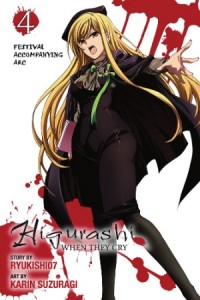
As I review this final volume of the main Higurashi series, it’s worth noting something: Ryukishi07 really, REALLY loves his shonen cliches. It’s something I’m sure I’ve said before, but to properly enjoy this volume you really have to buy into the fact that it is going to be totally ridiculous. A majority of this volume is a counterintelligence task force from Tokyo getting their asses kicked by a group of 12-17 year old teenagers.

higurashi25

The manga actually tones down the original source a bit – Mion brags about her leadership skills briefly, but the narration praising her to the skies is mercifully cut. Even so, the physical battle between her and Okonogi (who has elf ears just so you know he’s EVIL) should spell out how this has become an action movie. Everyone gets to do their thing – Keiichi beats up soldiers with his bat, Rena pounds ‘adowable’ guys with cute kitty buckets stuck to their heads, Satoko deals out horrible traps to Amakusa from Umineko’s manga (making a brief cameo here, possibly to remind us not to trust him in the other series) and Rika, her future finally secured, gets to pat people on the head.

There’s another team sent to deal with the clinic – they’re there to rescue Tomitake and move the comatose Satoshi somewhere else. Shion, by the way, does NOT get to be awesomely shonen like everyone else – possibly as repentance from her former villain status, she runs off half-cocked and gets captured. But then, she’s just found out that Satoshi is alive, and is not in the best of mindsets. I did like Rika forgiving her – in our eyes for the events of the Eye Opening Arc, but to Shion more of a general ‘you are a good person after all’ forgiveness.

Of course, there’s still Takano to deal with, but we’ve spent 6 volumes showing how she’s not so much an evil villain as a horribly broken PTSD-afflicted tragic villain. The scene at the start with Tomitake is one of the best in the book, where she says that after all this is over she’ll return to the orphanage to die – i.e., kill herself. Even more lucid Takano knows she’ll be killed once her usefulness is over. And she’s absolutely correct, as Okonogi, whose team is working for Nomura and not her, gives her a gun to blow her brains out with.

But she doesn’t want to die, so instead runs off to have a final confrontation with Hanyuu, who is her mirror in many ways – especially spelled out in this final scene, where Hanyuu also notes that after all this is over she plans to die, or at least return to her incorporeal state. It’s Rika who, pulling one last deus ex machina from her deck, stops time and stops the bullet Takano fires from hitting anyone. (She shows off the bullet afterwards, and it seems totally ridiculous, but I wonder if Rika simply grabbed a bullet casing and is using narrative structure to bend reality to her story? But that way lies Umineko…)

So in the end everyone lives, and we get a long epilogue showing the happy endings. Rika planning for her first post-June 1983 days. Mion mildly preparing for college, but still stuck on Keiichi and unable to get past his denseness. Rena in the same boat, but happier about it. Satoko learning cooking and awaiting her missing brother, Shion reading to him in hopes he’ll wake up. Even Takano, recovering in the clinic from Hinamizawa Syndrome, isn’t condemned, and Hanyuu wonders if she’ll be up and about telling everyone scary stories before long. (Optimistic, I suspect, Hanyuu. Have you discussed this with Rika?)

Two odd discordant notes in the happily ever after, by the way. Firt, we get the report done with the Tokyo Government, with edits by Nomura. She gets away with everything 100% here, and Ryukishi07 admitted in interviews that this was on purpose, as he wanted to show that not everything gets wrapped up in a big bow (likely why Satoshi doesn’t wake up either.) Second, we get the odd epilogue where an adult Rika meets a child Miyoko Tanashi, on the morning her parents are killed, and manipulates her into going with them. History is changed, though, and no one dies in the crash. No more Miyo Takano… which means many, many things change in the future. Where could this be leading?

If we see the Dice-Killing Arc, we may find out. In the meantime, this is an excellent (if at times ridiculous) conclusion to a series that proved to be far more than just “Lol killer lolis”, as I expected from opinions from anime fans. I really came to adore the franchise, and have since read the sound novels it was based on, and urge everyone to do the same (it’s out in English via Mangagamer, though beware when you buy – it’s their one non-porn title.) And if you enjoy Ryukishi07’s writing, there’s still more Umineko to go!