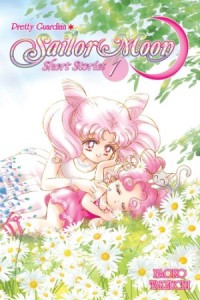
Pretty Guardian Sailor Moon Short Stories, Vol. 1

By Naoko Takeuchi. Released in Japan as “Bishoujo Senshi Sailor Moon” by Kodansha, serialized in the magazine Run Run. Released in North America by Kodansha Comics.

There’s an important thing to keep in mind when reading this first of two collections of short stories that were interspersed throughout the series’ run: they didn’t run in Nakayoshi. They ran in a sister magazine, run Run, which was also home to Sailor V. Run Run no longer exists today, but I seem to recall when it was around that its core audience was girls about 2-3 years younger than the usual Nakayoshi audience. And that’s not even getting into the fact that these are quick side-stories Naoko dashed off in between chapters, so are naturally going to be a bit more comedic and fluffy than the core plotline.
sailormoonss1

If all of this sounds a bit defensive, well, let’s just say that ‘light and frothy’ doesn’t begin to describe this volume of Sailor Moon extras, most of which are very silly and not exactly lending themselves to deeper analysis. Four of the stories star Chibi-Usa and her friends (with occasional rescues from Sailors Moon and V), while three others detail the struggles of the Inners to pass high school exams. The first one is around the R continuity (Chibi-Usa has just arrived, and is meeting her very busty friend Momo… Ranma fans will immediately be reminded of Shampoo), but most of the stories take place around the SuperS continuity – indeed, a few of them were adapted into the SuperS anime – with the final one seeming to be around Stars, given it has Hotaru.

This is not to say I did not 100% enjoy these stories, as I did. I like Naoko’s style of blatant humor, and she has a knack for amusing caricature faces. The Chibi-Usa stories at the beginning are pure fun for kids, with the kids getting into danger and having to transform to get themselves out of it. The story at the end is slightly longer and attempts to have more depth, but there’s only so far you can go when you find out that Naru’s sister is not only a kogal but is also named Naruru. It’s good to know that Japan has horrible naming sense as well. (Also, kudos to Mari Morimoto for the translation of this chapter, which was filled with topical Japanese slang that Chibi-Usa and Hotaru pointed out and lampshaded throughout, thus making it virtually unadaptable. A very nice job.)

My favorite part of the book, I will admit, are the three stories focusing on the Inners. Makoto’s is probably the weakest, but we do get some amusing scenes of her procrastination through cooking and housework, and also hear about her late parents for what may be the only time in the manga OR anime canon. (They’re killed in a plane crash when Makoto was a little girl, which is used here as both an amusing gag and to have Mako gain sympathy points from her friends.) Ami’s First Love is probably the best written of the three, and it’s no surprise that the anime adapted this into a short film for theaters. Ami can be very tightly wound, so seeing her coming unglued at finding a student who’s just as perfect in studying as she is is hilarious, particularly when she gets so upset by this she seems to make herself ill.

And then there’s Rei and Minako. I’ve discussed how much I love this chapter before, silly as it is, and that hasn’t changed. The manga version of Rei – cool, collection, a bit ‘ice queen’ – is in such contrast to Minako’s extrovert that it makes sense that she’d want to see what Rei’s life at school is like – and yes, she’d want to ask if Rei farted. I think that Minako regards Rei as a bit too perfect, and this is just her own tactless way of trying to reassure herself that Rei is human after all. Of course, all that her visit to Rei’s perfect Catholic school ends up doing is tweaking Minako’s own insecurities – and that leads to Rei seeming genuinely upset at Minako getting angry, showing she *isn’t* the perfect ice princess. Rei is likely very lonely at that school where she only has admirers, and just can’t express her friendships in the way that Minako wants her to. Still, they manage to bond by… well, Rei being possessed and trying to kiss Minako. And afterwards being crankier than ever. But Minako’s feeling good again, and that’s what’s important. Bless these children.

So if the Sailor Moon series was a full-course meal, then this is dessert. Don’t go into it expecting anything more than delicious sweets that are easy on the eyes but not all that good for you, and you should be fine. Also, Rei has never farted. She is better than all of us.

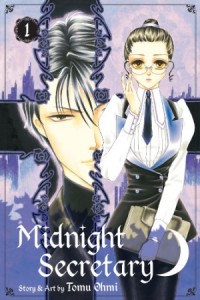
Midnight Secretary, Vol. 1

By Tomu Ohmi. Released in Japan by Shogakukan, serialized in the magazine Petit Comic. Released in North America by Viz.

I often joke when discussing licenses that the thing most companies tend to look for is “does this manga have vampires in it? And are they hot??”. But of course in general there has to be more substance to it than that. We need smart, compelling characters, we need some intriguing backstory, and of course we do need some nice seductive romance. With Midnight Secretary we get two out of the three, and I suspect the intriguing backstory will come in future volumes as this develops more of a plot.

midnightsecretary1

Kaya is a young woman living with her mother who is highly skilled but has one big problem (at least it’s a problem to her): she has a face that makes her look far too young. So, in order to get the secretarial work that she’s so good at, she does her hair up in a tight bun and wears glasses, looking very much like the cliche of what we think good secretaries should be. Like most Petit Comic heroines I’ve read about, her family has fallen on hard times, and her father has passed away from being incompetent… um, from stress. Luckily, she has a new job as secretary to the company director. Unluckily, he’s a womanizer, arrogant, and unimpressed with her looks. Oh yes, and he’s a vampire.

I am pleased that we get the reveal to this right off the bat, and that, after a bit of soul searching (and some blackmail on Kyohei’s part) she manages to file “vampire” under “things I have to manage in my boss’ day”. Indeed, Kaya takes her job very seriously indeed, and once she accepts what Kyohei is, she’s quick to research everything about vampires (most of which, amusingly, is wrong) and try to deal with the issues. And yes, sometimes that involves his sucking her blood, but only in emergencies. And it’s totally not one of the most erotic experiences she’s ever had, nope.

Kyohei’s brother is the executive director, and Kaya notes he isn’t a vampire, something I was prepared to have be wrong but no, it appears that is the case. It’s amusing to me that most of the drama in this fist volume comes less from Kyohei’s vampiric tendencies and more from the corporate intrigue. Kaya is far more valuable to him for her smarts and her spying ability than as a free meal ticket. Of course, he does eventually get her hair down and glasses off, and we start to see the smoldering passion that will no doubt justify this series’ 7-volume length. Indeed, by the end of Vol. 1 Kyohei is finding that other women’s blood just doesn’t do it for him, and he adds ‘blood for me’ to the endless list of Kaya’s tasks.

This is a fun series, with a more capable heroine than I’m used to seeing in this type of title. I wonder if we’ll get more of Kyohei’s vampire backstory as the series goes on, or if it will stick to corporate intrigue. And of course how these two will fall deeper in love. It’s another spicy romantic josei series from Shojo Beat. Fans of romance and the supernatural will snap it up.

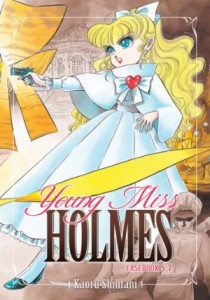
Young Miss Holmes, Casebook 5-7

By Kaoru Shintani. Released in Japan as “Christie High Tension” by Media Factory, serialized in the magazine Comic Flapper. Released in North America by Seven Seas.

The Young Miss Holmes series wraps up here with an omnibus of the final three volumes, and also takes a departure from canon, as only the first story, “The Adventure of the Solitary Cyclist”, is a Watson story published by Conan Doyle. That said, some of the titles of the remaining stories here may be familiar with Holmes and Watson, particularly the “Canary Trainer” mentioned in “The Adventure of Black Peter”, and the infamous “Giant Rat of Sumatra”, mentioned in the “Adventure of the Sussex Vampire” story. Shintani makes a decent effort at leaving the Holmes canon, and it allows him to do a bit more with Christie than simple sleuthing, particularly in the finale, which is basically an action movie with very little detecting.

ymh3

The canonical Holmes story, Solitary Cyclist, does a decent job of having Christie and Sherlock join forces. Violet Smith is an old friend of Grace, Christie’s governess. Christie herself is chomping at the bit to become more independent, while still retaining a childlike air (particularly in the Circus chapters). That said, she’s not only more mature than most girls her age but far more modern, discussing how she has no desire to be a young lady the way the Victorians see them, and is already taking her savings and starting a pension plan to allow her servants to retire happily. It’s a good way to try to drag Holmes into the 21st century a bit, while still maintaining the charm of the original. (That said, I could have done without the appearance of Queen Victoria herself, in the weakest part of the book.)

The book is not faultless, of course. There is less nudity and gore than the first two omnibuses, but there’s still lots of corpses for an All-Ages rating, and Comic Flapper and Shintani still seem to sexualize Christie more than is necessary on a few title pages. The use of ‘moneylenders’ once or twice comes with some Victorian stereotypes, although it’s not really bad unless you’re looking for it. (Indeed, most of the villains here suffer from “I am ugly and therefore a villain” disease, which is quite common in comics and manga alike.) “The Dying Message” and “The Flying Dancer” aren’t too bad, but are weaker than the other stories we see here.

The Canary Trainer story is easily the creepiest of the book, featuring murder, suicide, child slavery, hypnotic suggestion, and child prostitution. It also merges Christie and Holmes the best of the five stories seen here, as they start out pursuing two totally different cases that only turn out to be the same thing right near the end. However, in a shocking display of canon ignorance, Shintani may have drawn Mycroft Holmes as slim. Luckily, there’s an out: everyone who says “that must have been Mycroft” didn’t actually see him. Perhaps it was Sherringford. Let’s go with that.

Things come to a head with the 7th volume/last third of the book, The Giant Rat of Sumatra. This helps to avoid the stereotype of “foreign villains” by sending a troup of good guys from India to help protect Christie from the thuggee bad guys. They are, of course, led by a young woman who is basically the Indian version of Christie, complete with tomboy mannerisms and snarky retainers. She’s good in a fight, however, which is a bonus, as Christie decides to simply go to ground in her mansion and let the villains come to her. Which they do, in one big final conflagration.

The series ends with the return of Christie’s parents, which marks a good stopping point – I’m sure they won’t totally stop her getting into adventures, but no doubt she will have to slow down a little. Shintani is currently writing a sequel, Christie London Massive, featuring a 17-year-old Christie, a whole new cadre of battle maids (led by Nora, no fear, she’s still there), and perhaps a familiar adversary of Sherlock Holmes thrown into the mix. Of course, that’s Japan. Whether it comes out here or not depends on how well the print and E-Book versions do. I had a ball reading them, particularly as a Holmes fan, and definitely recommend picking up the whole series.

Also, there is a dodo. For some reason.