Higurashi: When They Cry, Vol. 21

Story by Ryukishi07; Art by Hinase Momoyama. Released in Japan as “Higurashi no Naku Koro ni: Minagoroshi-hen” by Square Enix, serialized in the magazine GFantasy. Released in North America by Yen Press.

And so we come to the end of the penultimate Higurashi arc, and – no surprise here – everyone is dead. And I do mean everyone, as this volume, having finally given away most of the secrets, goes into great detail how the “disaster” that wipes out the village actually occurs. Things are not particularly improved by Takano, who is waving her arms around during all this as if she’s a conductor, and has a final face that is perhaps the template for all “crazy Higurashi faces”. But let’s jump back a bit and see how we got here.
massacre3

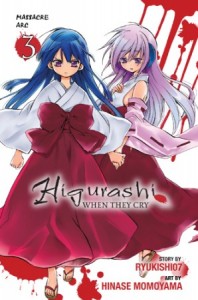
Rika and Hanyuu both feature on Yen’s chosen omnibus cover art (sorry, Takano, you just aren’t cute enough), with Rika having a resolved, determined face and Hanyuu looking depressed and dead inside. Most of this volume is showing us how Rika gets that determined, as getting the news about Tomitake’s death just seems to take all the fight out of her. Especially when she hears Oishii’s theories about who did it. A lot of fans have gotten on Rika’s case about being unable to figure out the killer, who seems really obvious in retrospect, and that she should have pieced it together after so many worlds in a row. Of course, as we see here, this is the first world where she’s not drugged up at the time of her execution. More to the point, she may have a hundred worlds of experience, but they’re the experience of a girl who only gets to about 12 years old. Rika has years, but not maturity, and it shows clearly here, when she resolves to hide everything from her friends so they don’t get killed.

That’s hardly going to work, however, given what happened with Satoko just a few days ago. Indeed, Satoko points this out to Rika directly, and Keiichi and the others make it clear that they’re not going to sit there and let Rika be sacrificed. We even have Rika quoting one of Bernkastel’s poems – usually reserved for the start and end of each arc, and indeed we get one at the end as well – which talks about who has a right to happiness. It’s easy to stand up against someone when it’s for the sake of others. When you do it for yourself, it can seem selfish, especially if it will put your friends in danger. Rika has to break through that barrier before she can accomplish anything.

We are – finally! – starting to get answers here, and indeed most of the pieces are together now. Not only is Takano the villain, but so are the “Wild Dog” bodyguards, who have always resembled a militia a bit too much for my taste. (I like how they are mook enough to have Keiichi and company take them out in order to rescue Rika, but not actually mook enough to have that last more than a few minutes – in the end, the kids lose.) And Hinamizawa Syndrome, the disease that causes the paranoia and killing impulses, is explained as well. This leads to why Rika keeps getting ritually slaughtered on an altar – Takano has gone mad and believes that if she kills the Queen Carrier, she’ll gain godlike powers.

And then there’s Hanyuu. We still don’t know much about her. She’s the incarnation of Oyashiro-sama, but strangely powerless, except for her ability to reset the worlds. She’s also even more worn down than Rika, and is also terrified that if she loses Rika this time she’ll be alone again… as she was for about a thousand years. Rena calls her out on this, as she too has the reoccurring theme of the Massacre arc – fighting back hurts too many people, it’s best not to have any hope. We’ve just proven how wrong this is, even if it did end badly. What’s more, we don’t really have much background on why the hell Takano is doing this, aside from “She’s insane”.

Luckily, we have one more arc – the longest yet, 8 volumes/4 omnibuses! – that should tell us about them, and will hopefully finally give us something that the characters and readers truly deserve after all this tragedy – a happy ending. Stay tuned for Vol. 1 of the awkwardly titled “Festival Accompanying” arc, where we meet a young girl named Miyoko Tanashi, and find out what makes her tick.

Pretty Guardian Sailor Moon, Vol. 10

By Naoko Takeuchi. Released in Japan as “Bishoujo Senshi Sailor Moon” by Kodansha, serialized in the magazine Nakayoshi. Released in North America by Kodansha Comics.

In the last volume of Sailor Moon, we had chapters each devoted to the development of a senshi, be it Mercury, Mars, Jupiter, Venus, or the Outers. That having been done, it’s time for an action-packed climax to the SuperS arc. Now, this can also be a drawback. Takeuchi’s battles do tend to have a certain sameness to them, and in many ways this is just another variation on “our light is purer than your dark”. So with that in mind, let me talk about all the other things that I loved about this volume.

sailormoon10

First of all, the entire arc has been a look at the dreams and nightmares of the world, with the Dark Moon Circus dealing out both with impunity. We’re definitely on the nightmare end of the scale for this volume, with many grotesque, horrific images that look even better in Takuuchi’s long-limbed shoujo style. Seeing Usagi’s face melting off was what caused me to buy a copy of the manga in my comic store years ago (this was an older Japanese tankobon, I think), and it hits Venus and the rest of the senshi right where they live – the Princess is dead, they failed to protect her. (A flashback showing the very Sleeping Beauty-esque appearance of Nehelenia in the Silver Millennium only reinforces that – also, Venus and the others as chibi-Senshi are adorable.) Usagi, meanwhile, is caught in what seems an idealistic dream – she and Mamoru are the same age, and he makes her breakfast before they go to school together. But she immediately starts to see through it, even if regretfully – Mamoru was never that sicky sweet. It’s a childish Usagi dream, and she’s moved beyond that.

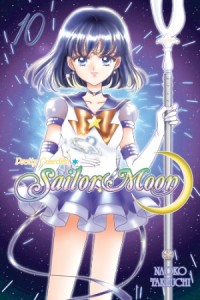
The other senshi mostly get to stand around and gape, but there are occasional moments of awesome. Venus and Uranus are the clear team leaders of their respective groups, and there’s a brief moment where we see they don’t really get along. We also see a magic mirror that needs to be broken, and after senshi attacks fail to do the job Jupiter goes with her Plan A – punch it really hard. (Who needs superpowers when you have MONSTER STRENGTH?) But the big winner here is Saturn, who is back, is around Chibi-Usa’s age, and is clearly the most savvy of the entire group – so much so that she and Chibi-Moon actually have to be banished from the plot for half the book (in another really creepy and well-drawn sequence where they’re imprisoned in shards of mirror). She confronts the Amazoness Quartet, abut can see them for who they really are – and almost manages to get them to remember before Nehelenia steps in and turns them into dull black orbs. (Also, she gets to do something in the volume on which she’s the cover star – a rarity for this re-released series.)

After Nehelenia is defeated (sorry, honey, no redemption for you here), we see everyone transformed into their ‘royalty’ dresses (we actually see it earlier as well, and it’s worth noting a couple of things. First, Serenity apparently has powers so vast that she can give her retinue prom formal gowns almost by default. Secondly, everyone gets white gowns bar Pluto and Saturn’s, which are black. I’d like to think there’s meaning to that beyond “breaking up the color scheme”), Saturn is still in her senshi outfit as she has another duty – have Serenity purify the orbs. And after she does so, we see the true forms of the Amazoness Quartet – the Asteroid Senshi, Chibi-Moon’s own inner retinue from the future. (This is actually not explained quite as well as I’d like, and is another weakness of this volume.) Add that to Helios, who is at last free to not be a giant magic horse and romance Chibi-Moon as himself – and one purpose of this arc is to give Chibi-Usa her own group to turn to in Crystal Tokyo that’s not simply her parents and guardians. She’s free to grow up.

For a volume that seems to be, on flip through, about half ‘senshi gape at encroaching darkness’ pictures over and over, there was a lot going on here. We’ve got two volumes of the main storyline to go, which will be the last arc, Stars. I’m especially looking forward to these as it’s the arc I re-read the least first time round, so I want to see what new insights I can find in it. (I also want a street date for the Takeuchi artbook – some of the title pages in this cry out for big color prints.) Still a can’t miss shoujo classic.

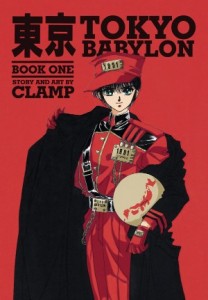
Tokyo Babylon Omnibus, Vol. 1

By CLAMP. Released in Japan by Shinshokan, serialized in the magazine Wings. Released in North America by Dark Horse Comics.

This is one of the big CLAMP series, the ones that first come to mind when you mention the creative team. It was their first really big hit (sorry, RG Veda), and when you read this first volume you can easily pick out why. Some manga are about the storyline and characters, some deal with building a world. But Tokyo Babylon is about building a mood, and it combines terrific artwork and a naive, somewhat somber hero to show us the world careening towards an inevitable apocalypse, one we’d see play out in the semi-sequel to this work, X.

tokyobabylon1

I’ve made a habit of pointing out CLAMP’s shortcomings in their post-2000 works, so it’s important to note how much they get right here. The artwork alone is worth buying the volume for, with a cute/handsome cast, striking settings, and strong, confident action scenes. Each story is self-contained so far, and has a plot that we’ve seen in many series before – a young spiritualists deals with restless ghosts and helps them find eternal rest – but it doesn’t feel tired, thanks in no small part to keeping the cast small and nuanced. Subaru’s noble idealism shines off the page, and makes an excellent contrast with his sister Hokuto’s eccentric extrovert. and then there’s Seishiro…

Let’s face it, Seishiro’s got something going on. I’m not spoiling anything, it’s just signposted – Hokuto even notes how he keeps changing the subject. At the start of the book he seems to be the most shallow – a nice, always smiling guy who tries to give Subaru gentle, older-man to younger-man advice while making cute jokes about seducing him. But by the time we get to the end of this volume, it’s clear that there’s something dark and unpleasant underneath that, and that Subaru’s idealism is going to run into it with a giant crunch. Honestly, in a way I can sort of see it. Subaru’s shininess is *so* over the top that it’s hard not to look at him every day and want to try to break it just a little bit…

I’ve jokes before about the magazine that Tokyo Babylon ran in, Wings, which is a shoujo/josei/fantasy/BL-lite hybrid that essentially became its own genre. Dark Horse advertises the series as one of the first BL manga to come out over here, but the BL in it is quite mild. Hokuto and Seishiro constantly joke about his love for Subaru, but Subaru’s lack of response beyond the occasional blush means that things don’t really go very far. Honestly, Hokuto is the big reason that this title isn’t completely bleak and grim – she’s a spark of life that brightens every scene she appears in. This will become far more important in the second volume, believe you me.

Dark Horse has done a really nice omnibus here, based on the re-released version from Japan (in case you’re wondering where Hokuto’s side-story got off to – it’ll be in the next one). A little oversize, nice thick paper, it’s a quality release. I’m not certain how changed the translation is from the Tokyopop edition, but it’s likely worth exchanging your old copies for this one anyway. And for those who haven’t tried this series, you really should – it’s CLAMP at their mightiest.