
By Tsutomo Nihei. Released in Japan by Kodansha, serialization ongoing in the magazine Afternoon. Released in the United States by Vertical, Inc.
I will admit to being one of the few people reviewing this title who has not read either Biomega or Blame, the author’s previous series released here. As a result, I wasn’t quite sure what I was getting into, except that the series looked vaguely Gundam-ey. And I have to admit, after finishing the first volume, I’m still not quite sure what’s going on. That said, it’s the sort of manga that rewards trying to find out, and there’s lots of little things here and there that make this well worth a read.
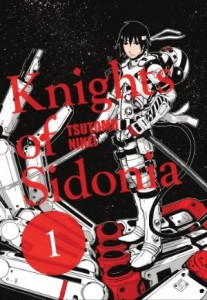
This takes place somewhere in the future on a World Spaceship, a la Heinlein’s Orphans of the Sky. Much of the plot is not told to us via exposition or narrative, but simply by immersing us in our hero’s day-to-day life and expecting us to figure it out as we go along. Our hero, Nagate, has been living secretly underground for years with his grandfather (I think), practicing blowing things up in a flight simulator. When he runs out of food (is his grandfather dead? And for how long?), Nagate goes to find some, and accidentally falls into the processing machine (one of the more morbidly funny scenes in the entire volume). After being discovered, he’s quickly indoctrinated into the military and added to a team whose mission is to battle the Gaunas, alien life forces intent on destruction.
Our hero is not much for words (or indeed facial expressions), so getting some battle scenes almost feels like a relief. My favorite part of the entire manga is probably the cruelest: we meet a new girl, Eiko, who is standoffish and avoiding all the superstition that the other pilots perform. Given she’s in the chapter title, we naturally assume she’ll be like Izana and come to befriend our hero, though given how prickly she seems it may require him to show initiative. But no! They go out to battle Gaunas, and she’s not only killed off immediately but her form is used to become a hideous monstrosity that almost kills off Nagate too. This fakeout was well-played, and I applaud the author for it.
Towards the end of the volume we get a few more new characters, who are a bit too new to really grasp on to, as well as an indication that Izana seems to have fallen hard for our hero. Clearly this is meant to be a series with a few volumes to it, and I imagine all will become clearer as I go along. I’m left, however, with a sense of distance about the whole thing. Nagate has difficulty emoting due to his upbringing (at least, that’s what I imagine), Izana seems naturally repressed, and through most of the volume I kept wishing that I could get closer to our heroes’ mindset while being unable to. I did enjoy Nagate defending Izana against a hotshot egotistical jerk pilot (who then breaks Nagate’s arm), and hope that we’ll see more elements like this. Knights of Sidonia as a series is cool rather than warm, but it’s still fascinating, and I look forward to working out what’s going on in future volumes.


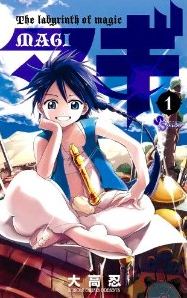 I’ve spent quite a few posts discussing Shonen Sunday, and Viz’s lack of enthusiasm about the titles as opposed to Shonen Jump. Of course, this is a vicious circle, as SS series tend not to be among the best-sellers or ‘fan-obsessive’ series. That may change with this new license, however. If ever there was a series running in Sunday that cried out to be licensed, Magi was it. The author has been seen on these shores before with Yen Press’s Sumomomo Momomo, but Magi is a better, more mature work with a manga take on Aladdin and the Arabian Nights. This has the potential to be the first really big Sunday title over here since Inu Yasha, and comes highly recommended.
 I was always a big fan of S.A. and its dense as lead heroine, so I’m quite happy to hear that they’ve licensed Maki Minami’s next series that ran in Hana to Yume, Seiyuu Kaa!, which will come out here as Voice Over! – Seiyuu Academy. The title describes the series – our heroine is enrolled in a voice actor’s high school, and not only has to deal with her less than stellar voice qualities, but also the usual high school shenanigans. This being a Hakusensha shoujo series, I’m certain that there will be a few pretty guys to help her out. The series should be 11 or 12 volumes.
 Jigokuren – Love in Hell is from Futabasha’s Web Comic High, and features a guy who dies one day and finds himself in hell. But he has the chance to repent. Judging by the art and descriptions I’ve seen, however, this title seems to aim at the reader who enjoys seeing young-looking girls torturing guys in various ways. I’d put it in the I Don’t Like You At All Big Brother/Mayo Chiki category.