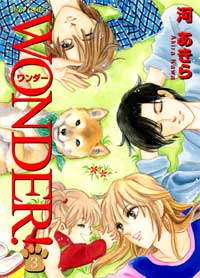
Higurashi: When They Cry, Vol. 20

Story by Ryukishi07; Art by Hinase Momoyama. Released in Japan as “Higurashi no Naku Koro ni: Minagoroshi-hen” by Square Enix, serialized in the magazine GFantasy. Released in North America by Yen Press.

(This review talks briefly about the villain of the series, for the one or two of you who haven’t figured it out or spoiled yourselves.)

I have a lot I want to say about this 2nd Massacre omnibus, so pardon me if I go on for a bit. Let’s start with what we’re fighting against here and what our weapons are. The villain here isn’t the child center, or the village, or the Sonozakis, or even Satoko’s uncle, really – it’s apathy, discouragement, and stubborn pride. When you know something is wrong but look the other way, or go along with everyone else, or simply lie to yourself that it’s the right thing to do – after all, if it was wrong, someone would step in, right? And so Satoko is scapegoated by the entire village, just as her brother was, for their parent’s actions, even though everyone knows deep inside she’s an innocent girl. She is fighting against the unity of the status quo.

massacre2

Then we have the weapons that can free her. Not Keiichi and Rena, though as semi-outsiders, they are eminently suited to be more appalled at everyone else’s behavior than the others. Not the Sonozaki family, who, once converted, prove to be able to take down any governmental barrier with just a few well-placed lawyers and friends in high places. (Speaking of which, has anyone noticed that the Sonozakis being essentially yakuza isn’t really remarked on as horrible? We see them do yakuza-type things – they have a torture chamber, for chrissakes – but there’s no suggestion, even with the upcoming ‘Good End’ in the next arc, that Mion will do anything other than take up the reins of the family when she is of age and her grandmother dies. It’s quite odd from a Western standpoint.)

No, the weapons everyone uses are courage, resolve, and unity. I like the way that this plays out in regards to the writing. Unity has been killing Satoko – but it’s a terrified village afraid to speak up for fear of getting ostracized just like she is. Keiichi, however, reminds them of what they once were, rebelling against the unfeeling government in the dam project. He points out the force for true greatness that a united village can be – and then Rena shames them by reminding them what that unity is doing to Satoko right now. Then, when confronting Oryou, Mion’s grandmother, Keiichi and the others need to muster their courage and resolve. Oryou is the most prideful of this bunch, and to the end she refuses to publicly back down. But it’s Keiichi’s resolve – along with a death threat, but hey, he’s held back from actually doing anything – that impresses her, and once the public eye is away from her, she too makes the right decision.

This arc seems at times to play out like a series of boss fights in a video game, where you need to face tougher and tougher foes and come up with new and creative weapons. Luckily, the last 6 arcs before this have been tempering our heroes, even if they don’t remember it save for Rika. Again, we see what happens when the answer to everyone’s problems is not ‘goo off on your own’. Even Ooishi, who I noted gave us a cliffhanger last time by looking creepy and threatening, is trying to give Keiichi some good and sensible advice. He just… looks creepy, it’s how it is. By the way, we also meet for the first significant time Akane, Mion and Shion’s mother. She appears to be semi-ostracized from her mother, which is why Mion is next in like as clan leader. She’s also an even better tease than her daughters, both of whom she offers to Keiichi.

Speaking of which, I’ve noted before how this has harem aspects to it, many times playing out like a date sim. This is especially true in the early visual novels, where you don’t see Keiichi’s face – he’s the generic player character. He was initially the harem lead because, well, there weren’t any other options around, really. But as the series has gone on and he’s been overtaken by Rika, he’s really impressed. Both in the Atonement arc and here, he shows why the nickname given to him is ‘master of words’ – he is the heart of this group (Rena, who’s always one step ahead, is the brains) – and there’s no longer any question as to why Rena and Mion fell for him hard.

I wonder if we’ll ever see what motivated Satoko’s parents to be the lone villagers saying the dam should go through. Was there some deep reason behind it, or are they meant to be simply ‘bad guys’ as Satoko’s aunt and uncle were? Speaking of which, I don’t think there’s been any villain character in Higurashi more deserving of his fate than Teppei. He gets some of the more terrifying Higurashi faces here, and his physical, mental and emotional abuse of Satoko is teeth-grindingly appalling. But of course, that’s what makes the scene where she finally asked the child center for help, and then stands up to her uncle, so amazing. This is what the unity of the villagers can lead to – a downtrodden 9-year-old girl finding her own courage and taking a stand against a horrible man. When she brags to her friends about how something like this won’t get her down, it’s impossible not to have a tear come to your eye.

(By the way, the artist for this arc, Hinase Momoyama, is one of the best of the entire series, keeping everything light and moe but avoiding some of the awkward bodies and weird posing from prior arcs. She also does some really over the top ‘Higurashi faces’, which will only get worse as the series goes on.)

Oh, yes, the series goes on. Thought you were done? This is only omnibus 2 of 3, and this is called the Massacre arc but has been rather free of massacres. And Rika is aware of this – Teppei is horrible, but he’s not gutting her on an altar. She still has to stop the killings after the Cotton Drifting. And that leads us to our villain, who I can now, at last, discuss. Not that it hasn’t been somewhat obvious. Some stories try to hide their villains by making them the seemingly nice, friendly person. But Ryukishi07 is perfectly content with making it the paranoid, occult-loving woman who was practically having an orgasm when she was shown the torture weapons of Hinamizawa.

Rika and Bernkastel had gone over the 3 ironclad rules of each world, and it’s here that we see that one of the rules is obviously incorrect – Takano is the villain, so she’s not the corpse found in the oil drum. Not that faking your death in this series seems all that hard. I will admit, the final scene in the manga doesn’t have all the impact it should, in my opinion, mostly as the audience still doesn’t really have all the facts – Takano’s revelations to Tomitake are as confusing to us as they are to her, and a casual reader might very well think, “Wait, it’s her? Where did that come from?” Of course, in Japan this series had few casual readers – the anime was over, the visual novels were done, and everyone knew what was going to happen. As Frederica Bernkastel notes in her poem, the cat in the box is dead. This is not the Good End world.

And so with one omnibus to go, where will Takano lead us? To a massacre? And for god’s sake, what does Rika have to do to stop dying? What is the solution here? How can Takano be stopped? Well, we won’t find that out next time. But we will get to see some VERY over the top, scary Higurashi faces. Stay tuned.

(TL, DR: this volume was fabulous, except maybe towards the end.)

Blood Lad, Vol. 1

By Yuuki Kodama. Released in Japan by Kadokawa Shoten, serialization ongoing in the magazine Young Ace. Released in North America by Yen Press.

I wasn’t quite sure what to expect with this series aside from ‘vampires’. And that ends up being pretty fitting, as I think the series itself is not quite sure where it’s going to go until we get about halfway through this omnibus, at which point it finds its feet surprisingly quickly. There’s some interesting characters, attempts at world building, and some surprisingly vicious backstory, along with a healthy dollop of humor and fanservice. Honestly, I’m not really sure why this is in the seinen magazine Young Ace rather than its Shonen equivalent, unless it gets far more violent later on. It could simply be Young Ace had the free slot for a new series.

bloodlad1

Admittedly, after the first few pages I was expecting something far worse than what this turned out to be. The idea of a slacker vampire who’s a secret otaku made me groan, and thankfully this aspect of Staz’s personality is given shot shrift as the series goes on. More to the point, we see that Staz’s seeming apathy towards life stems from his own family relationships, and that he’s surprisingly tough and powerful – and even clever, when he bothers to be. I was amused at one or two points in the volume where he analyzed the situation and immediately gave up fighting, knowing that he would lose and it’s best to conserve his powers. I was also pleased to see that his obsession with Fuyumi lasted only till she died – after which, he really wants to resurrect her but is clearly not enamored of her. Blood Lad is driven by its action and fantasy, not its harem aspects (though those do linger, mainly via Bell).

As for Fuyumi, she’s probably the aspect of this story I enjoyed the least. She should be there to be the audience identification figure, the lone normal Japanese girl among a town full of freaks. Unfortunately, you don’t get very far in to this volume before you see her role is to have large breasts and get captured a lot. There is a bit of existential angst when she and Staz return to Japan, and he uses mind control to make everyone think she’s still there – this horrifies her till he points out the alternative. Mostly, though, Fuyumi seems to be there to draw in readers who want a passive female in their action fantasy manga.

As I noted earlier, Staz does not have a very nice backstory, and no doubt we will meet his brother in the second volume. The idea of how Staz’s magic is suppressed is quite scary, and certainly explains why he’s so reluctant to take any actions. We also meet his sister Liz, who quickly proceeds to torture him, though I have a nagging suspicion that there may be a bit of a brother complex behind all this – possibly as I’ve read too many moe manga in a row recently.

Blood Lad isn’t terrific – Soul Eater handles almost everything this manga tries to do better – but it’s a solid title, and better than I’d expected. If it can do something with Fuyumi next time, that’s be appreciated. But either way, I look forward to seeing Staz break out and kick some more asses in Volume 2.

Kaoru Mori: Anything and Something

By Kaoru Mori. Released in Japan by Enterbrain, serialized in various magazines. Released in North America by Yen Press.

Well this is a bit of an odd duck, isn’t it? Half story collection, half sketchbook, it’s no surprise that this is being released in more expensive hardcover, as I doubt it would recoup any costs whatsoever otherwise. But then that’s also true of A Bride’s Story as well (and note Emma and Shirley were “blogger favorites” with crappy sales). Kaoru Mori is not the author of a Bleach or Naruto, and has a very enthusiastic but minimal audience. As such, this may almost be review proof – anyone buying this is getting it because it’s something new by the author, and the content is mostly irrelevant. That said, there is a lot to like here, even as there’s also a lot that left me scratching my head or feeling vaguely unsatisfied. Which is about what you’d expect from a collection like this.

anythingandsomething

One thing that pleased me greatly was the sense of humor of many of these stories. Indeed, they’re not simply funny but eccentric – always one of my favorites. The first story in the collection shows a butler and maid desperate for a master so that they can continue to live as they are accustomed – and it’s clear who’s going to be in charge. Then there’s the very early story involving a perverted loon of an inventor and his implacable battle maid. It was impossible for me not to think of the inventor as being played by Michael Bentine (google it). And the cute yet slight story of a girl who takes forever to grow into her school uniform just brings a smile to the face. Some girls are born to attract attention no matter how they look.

There’s also quite a bit of cheesecake here, as if the cover art didn’t clue you in. A Bride’s Story and Emma don’t exactly give a lot of opportunities to draw the female form (except covered in gorgeous clothing). Also, Mori writes mainly for Fellows!, an Enterbrain seinen magazine whose content is geared towards older men who like to see something sexy. This explains the almost static chapters with the Host Club bunny and the wife trying on her swimsuit, which are almost there for art alone. Indeed, one very short story about a girl who is bird-watching essentially stars her posterior.

There were one or two stories that reminded me of my frustration with Mori’s implacable females, particularly one involving a young master wanting to no longer be treated like a child and his maid who smiles politely no matter what. I admit it’s what she does best, but I was hoping for a bit more wackiness. Ironically, the longest story of the collection (and one of my favorites) wasn’t written by Mori, but by fellow Fellows! writer Satoshi Fukushima (who writes Kidou Ryodan Hachifukujin, which would be an awesome if unsellable license). This also features a seemingly implacable girl, but mostly focuses on the ‘normal’ girl who becomes her friend. There were a lot of subtleties here regarding art and life, and I worried that the story was going to end far more tragically, so was pleased at its more ambiguous climax.

After that, there’s the 2nd half of the book. I have far less to say about it – it’s a sketchbook, basically – and if you like Emma or A Bride’s Story, or simply reading about things like fireplaces, then you should find it satisfying. I do wish it had been interspersed with the short stories – having it all come in the 2nd half ends up making the whole book feel like a bit of a curate’s egg (google that too). There’s some good stuff here, but as a collection it’s more ‘odd’ than ‘satisfying’. Which is appropriate, as that’s how I’ve come to view Mori’s work as a whole.