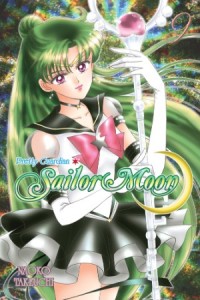
By Naoko Takeuchi. Released in Japan as “Bishoujo Senshi Sailor Moon” by Kodansha, serialized in the magazine Nakayoshi. Released in North America by Kodansha Comics.
I have so many things to say about this volume of Sailor Moon that I’m not even sure where to begin, so please forgive me if I start to ramble. For those of you wondering what’s going on, the Senshi are dealing with the Dead Moon Circus and Chibi-Usa’s getting visions of a pegasus who’s looking for the Legendary GOLDEN Crystal. Meanwhile, all the senshi have found themselves unable to transform and are wondering if this means their duties are over… and whether they can start to follow their dreams.
The volume opens with each of the four Inner Senshi discussing their dreams of the future. Ami wants to follow in her mother’s footsteps and become a doctor, Rei likewise wants to succeed her grandfather (who I’d forgotten looks nothing like his anime counterpart) at the shrine. Makoto wants to be a wife and baker; and Minako of course dreams of being an idol singer. As we move on, it’s not limited to just them. Not only do the Outer Senshi find themselves living in a small bubble of ‘perfect happy family’ that seems like a dream, but even the Amazoness Quartet, this arc’s minor villains, use the same language – getting their freedom to move in the real world is referred to as their dream.
The first three chapters also remind us that many of the senshi have family issues. Ami’s mother is really too busy to give her the care she needs (though notably she seems to show remorse about it, unlike a lot of ‘education mama’ portrayals of Ami’s mother I’ve seen), and her father essentially ran away and divorced them a few years prior. Rei’s mother died soon after she was born, and her dad is a government minister who has no time for his daughter and has sent her off to live at the shrine. (As we’ll find in a later short story, he *is* as unpleasant as he sounds.) And Makoto’s parents are both dead, and she’s living on her own with the traditional manga “where the hell does she get the money to afford that place” apartment.
The Amazon Trio (who, this being the manga, are barely characterized and killed off right away) thus have no trouble finding ways to get into the girls’ heads and try to tempt them away from their true calling. Preying on Ami’s loneliness and abandonment issues, Rei’s sense of duty and how oppressive that can feel, and Makoto’s indecision and feelings of being weak. Naturally, in the end, each finds the inner strength to go on (in Jupiter’s case, MONSTER STRENGTH, a line that had me laughing hard) and are able to transform, power up, gain new attacks, and wipe out the enemy. (Though not, notably, the Quartet, who always get away. Maybe it’s because they always work in a group, rather than on their own like the previous minor villains. You’d almost think they were friends…)
And then there’s Minako, who has issues of her own. She’s supposed to be the leader of the Inner Senshi, after all (something the anime quietly dropped), and is rather upset that they can all now transform and she still cannot. What’s more, the other three are all mentioning the Outers more and more – how inspirational they find them, the good advice they received from them, and how it would be great if they could show up to help everyone out. This makes Minako even more annoyed, as she never really bonded with them the way the others did, and is unable to offer advice as she’s still powerless. We see in the previous chapters each Inner thinking of advice from their Outer mentor – Ami with Setsuna, Rei with Michiru and Makoto with Haruka. Clearly that would leave Hotaru for Minako, but as she’s a baby right now that doesn’t really happen.
(Speaking of which, when did all these chats and bonding with the Outers actually happen? Between S and SuperS, or in the bits we didn’t see between S? Also, I know that Minako and Hotaru is quite a popular fanfic crack pairing, and I wonder if this might be a reason why.)
In many ways, this parallels an episode of the S anime, where Minako is frustrated that she’s the only one who hasn’t been attacked by the enemy. Here she charges forward into the enemy’s trap (and yes, she’s quite aware it’s a trap) in an attempt to make herself power up through sheer force of will. Unfortunately, what this leads to is her being dropped off of a tall platform, and the only thing holding her up is Artemis. Ignoring the physics of that for a moment, this resonates the best of the four Inner Senshi stories. Ami and Makoto had tiny little versions of themselves gibing them pep talks, and although Rei and Phobos and Deimos turn human briefly, we’d never seen her interact with her crows in quite the same way. But Minako and Artemis are partners (in a way that Usagi and Luna will never be), and when Minako thinks he’s been killed she’s heartbroken.
Artemis’s transformation into a white-haired handsome bishie would likely be less startling to those who read the manga when it first came out (they’d already seen a side-story where Luna did the same, which was adapted into the S movie), and it’s presented as sort of a powerup, much as the senshi go from Planet Power or Star Power to Crystal Power, Artemis is now strong enough to turn human in times of need. This is turn allows Minako to find the strength to make her own transformation.
In the meantime, as I noted, the Outers are living an idyllic life in a mansion somewhere. Haruka’s racing idiots on the highway, Michiru’s recording CDs (and getting hit on), Setsuna is doing important research, and Hotaru… now seems to be about 5 years old. And is quoting Yeats. The Senshi of Destruction quoting The Second Coming is never a good sign. She has her memories as Hotaru, her memories as Saturn, and these new memories of growing up with the Outers all in her head, and it’s turned her into quite the little prodigy. Of course, she also has her deep bond with Chibi-Usa, and knowing that she’s in trouble leads to her age up, again (this time to about 12, it seems), and unite the other Outers to do the same. It’s the sort of scene you want to see set to music, and is beautiful, inspiring, and a bit scary all at once.
In the meantime, what of our leads? Well, poor Mamoru is once again suffering by being the one who is always targeted. This time it’s shadows on the lung, which then becomes coughing up black blood – and even worse, it seems to be contagious, something we find at the very end of this volume when Usagi starts to cough as well. The ‘swapped bodies’ cliffhanger from last time is resolved fairly quickly (though not before Usagi tries to cuddle up with Mamoru in her chibi body, and finds that though he likes ’em young, that’s a little *too* young). Most of the book has Chibi-Usa trying to figure out what’s going on with Pegasus, which is a combination of ‘I want to save him from the bad guys’ and ‘he transformed into a hot guy what are these feelings in my heart?’. This, by the way, leads to the other big funny moment in the volume, where Chibi-Usa imagines talking about her unicorn wannabe-boyfriend with the other Inners, and quickly realizes Makoto is the only conversation that wouldn’t be a disaster.
I seem to have gone on a bit. Suffice to say this book was basically everything I wanted it to be, gave me tons of character stuff to analyze (giving lie to the anime fans saying the manga characters are too dull), and had huge roles for Minako and Hotaru, my two favorite senshi. And, if I recall, the next volume is just as good, and will wrap up the SuperS arc. Get it!