Phoenix Wright: Ace Attorney Volume 1

By Kenji Kuroda and Kazuo Maekawa, based on the video game by Capcom. Released in Japan by Kodansha, serialized in the magazine Young Magazine. Released in North America by Kodansha Comics.

Back when Kodansha Comics was still Del Rey, they put out two doujinshi anthologies based on the popular video game series, featuring lots of cute stories and bad puns. In Japan, however, there was actually a genuine ongoing manga based off of the series. It ran for five volumes, and also spawned a sequel based off of Phoenix’s rival Miles Edgeworth which ran an additional four. Rather than a gaming magazine, it appeared in one of their titles aimed at young men, the appropriately named Young Magazine.

I’m not normally a gamer, but I make an exception for Phoenix, whose games were so much fun. For those unfamiliar with the premise, Phoenix Wright is a young up and coming defense attorney who usually finds himself dealing with clients who look incredibly guilty but profess their innocence. He and his partner, the perky teenage spirit medium Maya Fey, investigate the crime, stack up clues, and eventually arrive at the trial, where they cross-examine witnesses and try to get the judge to see what really happened.

The manga based off of it is much the same, and even starts the way most games in this series have, with Phoenix called on to defend his hapless childhood friend Larry Butz, who is accused of murder – again. Once this appetizer is finished, we get the main case of the volume, which actually will be spreading out into Volume 2 as well. Phoenix is called to the house of a somewhat jerkass president of an IT company, who suspects he will soon be arrested for murder and wants Phoenix to represent him before that even happens. What follows is a rather claustrophobic tale of a messed-up family, a building that screams ‘deathtrap’, and spiders. A whole mess of spiders.

The manga follows the general theme of the games quite well. We meet a pile of different characters, all of whom seem to be at odds with each other, leaving Phoenix and Maya to try to figure things out. I was also very pleased to see that they kept the basic humor that makes Phoenix Wright so much fun – Phoenix and Maya snark at each other (and other characters) constantly, and there’s no shortage of goofy characters and evidence, especially in the first case. That said, the murders themselves are treated quite seriously. The first case ends on a melancholy note, and the second one gets very intense – folks who don’t like spiders might want to steer clear of this volume.

The localization of the manga reads fine, sounding much like the games. Occasionally they have to cheat, as the manga can show things like Maya’s ramen obsession – so the translation notes say Maya likes burgers AND ramen! Fans of Miles Edgeworth should be warned, however, that he doesn’t appear here beyond Phoenix briefly thinking of him. Winston Payne is the prosecution in Larry’s case, and we have not gotten to the trial for the second one yet. Heck, even Dick Gumshoe doesn’t show up until the end!

Oh, and the Judge asking Phoenix and Maya to keep their lover’s spats outside the court did my little shipping heart good. :)

There’s nothing groundbreaking about this manga. It gives readers exactly what they want – more adventures of Phoenix Wright – and does it in a way that won’t disappoint fans. People who aren’t fans of the game might find its attitude hard to take at first – it’s very glib for a detective series – but for what it is, it works very well.

Soul Eater Volume 6

By Atsushi Ohkubo. Released in Japan by Square Enix, serialization ongoing in the magazine Shonen Gangan. Released in North America by Yen Press.

I somehow missed reviewing Volume 5 of this series, but no worries. This new volume sees the series doing a lot of things right, and the result is that I feel I can finally wholeheartedly recommend it in ways that go beyond the art style.

The plot here continues from the last volume: our heroes are trying to stop Medusa and her cronies from resurrecting the Kishin, a Very Big Bad who has been sealed up in a subbasement in a bag made of his own skin. Maka has found herself confronted by the series’ most disturbing character (and that’s saying a lot!), Crona, who definitely seems to have the upper hand. Maka can get it back, but only to abandoning herself to madness, and trusting that Soul will be able to bring her back.

This series runs in a magazine called ‘Shonen Gangan’, but the age bracket it seems to market itself to is noticeably higher than the big 3’s shonen titles – more of a 10-15-year-old market. I’d say that’s definitely a good thing, as some of the events in this volume can be downright unnerving and almost terrifying. In fact, at times the unnatural and abstract art style helps – at one point, Maka grabs Crona’s face and runs it along the blade of her scythe, something that would make you scream in horror if it weren’t so cartoonlike. The distancing works very well.

As for Crona (who Yen seem to have dubbed ‘male’ simply because avoiding pronouns is very awkward in English – Crona generally is sexless), in trying to open up, Maka discovers that Crona lacks a very good sense of self, and in many ways almost seems to have a split personality. Maka breaks through using the power of friendship, of course, but it’s very uneasy – Crona’s weapon rebels against this, and there’s a sense that everything is still hanging on a knife-edge.

The rest of the volume sees Black*Star and Death the Kid try to get to the basement to stop the Kishin’s resurrection. This is more shonen battle oriented, with lots of killer hidden moves and self-doubt – hallucinatory images play a big role here, and at one point even the villains almost commit suicide because they’re being tricked by the sheer insanity of the Kishin’s thoughts. However, they finally make it down there, and…

…well, they fail. The Kishin ends up being resurrected after all, though at least Medusa is killed (or is she?). This is the first really big plot line that our three groups have worked together on, and though they all get to strut their stuff and do cool things, it’s rather noticeable that it ends in failure. It has to be said that Soul Eater is, at heart, a world that seems to live off of fear and madness. As a result, things like this happening are far more the norm. Hopefully as they get stronger Maka and company will be able to help prevent this, but for the moment the bad guys have won.

This is not your typical shonen series. It has a high body count and a lot of blood, as well as facial expressions which can cause you to whimper in horror. And as always there is the art, giving you a comforting disconnect from reality to help with the worst gory bits, but also being nowhere near reality in terms of its everyday setting. I’m enjoying it more with every volume, and now that it’s settled down into a plot-oriented groove, it’s become one of Yen Press’s better acquisitions. Recommended, especially for those who want something a little different.

Oh yes, and Patty’s ‘Voice of Authority’ was hilarious. :D

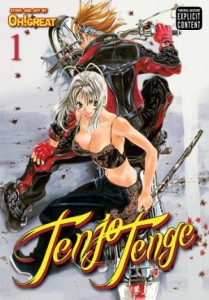
Tenjo Tenge Volume 1

By Oh!Great. Released in Japan by Shueisha, serialized in the magazine Ultra Jump. Released in North America by Viz.

Well, I must admit, I feel I brought this on myself. I kept bringing up the fact that Japan was filled with delinquent manga, featuring entire schools filled with young bruisers of both sexes who are there to kick ass, take names, and fight increasingly stronger other guys. And I noted how we rarely saw these over here, and that when we did (Digital Manga Publishing’s three released volumes of Worst come to mind), they tend not to do so well.

So now we have a re-release of the classic boobs ‘n martial arts extravaganza Tenjo Tenge, this time with all of the sex that original publisher CMX covered up or simply cut out. This volume actually contains the first two volumes of the original series (and confusingly, has the cover for Volume 2 on its cover and the original cover for Volume 1 before the second volume), and is unedited as far as I can tell. I don’t have the original Japanese to compare it to, but certainly looking at several of the sequences, if Viz *is* editing anything I can’t imagine what it is. It also has lots of nice color pages, and is slightly larger in size than the typical manga volume – it’s a really nice reproduction.

As for the content, it’s exactly what a young reader of Ultra Jump would want. Really, Oh!Great knows his audience and delivers exactly what they’re after without fail. There’s lots of nudity and suggestion of sex (and one rape scene that gets fairly graphic), lots of fists flying and kicks connecting, and a school full of people who like to pose and sneer. It is, in other words, the PERFECT manga for fourteen-year-old boys. There seems to be a bit of a plot regarding the past of the school’s club and the heroine’s dead brother, and some vague supernatural powers at work, but none of that detracts from what the manga is there to deliver. You need SOME plot to hang your sex and violence on.

Soichiro and Bob (half-black, half-Japanese) are two best friends who are used to dominating their old school by being the top fighters around. They arrive at Todo Academy ready to put it under their thumb, only to find that the students here are even better fighters, who can kick their ass without breaking much of a sweat. This delights them, as they’re itching to find anyone who can drive them to be even better. Of course, as Bob knows and Soichiro starts to learn here, you need a reason to be strong besides ‘strong is cool’.

The characters here are all types, but they’re decent enough types – for characters where you know their whole arc in advance, they don’t put a foot wrong. Aya is the classic overenthusiastic girl who has already declared the hero her husband (shades of Lum/Shampoo/etc.) but is plagued by inner doubts. Her sister Maya is a mentor figure so far, but shows signs that she has a troubling past that drives her. Soichiro seems to be the idiot hero who will get better and faster based on pure instinct. Heck, even Chiaki, Bob’s girlfriend whose sole role in the story seems to be to have sex with her boyfriend and get threatened, is handled pretty well – after the aforementioned rape scene (she was the victim), her laughter and bravado at saying that he didn’t go all the way and that she fought him off is both heartbreaking and realistic, especially contrasted with the three broken heroes she’s trying to pass it off to. (The rape itself is incredibly exploitative, of course, a classic example of Oh!Great trying to have his cake and eat it too.)

And then there’s Isuzu. A heh. Well, I know that sort of fetish is out there, and for those who love it, here she is.

I don’t want to give the impression that this is anything more than a pandering school delinquent manga with fantasy overtones, as that’s just what it is. There’s an incredibly bad onsen scene that is there to give faux yuri fanservice and nothing more. And though I did note that there are semblances of a plot here, I do not expect this to remotely overtake the manga’s primary goals: to excite and titillate. And yes, the girls look like plastic fantastic lovers.

That said, if a manga succeeds entirely at giving its target audience exactly what they want, can one call it a failure because it doesn’t deliver at all outside that target? Tenjo Tenge is what it is, a boobs ‘n martial arts manga. And with ten more omnibus volumes to go, there’s a lot of both of those still to come. I wouldn’t recommend it to anyone who doesn’t enjoy people hitting each other with grins on their faces while girls with unrealistic bodies lose their clothing a lot. If you don’t mind that? I think this is quite decent, and even entertaining.