My Happy Marriage, Vol. 7

By Akumi Agitogi and Tsukiho Tsukioka. Released in Japan as “Watashi no Shiawase na Kekkon” by Fujimi L Bunko. Released in North America Yen On. Translated by David Musto.

Every so often, I hot a point in a book where a plot point bounces off me so hard that I just go “NOPE” and throw the book away. Usually it’s pretty easy, as it’s in the first or second volume in a series and I can easily just drop it and never look back. It’s much harder when it’s in a series I really like. I don’t WANT to drop this series. And yeah, the second half of the book is basically everything we wanted to have happen. But man alive. I absolutely did not need the main plotline of this volume, whose entire purpose (and it’s clearly, deliberately on purpose) is to fill this volume with drama even though all the roadblolcks and evil villains have been taken care of. It is there to pile on the pain and suffering once more, and I’m not sure it makes the resolution sweeter for that fact. Basically, there is a scene (it has the words “I hate you” in it) that made me want to jump into the sea. Anyway. Moving on.
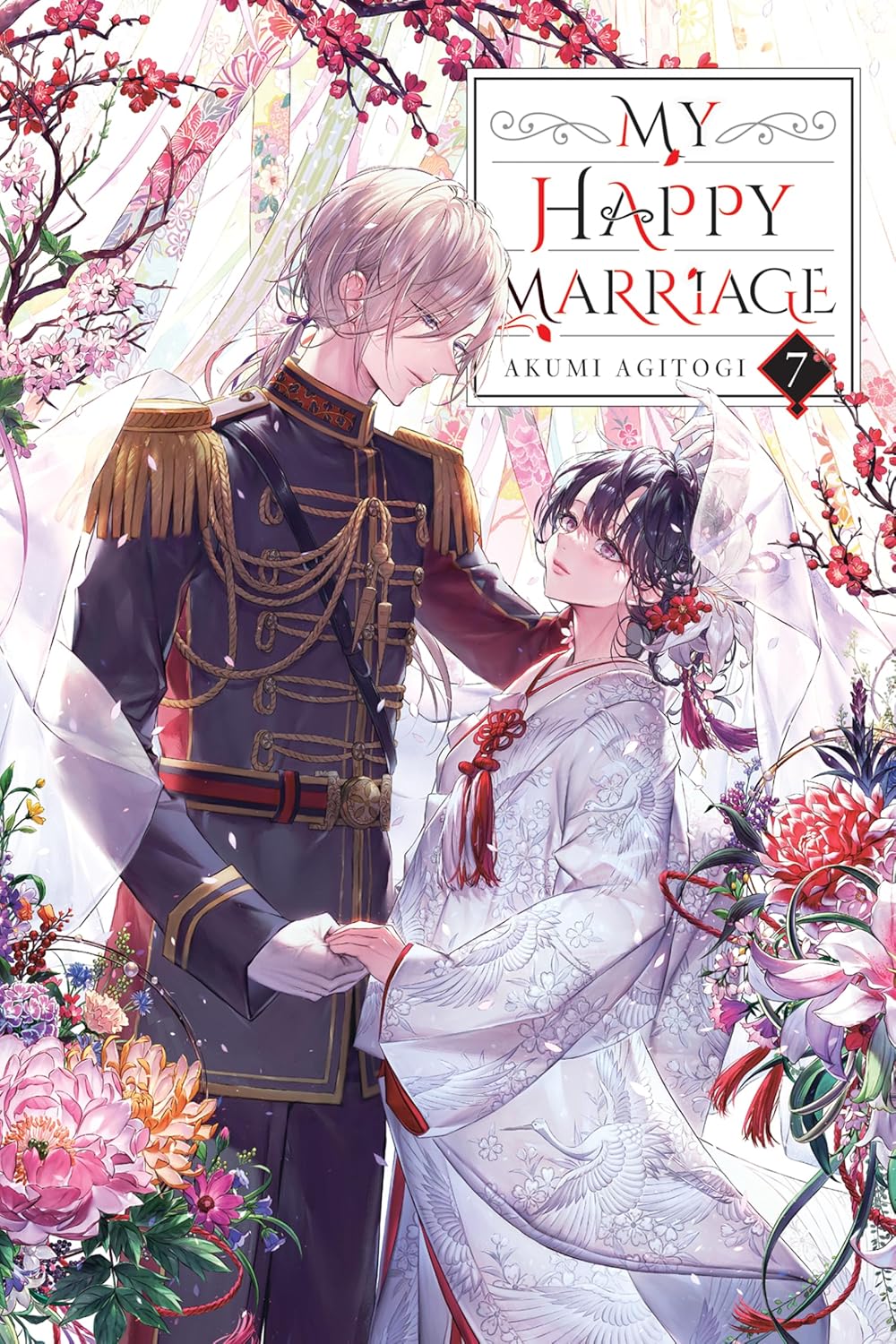
It’s finally time. We’re at the wedding, Miyo looks gorgeous, the guests are here, everything is prepared… and the groom is absent. Clearly it’s time for a flashback to show how we got to this point. Miyo is doing her best to get ready for being an actual wife, including facing up to the fact that she will need to be intimate with her husband (when she can’t even say the word “darling” without falling over with a red face) and also trying to brush up on her cooking skills, which are already miles better than her sister-in-law but could use some work. While at a cooking demonstration, she runs into an old classmate from elementary school, who was the other “quiet, shy girl nobody liked” in class, and Miyo gets told a rather depressing story about a sacrificial marriage. She then goes home… and has the scene I mentioned at the start.

The good and bad thing about this series is that it is filled with the supernatural, and there are tons of things that have something evil, monstrous, or twisted as their cause. This is bad because it means that we get everything that happens in this book, which involves curses, evil from the previous generation seemingly trying to rise up and make Kiyoka late for his wedding, and in the end, straight-up murder attempts. The good thing is that it means that we don’t have to have all those horrible romance cliches of “I misheard you and we must now not talk to each other for the next five volumes” miscommunication. It turns out to really be a curse. We also get to see discount bargain-basement Kiyoka and Miyo, who are there as an object lesson in how sometimes you can try to escape a terrible life by entering into an arranged marriage with a stoic, cold man and it goes really badly. I don’t think there’s supposed to be a moral here, like “they should have tried harder”, I think it’s just meant to be “there but for the grace of God go I”.

The good bits of this book were very good. The wedding was fantastic, the ceremony afterwords was heartwarming, the wedding night was moved offscreen but we assume it happened without a lot of blushing and awkwardness, and after that there’s only one minor knife to the heart to deal with and we can get our happily ever after. Except we get an 8th volume soon, so now we get My Happy Married Life. I’ll be reading more. Just… perhaps fewer road cones for the sake of being road cones?

Is It Wrong to Try to Pick Up Girls in a Dungeon?, Vol. 19

By Fujino Omori and Suzuhito Yasuda. Released in Japan as “Dungeon ni Deai o Motomeru no wa Machigatte Iru Darou ka?” by GA Bunko. Released in North America by Yen On. Translated by Dale DeLucia.

I needed this almost as much as Bell did. I suspect there are a few people who will be disappointed by this volume. After the highs and lows of the last few arcs, something like this, which is a deliberate “let’s do something totally different” thing, might feel out of place. But the volume is also filled with hints that we’re getting close to, if not the end of the series, then at least the beginning of the end of the series. Bell is being prepared for heroism, and he is going to be a hero. He’s being forced to pay attention to the world outside of Orario, and we see m,any signs that things outside Orario are not happy and peaceful. And, of course, despite yet another addition to the harem this time around, there’s still one main couple that is holding everything back. (Aiz is entirely absent from this book, pointedly so.) So yeah, let’s do it, why not a magical academy volume?

We pick up after the end of the last book. Freya Familia is no more, and in fact a large number of them are now staff at The Benevolent Mistress, presumably to watch over Syr, who is getting absolutely worked to death by irritated gods who are still upset about everything Freya did. Another large number of them are watching over Haruhime, whose secret level up powers are now known to all, and Lyu, who has returned from seeing off Astrea and has made peace with her past at last (and joined Hestia Familia) in order to make sure they are not kidnapped. Bell thinks his Familia,. now with added Lyu, should head right back into the dungeon, but Eine tells him it’s a good time to relax. It has been (good lord) six months since the start of the series. That’s a LOT to happen to Bell in that little time. He deserves a break. He deserves… to be abducted by Hermes and forced to infiltrate the massive floating school that’s just docked at Orario for the next few months.

There’s almost a deliberate lack of originality here. After nearly getting caught infiltrating the high security school, Bell has to disguise himself as an ordinary Level-1 rabbit boy and pretend to be meek and still learning. And then he promptly gets assigned with all the class losers, who can’t work together to save their lives, even though they’re powerful. Also in the group is Nina, Eine’s younger sister, who is having a lot of trouble living up to her sister’s standards and it’s crushing her. Her scenes with Bell are some of the best of the book. I also enjoyed seeing Bell studying hard, and his studies later proving useful in actual dungeon battles. Bell was always naive and inexperienced, but he was never stupid, and now that he’s no longer inexperienced (we’ll put a pin in naive for now), his smarts are really impressive.

Basically, by the end of this book you definitely see WHY the gods are pinning all their hopes on Bell. Unfortunately, we’re caught up with Japan again. Fortunately, we’re getting the last volume of depress-o-thon Astrea Record soon, as well as the first Sword Oratoria light novel in over four years. So there’s plenty of stories to be told in this world. This is just a “Bell is a student” one.

Sword Art Online Alternative: Clover’s Regret, Vol. 1

By Soitiro Watase and Ginta, based on the series created by Reki Kawahara. Released in Japan by Dengeki Bunko. Released in North America by Yen On. Translated by Stephen Paul.

So, just like the Re: Zero SS collection, we’re getting this one a bit late. The first volume of Clover’s Regret, the second in the “Alternative” spinoff series, came out in 2016, after the 5th volume of the Gun Gale Online books. But we had to wait till we’re caught up with both the main series, its Progressive rewrite, *and* the GGO series before we get this spinoff. Part of that is because, unlike GGO, this never got an anime, and it features none of the main SAO cast. It doesn’t have an obvious hook to pull in Kirito casuals. The other reason, I think, is that unlike other Yen On light novel series from hell with extensive spinoffs, SAO has always been Stephen Paul’s baby, and I think we may have waited for this one just so that he can translate it properly rather than try to get someone new in. In any case, you’re not “missing” anything like we were with Re: Zero SS. This is pretty standalone.

Asuka Empire may not have the #1 ranking of ALfheim Online, but it tries harder. A far more Japanese-based MMORPH, it’s been struggling to keep its high ranking now that everyone has access to the Seed. As such, it has a new event that’s horror-based, and it’s also allowing users to submit their own game ideas to the event. Meanwhile, our heroines, matter of fact, somewhat emotionless Nayuta and genki, lovable scamp Koyomi are trying to clear one of the quests, which involves a mysterious ghost orchestra. While doing this, they meet a rarity in games like this – an old man, who has never gamed before but is really desperate to solve the ghost orchestra game for some reason. He was told about an in-game detective named Klever who might be able to help him. Why is he so interested in this quest? And what’s with that fox-faced detective?

This is another slow burner. About halfway through, I wondered, as I sometimes do with other spinoffs of popular franchises, why this could not have been a book on its own with no ties to Sword Art Online at all. But that’s just because the book saves all its twists for the second half, piling them on one after another. Not only do half the cast have a personal connection to the original Aincrad SAO game, but the ghost orchestra quest itself is written by a member of the Sleeping Knights… a member who, like so many other members of that party, has now died. (We’re told in this volume that Yuuki died “a few days ago”, which nails down the timeline.) The cast are excellent, particularly Nayuta and Klever… I’d argue that Koyomi is mere comic relief, but the author agrees with me, and states that her part was supposed to be smaller but she kept butting in. I hope she gains more depth next time.

Sorry not to go into my usual spoilers, but this book has good spoilers, so I recommend experiencing them yourself. Also, unlike GGO, this is a limited series of 3 books, so should not take up too much of your time. Go check it out.