Fake Saint of the Year: You Wanted the Perfect Saint? Too Bad!, Vol. 1

By kabedondaikou and Yunohito. Released in Japan as “Risō no Seijo? Zannen, Nise Seijo Deshita! Kuso of the Year to Yobareta Akuyaku ni Tensei Shitanda ga” by Kadokawa Books. Released in North America by J-Novel Club. Translated by Rymane Tsouria.

One of the struggles in reviewing a giant pile of light novels is that there is not a lot of binary to it. While it would be much easier if every series was either magical and something you need to read immediately, or else a terrible dumpster fire of a series that you never want to read another volume of, the sad fact is that most series are various types of OK. They do some things well, but they also do some things badly. And figuring out if the badly outweighs the well is something I have never really been that good at, as you can likely guess given how much I’m trying to read. Fake Saint of the Year is another book like that. There’s some interesting stuff going on here, with a twist I quite enjoyed. That said, there’s a lot of “let’s throw that cliche in as it’s popular”, and the lead character’s narrative voice… is awful.

A loser NEET guy enjoys playing visual novels, and then one day he wakes up to find he’s in the 5-year-old body of Ellize, who is… brace yourself… the villainess of the game he was playing! Supposedly the “saint” of this world ,she had a ton of power, but didn’t cultivate it, and was abusive and awful to everyone. As it turned out, she wasn’t the true saint, so ended up being shamed, exiled, and eventually ripped apart. You would think, now that he is trapped in this villainess body, our hero is going to change Ellize’s fate so that she lives, but, having spoilery knowledge of the way the game works, he has no intention of doing that. Instead, he’s going to manipulate things so that his OTP avoids the unhappy ending it got in canon!

Let’s start with the bad: Ellize’s narrative voice is that of a skeezy 20-ish young man, who enjoys leering at, and (on occasion) groping the women around him. It makes the book very hard to recommend. The reason that Ellize gets away with it is that this is also one of those “whatever the heroine does, everyone will misinterpret it in the best way possible” sort of books, a la Tearmoon Empire. This is not helped by Ellize herself (there is little to no gender dysphoria in this book, the author just wanted to write a girl with a horndog inner voice, so I’ll use her), who keeps trying to do things that will drive people away from her but ends up saying wonderful, heroic speeches and being utterly kind to people. I’m not even sure she’s aware of that. There’s also the big twist in the game, which is a twist that works very well in the book as well, and leads to some genuinely good drama.

Sadly, this is another one of those “this book does not end, it just stops” novels, so we’ll need to wait for Vol. 2 to find out what happens next. In the meantime, if you can overlook a heroine who enjoys ogling large-breasted woman and saying “no homo!” whenever it’s implied a guy might like her, there are things to enjoy here.
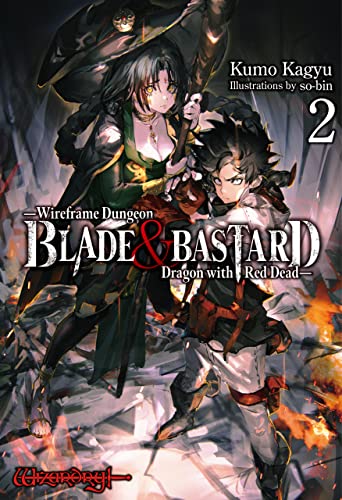
BLADE & BASTARD: Wireframe Dungeon & Dragon with Red Dead

By Kumo Kagyu and so-bin. Released in Japan as “Blade & Bastard” by Dre Novels. Released in North America by J-Novel Club. Translated by Sean McCann.

I will give Blade & Bastard some credit: the author is not afraid to state right up front that every woman in this book is the author’s barely disguised fetish. In the first volume we were introduced to the feral redhead who only communicates in barks and yaps, and here we see she’s also fond of stripping naked to clean herself in the middle of the street. There’s a nun who’s constantly trying to get people to be more religious, but she also really, really really REALLY loves violence. And in this second volume we mete a massive dojikko, and by massive I mean that she is six-foot-six. The book starts by describing her as “Tall, with big eyes. Big muscles, big boobs, and a big butt too.”. She also has the self-worth of a peanut. Really, you have to hand it to Kumo Kagyu. He knows that anyone who stays past that opening sentence is here for the long haul. And, to be fair, there is still a lot here to like as well.

The big everything girl is Berkanan, whose corpse our heroes find in the dungeon towards the start of the book. She’s been killed by a massive fire dragon that has taken residence in the dungeon, and is stopping adventurers from going through it, as the dragon is well-nigh unkillable. Upon revival, Berkanan begs Iarumas, Garbage and Raraja to help her go back into the dungeon and kill the dragon, out of a combination of anger that she was killed and a sort of desperate need to prove herself, probably as she’s a mage who’s trained for years but she only knows one low-level spell. Still, SOMEONE needs to kill the dragon, or this town that is surviving only because of this one dungeon is doomed. Why can’t it be her?

The author knows how to write atmosphere, and a good fight scene, which is still probably the main reason to get this. Despite being a walking stereotype, Berkanan is quite likeable, and you root for her to succeed. Garbage still only barks and yaps, but she’s also a bit less feral and more domesticated, and we get more evidence that she’s secret royalty – mostly as assassins keep trying to kill her. Iarumas, alas, remains a walking NPC, though it was nice to see him almost show an emotion during the fight with the dragon. On the down side, aside from Berkanan being a walking fetish (the artist also enjoys emphasizing this), there is a small little man named Bank who deals in money… I can’t call anti-semitic just yet, but I feel like the moment we get any description of him he will be anti-semitic. Though that may be down to the source material.

And perhaps the biggest drawback, the translation seems wedded to reminding us this is based on Wizardry. We here someone has the power to survive, and then we see (hit points) after the word survive, as though it’s translating from novel to game. Spells are also used, and it just types the acronym (I assume) for the spell, such as HALITO. I get this book is meant to sell to Wizardry fans rather than light novel fans, but it does not make life easy. That said… despite everything, I also really liked Berkanan, who is simply a very sympathetic character, and I hope that we get more of her gaining confidence. I also hope she does not end up in a romantic rivalry with Garbage over Raraja, but I’m far less optimistic about that.

Culinary Chronicles of the Court Flower, Vol. 10

By Miri Mikawa and Kasumi Nagi. Released in Japan as “Ikka Kōkyū Ryōrichō” by Kadokawa Beans Bunko. Released in North America digitally by J-Novel Club. Translated by Hunter Prigg.

For a great deal of this series, we’ve been presented with a question: who will Rimi end up with? It seemed fairly obvious for the first half, as it was very much a romance between her and Shusei, bonding over food and dodging inner court intrigue. But then Shohi also fell in love with Rimi, and things got shaken up… to the point that Shusei is now starting a war in order to gain the throne so he can get what he wants. Ironically, if he’s only waited a little bit longer he might have gotten it anyway, as while it’s clear Shohi does love Rimi, and she loves him, their relationship is explicitly likened to a mother and son, and so when he’s told he needs to sire an heir NOW because of the upcoming war, he can’t see Rimi as a partner in that way. This WOULD be good news for Shusei… if it weren’t for the last three or four books, and honestly, I’m starting to wonder if the books might now just end with no romantic resolution at all.

Rushing back to the palace, Shohi and company find that a large number of the bureaucrats have switched sides, and are asking him to abdicate. This includes Shusei, who is generously giving him ten days to decide whether to abdicate or go to war. And Shusei, by far, has the larger force to make war. There are, unfortunately, other problems as well. They still haven’t found the spy in the court, Mars. Tama has been out of sorts ever since they returned, and her actions midway through the book cause a crisis. Oh yes, and Shohi starts to become ill and also go blind, which doctors say is some mysterious illness, but the reader can very obviously see is because he’s being poisoned. By Hakurei. Which… makes no sense whatsoever. Can Rimi figure out what’s really going on? And are they really going to war?

Mars’ identity has been a well-placed mystery this whole book, and when it’s revealed here it makes sense – I won’t spoil it, but it has an impact. I also enjoyed seeing the four consorts have a large role in this book, especially Ho, who is forced to deal with all the manipulation Hakurei has done against her and help with the main plotline. (Yo continues to be comedy relief, alas, but at least she’s funny most of the time.) As for Shusei and Rimi, it’s very clear from Shusei’s actions that he’s got several tricks up his sleeve, and I don’t think all of those involve his own victory. Unfortunately, given he’s a traitor, and also given Rimi right now thinks that “Lord Ho” has killed the Shusei she knew and is 100% against him, I’m not sure quite how this ends. Exile with Rimi at his side would feel far too pat.

I should not have too long to find out, though, as the next book is the last in the series. A good addition to one of the classic “intrigue in the emperor’s court” genre.