Reign of the Seven Spellblades, Vol. 7

By Bokuto Uno and Miyuki Ruria. Released in Japan as “Nanatsu no Maken ga Shihai suru” by Dengeki Bunko. Released in North America by Yen On. Translated by Andrew Cunningham.

This is not, in general, a light and fluffy series in the least. However, with the exception of the start and final pages of this volume, this is definitely one that is on the lighter side. For one thing, our main group of six are now in their third year, and we’re long past their finding out how this school works – they know it well by now. Everyone (except Chela, who is sadly ignored for almost this entire volume, and who I hope gets some nice plot bits in 8 to make up for it) gets a chance to show off, especially Pete, Guy and Katie, who each get a nice bit at the start that allows them to be the elder student advising the newbies. This is especially welcome for Guy, who has honestly the least character development of the six. As for Oliver and Nanao, well, they get the bulk of the book to themselves, as always. Everyone is a protagonist, but some are more protagonist than others.
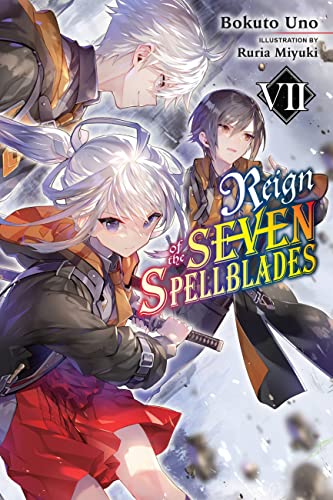
This book is the start of what amounts to a Tournament Arc, as there’s a Combat League competition coming up, and since there’s so no real stand-out winner in the election yet, it’s going to be a factional battle. Fortunately, the initial stages are grouped by year, meaning Oliver and company don’t have to fight Seventh-Years. That said, he and Nanao will need a third, as Chela’s dad clearly designed this year’s complicated rules, so she wants to keep a low profile. Fortunately, they have everyone’s favorite ball of sunshine, Yuri, to be on their team. (Guy, Katie and Pete also form a team, and get a chunk of the book to show off as well.) Their team will be up against three others that they’re unfamiliar with, which is a pain. Oh yes, and a seventh-year student is stealing other student’s bones.

That last bit is what forms the serious part of this book, and it is quite creepy, though it remains unclear how much permanent damage it actually does… or what the end goal is. It does show off Yuri’s worrying tendency to go after mysteries the way that the Scooby Doo gang do, and Oliver has to be the voice of reason multiple times throughout trying to keep him from haring off and getting himself killed. Other than that, this book is mostly here to show off everyone’s cool magic fighting. It does a very good job, and there are lots of interesting applications, but Oliver and Nanao are leagues above everyone else in their year, and that fact does not change with anything that we see in this volume. We also get to see the 4th/5th year and 6th/7th year fights, the latter of which is most interesting as it shows off Vanessa Aldiss, who loves to fight and who clearly is not above killing people if there aren’t rules in place. It’s clearly meant to show readers that the next Oliver v. teacher battle will be even harder and more vicious.

So yes, good volume. Needs More Chela. Not much to say.
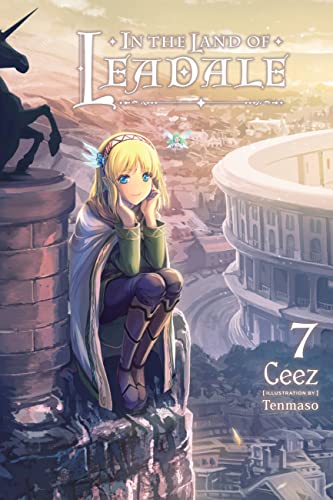
In the Land of Leadale, Vol. 7

By Ceez and Tenmaso. Released in Japan as “Leadale no Daichi nite” by Famitsu Bunko. Released in North America by Yen On. Translated by Jessica Lange.

One of the main reasons to read the Leadale series is to see the dissonance between Cayna as a centuries-old high elf who has great-grandchildren and can casually wipe out a continent with Cayna, who is a teenager who spent almost her entire life in a hospital bed and is still learning how to act like a normal person while also having the aforementioned massive power. That dissonance is felt keenly in this volume. At least twice in the book, Cayna overreacts to a situation so much that she causes terror in those around her. She claims that Opus is the dangerous loose cannon, but he (and the reader) know the actual truth. Watching the anime recently helped remind me of this, as there were a lot of viewers who could not get past Cayna’s “comedic violence” towards people, and the violence is no longer quite as comedic. She needs to get a handle on herself, especially now that she knows the true nature of where she is.

Cayna and Opus spend a lot of the start of the book looking around for the magic projector that will allow them to livestream the upcoming fighting tournament, which results in a sort of mini-tour of all the previous towers and shows off the eccentricities of the people who own them. This includes moving the giant turtle so it looks slightly less like it’s about to destroy the nearby city… as well as running into another relative, an elf queen who is rather enthusiastic about meeting Cayna. Unfortunately, now that Opus and Cayna are walking around together, her kids are starting to notice that Opus sounds exactly like who she said their dad was, which requires some last-second lying to avoid the topic. And then we get the tourney itself, which Cayna sits out but even so manages to accidentally ruin.

The world in general seems to treat Cayna as a natural disaster, and honestly the world isn’t wrong. She doesn’t react to things the way anyone would expect, mostly as she’s a teenager who never had a normal life being forced to deal with things that worry, upset, or embarrass her. She also looks like a cute l’il elf girl, so can occasionally be underestimated, though any of the players actually in this world who are able to see (or more accurately not see) her stats will be running away fast. She’s smart enough to know not to enter the tourney, but she then goes and gives Shining Saber one of her ludicrous monster swords, which results in the entire arena getting destroyed as he fights his opponent so hard that no one can continue. The reason I harp on this is because, unfortunately, I don’t think we’re going to see a lot of development with Cayna maturing. The series realizes that her overreactions are funny. So I will attempt to not take it too seriously. There are many funny bits here, which helps.

Leadale is never going to be great, but it’s always entertaining, and it’s a good read if you like fun fantasy with OP girls.

Rascal Does Not Dream of a Knapsack Kid

By Hajime Kamoshida and Keji Mizoguchi. Released in Japan as “Seishun Buta Yarou wa Randoseru Girl no Yume wo Minai” by Dengeki Bunko. Released in North America by Yen On. Translated by Andrew Cunningham.

My favorite episode of Urusei Yatsura (the original, not the 2022 reboot) has Lum end up in various alternate universes and unable to get back to the correct one. We see one where everyone is the opposite gender, one where her father actually invaded and everyone hates her, etc. Towards the end, she finds a world where everything seems to be absolutely perfect… including an Ataru who actually looks to be as handsome as she sees him, saying that he loves her. The look on her face when she hears “I love you” and knows that it’s the wrong world again may be the most heartbreaking moment in the series, topped only by her little “bye bye” as she flees, trying again to get back to HER Ataru. If you’re wondering what all this has to do with Rascal Does Not Dream, then I urge you to read this volume, which may be Sakuta’s best to date.

Things are going reasonably well for Sakuta. He’s still studying hard so he can go to college with Mai, Kaede has decided to start high school at the remote learning place, and he and Mai remain lovey-dovey (or at least as lovey-dovey as Mai ever gets). There’s even more good news coming – Sakuta and Kaede’s mother is getting released from the hospital and being allowed to go home, and she wants to see Kaede. Sakuta is naturally worried about how things will go, and does his best to be a good big brother and strong grownup for his sister. And indeed, things go very well. The reunion is a big success! The only trouble is that Sakuta is still running into the little girl version of Mai. Oh, yes, and one other problem – no one can see him anymore.

The callback to the very first book (though Sakuta does not wear a bunny girl outfit, or even consider it, which makes me sad) is appropriate given that this book pretty much resolves all the major plot points that were outstanding in the series to date. Sakuta’s parents were a constant invisible pressure on the series, but we only saw his father rarely, and we never saw his mother till this book. The middle part of this book is hideously depressing, especially when (helped by the child Mai) he does get back to a world where people can see him… but it’s the wrong one, and just makes him feel inadequate. Fortunately, Rio and Mai are the same no matter what universe, and give him some support… but unfortunately, the solution is something Sakuta will have to work out on his own.

This is not the final book in the series, but it feels like it is, with Sakuta’s entire third year being skipped as we jump to his graduation. There is more to come, and indeed there are teases for future books in this one, including a new character from Sakuta’s past. For this book, though, it’s all Sakuta. He ma never get a cover picture because of the genre he’s in, but if he did, this would be the book. Also: “Other Sakuta: fix your shit” is hilarious.