Haibara’s Teenage New Game+, Vol. 1

By Kazuki Amamiya and Gin. Released in Japan as “Haibara-kun no Tsuyokute Seishun New Game” by HJ Bunko. Released in North America by J-Novel Club. Translated by Esther Sun.

I think, like most people, I have no desire to go back in time and try to do things differently. Not because I’m reasonably content with all my life choices, but simply because I know that if I ever did I would be resolutely terrible at it, and probably locked away within the first week. I suppose with Haibara it helps that he’s not all that far removed from his past, but still: there’s too many ways for everything to go wrong. As indeed we find in this book, where we discover that the only thing worse than screwing up, is NOT screwing up. Fortunately, it turns out that Haibara’s old past was mostly self-inflicted, and that he’s hanging out with a nice gang of popular kids. Chitose Is in the Ramune Bottle might argue this is a bit unrealistic, but it’s not meant to be. Everyone knows what they’re getting with this teenage fantasy. And to its credit, it’s written pretty well.
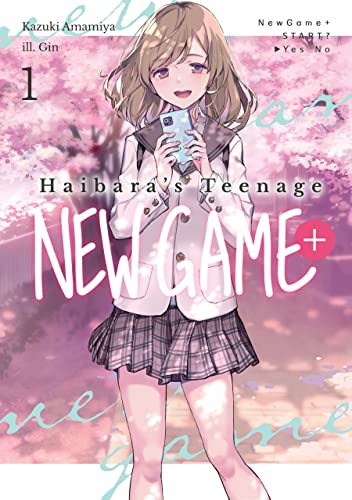
Natsuki Haibara is a college student who regrets his past. He tried to reinvent himself in high school, and it was such a failure that it cost him any friends he once had. He spent the rest of his time in a self-described grey existence. And so he makes a wish to God to get a do-over… and wakes up back in his parents’ home, 7 years earlier. He’s just graduated middle school, meaning he’s still overweight, wearing glasses, and fashion ignorant. He can’t do much about the last, but he can fix the first two, and goes on a month-long binge to get himself to the point where he can have a rainbow-colored high school debut… this time with the experience of knowing exactly where he went wrong. But that experience can cut both ways, and it turns out that just because you’ve gained 7 years worth of talents it does not make you less oblivious about other people’s feelings.

I appreciated that the main conflict in this first volume is not directly about Haibara and a series of girls who kind of like him (though that is of course here as well, as that’s the genre we’re in), but about trying to reconnect with one of the few friends in high school who supported him until he finally screwed up too much, Tatsuya. Initially Haibara is really wary of Tatsuya, and it shows, but he asks his friend Reita (who is the standard “cool hot boy” in these stories) to let him work it out himself. Then, he can’t take his own advice as he’s unable to realize that, thanks to years of extra experience, he’s now TOO perfect, to the point where he makes others jealous of him. And now he doesn’t realize that the answer is mostly “let Tatsuya work it out himself”. Luckily, everything turns out OK.

This can be hard to read at times, especially if you have no desire to relive the horrors of high school interrelations, but it’s solid and avoids most of the pitfalls I was hoping it would avoid. It’s decent romcom, with a minimum of rom at the moment, though I expect that to change.
The Princess of Convenient Plot Devices, Vol. 1

By Mamecyoro and Mitsuya Fuji. Released in Japan as “Watashi wa Gotsugou Shugi na Kaiketsu Tantou no Oujo de aru” by B’s-LOG Bunko. Released in North America by Yen On. Translated by Sarah Henshaw.

When you’re talking about a genre, it’s never quite just the same thing. No, not even isekai series starring Potato-kun protagonists. There’s mix and match, there’s variations, there’s ways to make this different enough that we don’t get sued. And some genres cross over with others. For example, one genre I quite like is “everyone thinks that the protagonist is being ridiculously clever and crafty, when they’re really just improvising and winging it”. Tearmoon Empire is probably the best current example, but we’ve seen a few others. And, of course, there are BL fantasy novels, where true love is found even if you have to rewrite reality so that the kingdom is predominately gay. And, of course, there are villainess books, where our heroine ends up being accused of things she either never did, or only did in the source material. Put them all together and you’ve got this series, which asks: how would a kingdom run on BL really work out?

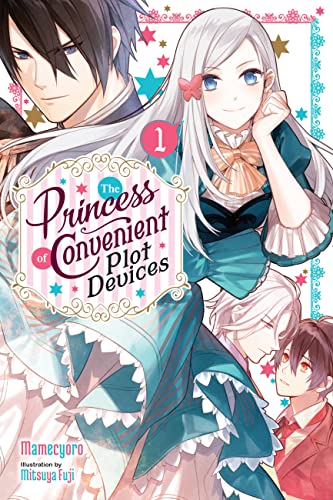
Maki was a girl who loved BL novels, particularly a series called The Noble King. It features a kingdom where the king is married to another man, and his son the prince is also in love with a man. In the novels, the prince’s younger sister, Octavia, was a big supporter of theirs, a perfect side character for a BL series. But now Mari has died and is reincarnated *as* Octavia, and has to deal with how the writer manages to have a working dynasty with all the nobility being gay: she will be married off (possibly to a not-gay man, possibly as a beard), produce a child, and then give him to her older brother and have him raise the child as his own. Needless to say, this does not delight Octavia AT ALL. She’s going to find a man of her own! There’s just one slight problem… everyone else thinks she has designs to take over the throne. And is possibly evil.

Octavia, in this first volume, is not an airhead like Katarina Claes. She sees her problem and takes actions to solve it. But she’s also not a clever genius like a lot of other Villainess heroines. Most of her action taking is spur of the moment and improvised, and sometimes quickly regretted. She is, in other words, a normal person reacting the way a normal person would to being in a novel that she’s very familiar with… to a point. (She died after Book 5, so has missed some later stuff.) Unfortunately, to a noble family who are used to everyone acting like they were born into nobility and set in very defined roles… she’s incredibly hard to read, and her actions frequently make no sense. Such as hiring as her new bodyguard a man who is likely an assassin. Or being ambivalent about her older brother’s relationship. Or… in political terms, she’s a bomb that hasn’t gone off yet. This provides terrific tension, which is offset by her narrative voice, which is very “chatty teen girl”.

Basically, this is excellent. It also moves a lot slower than I expected, as we only cover about three days in this first book. We don’t even get a ball where Octavia can be publicly shamed! Possibly next time?

Qualia the Purple

By Hisamitsu Ueo and Shirou Tsunashima. Released in Japan as “Murasakiiro no Qualia” by Dengeki Bunko. Released in North America by Airship. Translated by Daniel Komen. Adapted by Carly Smith.

I actually had to double check the dates after finishing this volume, to see which came first: Qualia the Purple or Puella Magi Madoka Magica. The answer is Qualia came first, by about two years. Still, folks who are familiar with the main plot of PMMM are going to find certain similarities to the main plot of Qualia, even if the two are handled quite differently. Qualia the Purple doesn’t involve Magical Girls, but it is a hard SF series about trying to save someone over and over again and being unable to fix things no matter how many tries are made, as well as the dangers of grief and obsession. The first third is a short story that won an award, the last two thirds are the expansion for the light novel. The last two thirds are the reason to read the book, but I would not blame readers who stop after Page 30 or so. The start of this book is deadly boring, and while the plot twist explains why, it’s still boring.

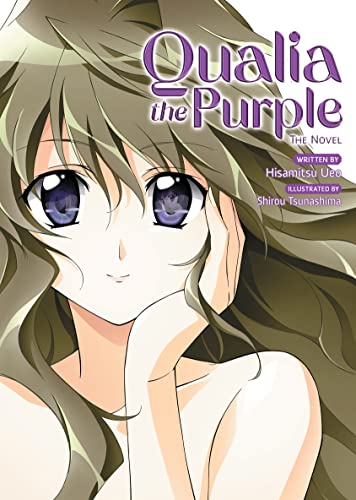
The girl on the cover, and the center of the book, is Yukari, a young “genius” middle school girl who sees everything as robots. When she’s looking at someone else, she sees them as a robot. This has led to difficulties. The narrator, and the actual protagonist of the series, is Manabu, aka “Gaku-chan”, an athletic girl in Yukari’s class who is her best friend and is, at least initially, the “normal” girl in the story. That begins to change when Yukari is drawn into the search for a serial killer. It changes even more when there’s a new transfer student in the second chunk of the book, Alice, who is determined to befriend Yukari and have her join an organization for geniuses. And everything completely falls apart when Yukari is killed, and the REAL plot kicks in.

Intellectually, I think this book is excellent… once you get past Manabu explaining Yukari to the reader in cute ways over the dire first 30 pages. The climax to the “short story” part of the book was well handled and surprising, and the hard SF gobbledygook that infests the second part (and there is an awful lot of that, be aware) is at least vaguely understandable. Manabu’s growing desperation and the lengths she will go to in order to try to save Yukari are jaw-dropping, and I can appreciate the writing quality and the thought that went into the plot itself. Emotionally, I sort of hated this. Mostly as I really, really started to hate Manabu. She does not skimp on telling us the things she does and the people she manipulates in order to do what she is doing, and some of it (particularly Alice’s subplot) are frankly loathsome. It’s on purpose, of course, but that doesn’t mean I want to read it. There’s also the problem, which Yukari herself brings up, that everything is being done for her sake but she’s not allowed to make the choice herself. Yukari ends up being a goal rather than a character in the last half of the book.

Of course, I’m supposed to feel all this. That’s the point. I do recommend this book, which is like a puzzle in many ways, and the way that Manabu’s narration changes as she does, sometimes from line to line, is amazing. Just… it’s not a feel good book.