Sword Art Online: Progressive, Vol. 8

By Reki Kawahara and abec. Released in Japan by Dengeki Bunko. Released in North America by Yen On. Translated by Stephen Paul.

(This review spoils the end of the book, but I’ll wait till after the cover art and summary to do so.)

For the most part, Sword Art Online is a cash cow. What this means, especially now that Kawahara is no longer relying on rewriting his webnovel, is that he is free to do what he wants and take all the time he needs without real fear of being cancelled. Now, this can be dangerous, and the series risks becoming a bit TOO meandering. But it also means that he’s happy to set up a bunch of stuff, lead us towards resolving it… and then kick it up to the next floor/book, knowing that he has time to look into it in greater detail then. This is what happens here with the ongoing Dark Elves plot. We get a few more hints about what’s going on, there’s some tantalizing angst as they worry about putting the main casino plot ahead of Kizmel’s (she assures them it’s fine.) And then the confrontation… isn’t. See you in Book 9.
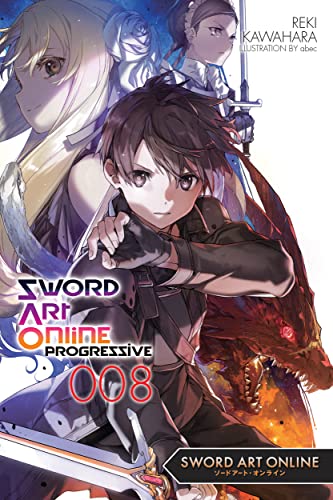
Kirito frequently runs on his instincts, which usually serve him well but also get him in a pile of trouble, as they do here where he essentially decides to rescue the monster dog from where it’s being slowly tortured to death for the casino games. Which is fine, but… that means they’ve got a lot that now needs to happen, including getting Nirrnir to inspect the enemy camp’s monster stables. Unfortunately, that leads to Very Bad Things, so now Kirito and Asuna are in a race against time to try to a) beat the cheating casino, b) beat the floor boss, and c) help Kizmel get un-disgraced. Fortunately, they have each other, they have Argo, and they have the power of delicious Greek food, so it won’t be TOO hard… maybe.

So yeah, I have to admit, I was not particularly surprised at the fact that Nirrnir was a vampire, as all the signs were there in the previous book. It would have been more odd if she WASN’T. No, the surprise was that I expected our heroes to win and be able to cure her poisoning at the last minute. I wasn’t even that surprised at Kirito telling Nirrnir to drink his blood in order to stay alive – this is a classic trope of vampire stories. I was pretty surprised that this caused Kirito to become a vampire himself. And I was VERY VERY surprised that this was not resolved by the end of the book, meaning he’s going to have to take on the next floor only in the evening, as he now has all the traditional vampire weaknesses. It fits with the story in this 2-book arc, but honestly, I hope “Kirito the Vampire” is resolved sooner rather than later in Book 9. And honestly, I kind of want the dark elf plot resolved as well. I love Kizmel, but ell… sometimes Progressive *is* too meandering.

We’re caught up with Japan again, and I’m not sure when Book 9 will come out. In the meantime, please enjoy a Kirito who is probably going to be staring at Asuna’s neck even more than he normally does.

Otherside Picnic, Vol. 7

By Iori Miyazawa and shirakaba. Released in Japan as “Urasekai Picnic” by Hayakawa Bunko JA. Released in North America by J-Novel Club. Translated by Sean McCann.

If Otherside Picnic is a series about ghost stories and legends, and going to another world to explore and confront them, then the series had to, at some point, deal with its own self-made ghost. Satsuki Uruma has been a part of this series from the very beginning, but we’ve never quite met her. Her presence has been felt, though, both from the impact her life and death had on Toriko and Kozakura and also because the Otherside has used her presence and likeness to hunt and destroy Sorawo. In this new volume, Sorawo finally meets Satsuki and has a conversation with her, and it helps to clear up a great many things. 1) the Satsuki they’re dealing with is not a human being, and b) Sorawo wants to murder her. Of course, this is Kozakura’s friend and Toriko’s former teacher/crush, so Sorawo will have to obfuscate her real motives… but not by much. Call it a funeral or an exorcism or what you will, it’s a final battle, and all it needs is a shootout.

While discussing Kozakura’s decision to take the wayward Otherside child Kasumi in (reasoning that she’s human because she’s not trying to look human), Sorawo and Toriko get into a fight because it turned out Toriko missed Sorawo’s birthday, which Sorawo doesn’t care about but Toriko certainly does. A few days later it’s not a fight but it’s not NOT a fight, so Sorawo, after her anthropology class, decides to return to the building where she first entered the Otherside and met Toriko. There she finds her doppelganger… and also Satsuki, who has a terrifying conversation with our heroine. After this, Sorawo is determined to do away with her, to the point where her romantic anniversary dinner with Toriko is somewhat waylaid by that fact. But how do you kill what Satsuki has become?

I brushed past the anthropology class, but it was a terrific part of the book, with Sorawo (who is no longer amnesiac, so is returning to her original topic) laying out the anthropological details behind ghost stories and the like. The class are doubtful but not mocking her, and the professor is quite supportive… especially when they do find evidence of T-san’s former presence. The other highlight of the book (aside from Sorawo really coming into her own as a leader and driver of the action) is, once again, Runa Urumi. Her interaction with Sorawo is fantastic, and I enjoyed seeing her assume that the only reason that Sorawo is allowed to walk around Japan with her eye that can drive people crazy is that she has friends in high places. Unfortunately, the final scene (which is both terrifying and vindicating, and makes you want to punch the air in victory) puts Runa away again” for a bit, but I now really look forward to seeing her again.

This is not the end of the series, but it’s very much the end of one of the major story arcs, and that makes it easier to wait for the 8th volume, which is not out in Japan yet. Till it comes out, this may be the best volume of the series to date.

How a Realist Hero Rebuilt the Kingdom, Vol. 16

By Dojyomaru and Fuyuyuki. Released in Japan as “Genjitsu Shugi Yuusha no Oukoku Saikenki” by Overlap Bunko. Released in North America by J-Novel Club. Translated by Sean McCann.

The Realist Hero series has occasionally shown us glimpses of the Gran Chaos Empire, but we’ve never really been inside it. And while we’ve seen Maria and Jeanne, for the most part they’ve been minor supporting characters in a series that, especially lately, has been far more concerned with Fuuga’s desire to be Genghis Khan and Souma’s reaction to this. That said, when we have seen Maria several things have become clear: she is very good at what she does, and she hates doing it. Sometimes just because you’re a born leader does not mean that leadership is the thing you actually desire. And lately, especially with the expansion of the other two major territories, her advisors are growing restless, tired of her “wait and see” approach. There has definitely been a sense that when the three powers clashed, the Empire would be the one to fall. That said, I don’t think we quite appreciated just how close to breaking Maria really was till the events of this book, which features what is for all intents and purposes a suicide attempt.

There’s a two-year timeskip near the start of this volume, which I point out only because the book itself is so blase about it you might forget. We also see Kuu’s marriage. After that, though, it’s all business. Fuuga will not be content till he’s conquered the world, and that means he has to take on either Maria or Souma… and frankly Maria is the more obvious choice. He and his people do a good job. They make the right feints. They coerce Maria’s allies into betraying her. They make it worth Souma’s while to stay out of things, even to the point of marrying him off to Yuriga (who is now 18, and yes, that’s probably the main reason for the timeskip). Fuuga even offers Souma the chance to actually rule the world after he conquers it – he has no interest in what comes after “I beat everyone”. That said, Maria is not without a cunning plan or two of her own.

I mention the suicide attempt mostly as it’s in the color pages, which are for once at the front of the volume (J-Novel Club started to put them at the back due to Amazon’s policies about art in the ‘ebook previews’), boldly feature it. It startles the hell out of absolutely everyone, including Souma, who almost panics and ruins their well-crafted plan (which, to be fair, did not have Maria jumping to her death) and Fuuga, for whom this would be the worst possible outcome. He doesn’t need the so-called Saint to be a martyr. As it happens, Maria’s not really sure why she did it either, at least until afterwards back in Souma’s castle when she essentially has a complete emotional breakdown and you realize that she’s been holding everything in for YEARS. Fortunately, thanks to the support of everyone (as well as marrying the man she loves – yes, Souma gets TWO new wives this volume), she can recover and go on to do what she’s really wanted to do all this time – philanthropy. AGGRESSIVE philanthropy.

These books are never going to be quality literature. But, like some of the more famous series out there, the quality of the writing is not as important as the resonance. Realist Hero resonates with its readers really well, which is why we’re still invested in it even after all these volumes. And all these wives.