No Game No Life, Vol. 11

By Yuu Kamiya. Released in Japan by MF Bunko J. Released in North America by Yen On. Translated by Richard Tobin.

The general rule of thumb when reading a volume of No Game No Life is to ignore anything that is not directly related to the plot or character development. and yes, this means you are ignoring about 85% of each book. This volume in particular is filled with pointless fanservice, cringey cliches, and more situations and art that remind you why this series got Amazon banned (though, again, this new volume is still there). When you get past all that, you’re essentially left with two things. First of all, the fact that [ ] actually lose for the first time in the series… and they’re not too sure how it happened yet. The result, though, is near catastrophic, though I guess it’s very good news if you’re Chlammy. The second thing is that Sora and Shiro, adopted siblings, are forced to confront their feelings for each other for real… and Shiro especially is almost broken by them. This is a rare reminder that she’s still eleven years old. And while there’s a reset at the end, I think both of them have moved forward a bit.

We open with Sora, Shiro, Steph, Jibril and Emir-Eins waking up to find they’re now trapped in a death game, to Sora’s horror. He hates the very idea of death games, and knows that the only reason that he and the others would ever have agreed to it is if [ ] had lost. Their host is Foeniculum a fairy who is streaming all of this on the fairy version of YouTube. The five of them are in a room where there’s an exit door… but only those who say they’re a couple can go through it. Needless to say, everyone is horrified at this… especially as there’s five of them, so someone will lose. Also, four of them are women. You can buy a key to get out… but the price is exorbitant, and depends entirely on getting donations from viewers. As a result… Sora and company need to be interesting enough to make money!

A lot of this, especially in the first half, is pure stupidity, with the usual antics. Sora has low self-esteem, Steph whines, Jibril and Emir-Eins fight, etc. Things change once the fairy viewers force Sora to tell Shiro that he finds her attractive… something Shiro, theoretically, has been waiting eleven books to hear. But theory and practice are two different things, and it turns out Sora seeing her sexually terrifies her… and indeed Sora, after being released from the fairy geas, is appalled he said it as well. The incest subtext has always been uncomfortable in this series, and it’s shoved in our faces here, but the outcome in the end is good; Shiro doesn’t really need Sora as a lover or a boyfriend, she just needs Sora there next to her all the time. As for [ ] losing, we’re still not sure how it happened either, but it’s setting up for a big battle against the elves next time.

I didn’t mention Steph, but her role is the same as always: be degraded and humiliated 95% of the book, then remind the cast she’s the emotional heart of the story, and far more sensible than any of them. NGNL fans will definitely have a ball with this. Hope we don’t wait so long for the 12th book.

86 –Eighty-Six–, Vol. 10: Fragmental Neoteny

By Asato Asato and Shirabii. Released in Japan by Dengeki Bunko. Released in North America by Yen On. Translated by Roman Lempert.

First of all: yes, it’s a short story collection. And, for the most part, it’s entirely about Shin, so if you’re looking for the others, well, you’ll only get them as we get closer to the end of the book. These stories are meant to fill in a bit of the gap between Shin being sent off t war and where we joined his story in the first volume. Now, I know what you’re thinking. “Isn’t this just an excuse to write a bunch of grimdark stuff where people are nice to Shin and then die horribly?” And hey, that’s just rude. There are also people that are mean and nasty to Shin who die horribly. That said, I was pleased that not EVERY story in this volume ended with the entire cast dead except for Shin… but most of them do. That said, it’s an excellent look into Shin’s mind, and into how he got to be the person he is today, even though everything but the final story and a few interludes takes place just after the events of the first volume.

The stories show us a freshly recruited Shin, already going far too hard into everything he can, being worried after by his commanding officer Alice; Shin being used as a scapegoat to attract the hatred of the rest of the unit so that it doesn’t spread to others; Shin getting the help of the mechanics to save a scavenger he found that seems to have a mind of its own; Shin discussing the nature of the afterlife with his comrades, as well as coming up with the handle of Undertaker; The Spearhead Squadron’s daily life just before they got Lena as their handler; and Shin, Raiden, Theo, Kurena and Anju marching off to their deaths, only to find that there is still life worth living out there, however dangerous and difficult.

I’ve left out two stories which are the best of this group. The story of Fido, told in several parts, is deeply heartwarming and tearjerking at the same time, and also gives us a much closer look at shin’s family before everything went to hell. Fido’s backstory is a revelation that will put a smile on most people’s faces, I think. The other interesting story is the final one, which appears to be a shared dream between Annette and Shin showing us what life would have been like if they really had managed to find unmanned units to fight the war for the Republic, and Shin and the others could have a normal life. It’s deeply bittersweet, and requires remembering what everyone looks like to get the most out of it (the main cast appears, but dream Shin doesn’t know who they re, so we only see their description), but it also shows us a Shin who regrets a lot of things but is ready to move forward. It’s a Shin prepared for the end of the series, which the author assures us is coming soon.

to sum up: this is how you do a short story volume. We get a lot more about Shin here, some backstory that wouldn’t really fit elsewhere, and yes, a lot of dead people. Come on, it’s still 86.

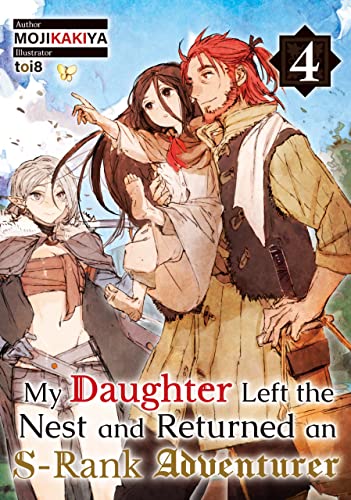
My Daughter Left the Nest and Returned an S-Rank Adventurer, Vol. 4

By MOJIKAKIYA and toi8. Released in Japan as “Boukensha ni Naritai to Miyako ni Deteitta Musume ga S-Rank ni Natteta” by Earth Star Novels. Released in North America digitally by J-Novel Club. Translated by Roy Nukia.

Easily the best in the series to date, despite the fact that we’re now at the second round of “I have gotten everything planned out to see my dad again but something comes along to screw it up at the last minute”. Angeline is still a big-time Daddy’s Girl, but she’s put into a situation where that’s mostly irrelevant, and when it is relevant she actually manages to use it as a force for good. Belgrieve is finally forced to admit to himself that he may actually be as good at fighting as Angeline says he is, after going toe-to-toe with a top-ranked adventurer and … not winning, but lasting far longer than a 40-year-old with one leg should really be lasting. And the overall plot is finally coming into focus, giving us more ongoing bad guys, as well as an idea of what they’re going to do. Which I suspect is “kill Belgrieve and then watch Angeline destroy the world”. Best to stop that.

Angeline and company are ready to take Charlotte and Byaku back to her hometown. Unfortunately, the nobles have finally gotten around to noticing her, and have called her to the capital to come get an award… which means she’ll get back too late to make the trip before winter sets in. She is… unhappy. Meanwhile, Belgrieve has settled in with his new mini-family back in Turnera, but some of them are leaving as well, mostly as they have the adventure lust in their blood. It’s also reminding him of his past, which we get brief glimpses of here, and we see how even as a younger man he was cautious and careful. As for Angeline, when she arrives at the capital she not only finds a pile of nobles but also a mysterious guy in a dungeon… who may be more connected to her than she thinks.

This is not really a big fighting volume. Belgrieve gets into a couple of spars, but that’s not the same thing. As for Angeline, as I noted above, the best part of the book is the fight she doesn’t get into, especially as it’s supposed to be used as the excuse for a coup. It’s actually the second time she avoids this, the first being in the middle of her awards ceremony, where a noble attempts to taunt her into fighting and she responds by pointing out exactly what battling monsters and demons should be for, and it’s not “to show off my strength against some noble jackasses”. That said, they aren’t all bad here, and I really liked the young spunky noble girl, who I hope we see again. Plus Angeline gets her reward at the end – her dad came to see her rather than the other way around, and he’ll be there all winter.

Despite once again keeping its two leads separated most of the book, this time it did it in exactly the right way. This is a solid fantasy series.