Reborn to Master the Blade: From Hero-King to Extraordinary Squire, Vol. 4

By Hayaken and Nagu. Released in Japan as “Eiyu-oh, Bu wo Kiwameru tame Tensei su. Soshite, Sekai Saikyou no Minarai Kisi ♀” by HJ Bunko. Released in North America by J-Novel Club. Translated by Mike Langwiser.

I have stated before that the main reason I enjoy this series is that it has only one joke: Inglis is a meathead who only cares about fighting, food, and Rafinha, in that order. The trouble is that the author wants to hammer home to the reader that this is not entirely amusing and something to appreciate for the lulz. I say trouble because we’re introduced halfway through to a girl who lost her entire family when her village was destroyed and therefore has… sigh… been sold and is working “in servitude”. Rafinha is appalled that this is happening, while Inglis points out the political realities of trying to shut it down everywhere. The trouble is that Inglis does not care about any of this. She’ll support Rafinha if she wants to fight against slavery, but that’s because she’ll follow her anywhere, not because of any actual moral center. Inglis’ moral center is: I want a good fight. And she will cheat and manipulate to get it.
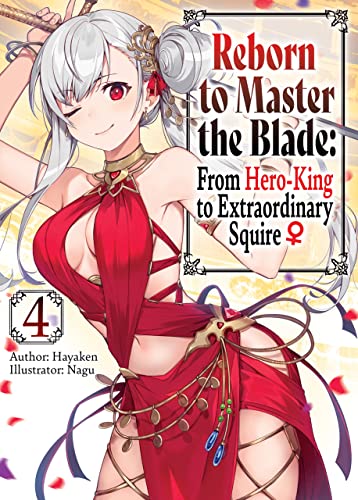
While working to help rebuild the school (and, more importantly, the school cafeteria), Inglis is called to the throne to be offered a position as Captain of the Royal Guard. A huge honor, but far too much work and would mean she would not get to do whatever the hell she wants, so she talks her way out of that one. More importantly, the acting troupe Inglis has met before are back in town, and they want her to play one of the roles and put on a spectacular fight scene. Inglis realizes that if she cons Yua into taking the other role, then she can get to fight the half-assed but equally strong women in a real (theatrical) battle. That said, there is a problem… the winner has to kiss the male lead, and the mere idea of this causes Inglis to flip out. That said, there may be even bigger problems… like an assassination attempt. Or an invasion.

I’m glad that Yua has essentially become Inglis Mark 2, because she’s just hilarious all the time, whereas Inglis occasionally has to play the straight man. Yua’s complete apathy to nearly anything extends even to her own self, as we discover that she may have a lingering side-effect from her death battle in the previous volume, to which her response is essentially “ah”. This is why it’s even funnier seeing her thirst for the girly-faced Ian, to the point where she spends most of the epilogue of the book carrying him around under her arm like a sack of potatoes. As for Inglis, she gets to have some really good fights here, so she must be happy. We also get to see the mothers of Inglis and Rafinha pay a visit, and it turns out that huge appetites definitely run on the mothers’ side, as between the four of them they terrify everyone with the amount of food consumed.

This series is never really going to get into Big Questions and Ethical Dilemmas, and even if it does it probably is not going to be Inglis having the dilemma. She gets why things are wrong. She gets they can be hard to fix. She doesn’t care. Fight now plz.
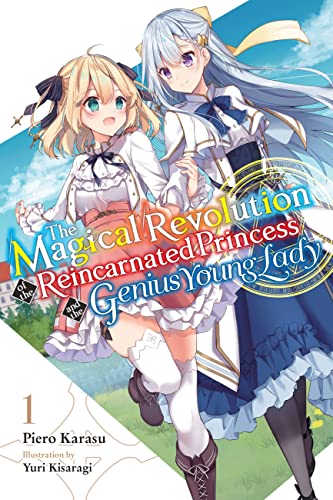
The Magical Revolution of the Reincarnated Princess and the Genius Young Lady, Vol. 1

By Piero Karasu and Yuri Kisaragi. Released in Japan as “Tensei Oujo to Tensai Reijou no Mahou Kakumei” by Fujimi Fantasia Bunko. Released in North America by Yen On. Translated by Haydn Trowell.

We’ve had enough villainess books by now that everyone knows the “Stations of the Canon” so to speak, and so therefore it warms my heart to see that we don’t have to dwell on them forever. One of our heroines, the reincarnated princess (who is NOT the villainess in this story) gains her memories of her life in Japan, discovers she’s in a fantasy world, and rushes off to go learn magic!… and then twelve years pass. As for the supposed villainess, we hit the high points in the by now traditional scene. Her fiance shames her in a public setting. Every other guy she knows is also sneering at her. She’s innocent, but no one believes her. No offense, but we’ve done this. And then our princess smashes through the window on her magical science broom, immediately realizes that this is a villainess shaming story, and yeets the villainess out the window with her. No time for that, there’s SCIENCE to be done!

Anisphia, aka Anis, is the titular princess. In a land where magic power is strongest in the royal family, she can’t use magic at all. But that’s not going to stop her dreams. She removes herself from succession, retires to a side mansion, and proceeds to use her vague knowledge from Japan and sheer GUTS to make tools that work using magic but that can be wielded by anyone… including her! For the most part, this has meant kettles powered by spirits, etc. But she has grander plans, and needs an assistant, preferably one who is a magic savant. Enter Euphyllia, aka Euphie, the duke’s daughter and fiancee to Anis’ younger brother. Having just been publicly shamed in front of most of nobility and dumped by her fiance, Euphie’s marriage prospects are near zero. So why not let her assist Anis in creating new tools? And if they have to fight a dragon too, well, so be it.

The manga of this series is coming out in a month or so, and I’m not sure how well it’s going to work, because so much of Anis and Euphie depend on the reader hearing the inner narration. Anis can seem like a ball of chaos, and she is a lot of the time, but there is real method to her madness, and deep down she’s desperate for the magic that everyone else has. As for Euphie, it’s rare we see the “villainess” (she’s nothing of the sort) so broken by having her engagement called off, and she spends most of the first half of this book feeling miserable and like she failed everyone. Seeing her gradually come into her own is a huge treat. As for the “yuri” of the series, well, though the word “lesbian” is not used, Anis has stated that she likes girls and will not marry a boy, which is close enough, probably. She freely admits one reason she wanted Euphie as her assistant is she’s gorgeous. I suspect once the two work out their issues romance will blossom quickly.

There’s still a lot left unresolved at the end of this book, most notably Anis’ younger brother, the instigator of all this, as well as the baron’s daughter who has “otome game protagonist” written all over her. But honestly, I’m not here for the villainess vibe. I just want to see Anis and Euphie hang out together and invent new things. A definite winner.

Apocalypse Bringer Mynoghra: World Conquest Starts with the Civilization of Ruin, Vol. 1

By Fehu Kazuno and Jun. Released in Japan as “Isekai Mokushiroku Mynoghra: Hametsu no Bunmei de Hajimeru Sekai Seifuku” by GC Novels. Released in North America by Cross Infinite World. Translated by Charis Messier.

This was the runner-up in my “what book that I skipped reading should I give a try?” poll, and unlike The World of Otome Games Is Tough for Mobs, I didn’t actually know anything about it in advance; it just did not sound like my thing. Honestly, when it was announced I was surprised. Cross Infinite World is a publisher that has a back catalog that, while not genre-specific, tends to lean more into “I am a girl in a fantasy world and romance is involved”. Licensing not just an isekai but also one from the POV of the “evil” side seemed like a step out of the comfort zone. Still, I think it’s done pretty well for them; it’s getting an audiobook, which shows that it must have some dedicated fans. That said, after reading the first volume, I think I will stick with my original premise: this series isn’t for me.

We open with Takuto Ira dying, as so many of these books do. He’s a rich kid who unfortunately has spent most of his life in a hospital bed, and has finally passed away from the incurable disease that kept him there. Then he wakes up… in what appears to be the game that he played so much in the hospital, Eternal Nations. Together with his most beloved NPC, the sludge girl Atou. Surprisingly, she remembers all the playthroughs she had with him, even though she is also surprised that this is where they are. As both try to figure out what’s going on, they have to deal with a tribe of dark elves on the run, some paladins who are investigating a dark prophecy, Takuto’s own communication disorder, and the possibility that this is not merely “I’m now in the world of my beloved game”. Also, they’re evil.

I said this series is not for me, but if you’re a fan of Overlord, or Her Majesty’s Swarm, then this is absolutely in your ballpark. It does a good job setting up its world, and while there is perhaps a bit more gaming talk than I’d like, it makes sense given that is where Takuto and Atou think they are. The relationship between the two of them is adorable, and also contrasts nicely to their relationship with everyone else in the cast. This all leads up to the climax of this first book, where – I hate to break it to you – there’s a lot of violent slaughter. This is not all that interesting in and of itself – in a book where the main cast is on the evil side, you sort of expect it – but the reaction of Takuto to it is the best part of the book, if only as it’s so disturbing. He’s shown no sign of not being “normal Japanese guy”, he’s talked before about trying to live in peace. So the sudden loss of morality and ethics in his behavior unnerves Atou and the reader at the same time.

For what it is, this is a good book. Not for me. But if you like dark fantasy with an emphasis on the dark, it’s fine.