Unnamed Memory, Vol. 4

By Kuji Furumiya and chibi. Released in Japan by Dengeki Bunko. Released in North America by Yen On. Translated by Sarah Tangney.

As I predicted, the afterword of Vol. 3 was not, in fact, telling the truth. We are still following the story of Oscar and Tinasha. Indeed, the story may start to seem a bit familiar. Oscar and his aide are still traveling to try to find a way to end his curse, and they run into Tinasha, who says she will do it in a certain amount of time. The trouble is that this is the changed timeline. In the last book Oscar changed history, and so he is not quite the Oscar we know. Tinasha is also different, though at least we’ve seen her before – the young queen who Oscar saved put herself in stasis for 400 years so that she could meet him again. As such, the main amusement with this new volume is that it’s Tinasha who’s instantly lovestruck and talking marriage, and Oscar who is the reluctant one putting her off. That said, they’re still clearly made for each other. Unfortunately, a lot of the same issues that were problems before are back, and still problems.

One thing that I find hard when I write about this series is that it really is a pure fantasy, with virtually none of the standard “Japanese light novel;” schtick we’ve gotten so used to. A lot of my reviews write themselves because I can talk about the standard tropes and how well they work, or how this character is slightly less bland than the norm. With Unnamed Memory, though, the plot and writing is so well done and the book so immersive that I can’t use that crutch. What’s more, I don’t really want to spoil the plot twists (aside from the one that, well, happens right at the very start of the book) because they’re good twists. So what am I supposed to do? Talk about how Oscar is a really good fighter and that Tinasha is cute when she’s angry? You already know that.

I could talk about the deaths. There are an awful lot of assassination attempts in this book, mostly against Oscar but also against Tinasha, and all of them involve finding the culprit and their accomplices and killing them. While Oscar and Tinasha are trying to move the world they live in into a more modern and peaceful age, this is not that age, and there are quite a few characters who are captured, forced to talk, and them killed – or kill themselves before that can happen. Indeed, one of the few surprises I will talk about is one where a villain is, in fact, NOT killed off – mostly as he was clearly trying to do this in order to help his country and their somewhat meek ruler, rather than because of evil power grabs. If you’re going to assassinate someone, you’d better have a damn good reason for it, it can’t just be “they obstruct my path to all-encompassing glory!”.

So yes, sorry to be a broken record, but this is still excellent. My one major complaint is how long each book is. This is going to be six volumes total, and there’s no reason why it could not be twelve normal-sized books.
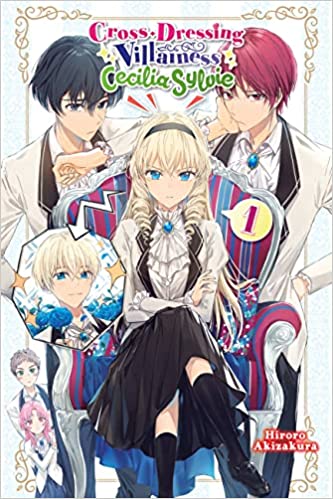
Cross-Dressing Villainess Cecilia Sylvie, Vol. 1

By Hiroro Akizakura and Dangmill. Released in Japan as “Akuyaku Reijou, Cecilia Sylvie wa Shinitakunai node Dansou suru Koto ni Shita” by Kadokawa Beans Bunko. Released in North America by Yen On. Translated by Sarah Tangney.

All novels, to one degree or another, require a certain suspension of disbelief by the reader in order to make the book function. If you pick too hard at things, you’re never going to enjoy anything. Or, as MST3K put it, “it’s just a book, I should really just relax”. Sometimes, though, it can be hard. We’ve seen enough villainess titles by now to know how they usually go down, and it’s always interesting to see what variations our heroines make to avoid their tragic fate. Cecelia’s answer is to pretend to be an invalid for 11 years, then go to school disguised as a boy, without telling her parents, so that the “villainess” doesn’t even exist in the story. Which… why is that what she thought of? We hear once or twice that she was a theater geek in her old life, but this goes above and beyond. That said, she has very sturdy plot armor on, so it mostly works fine.

Our heroine loves to play the otome game Holy Maiden of Vleugel Academy 3. So much so that she and her BL-loving friend go to see a movie based on the game… and tragically die in a fire at the theater. Now she finds that she’s Cecilia Sylvie, a duke’s daughter and the villainess of the game who’s doomed to die on every route! (And yes, before you ask, her fiancee is the prince and she has an adopted brother who dotes on her. Bakarina fans will be right at home here.) Cut to 11 years later, and we see her solution: disguising herself as Cecil Admina, a young man attending the same academy. After all, bad things can’t happen to Cecilia if she isn’t there. That said, the plot is still going to happen, and the heroine of the game, Lean, is still around. Only… why does Lean not seem to care about the other romance targets? In fact, why is Lean more interested in the romance targets ending up with each other?

This is not *quite* a BL title – Cecil is definitely Cecilia in disguise – but there’s no denying it has BL elements. Her adopted brother Gilbert knows her secret and is in love with her, and that comes out regardless of how she’s dressed. Her fiancee Oscar is rather disturbed to find how attracted he is to this young man who he’s supposed to dislike, especially when Cecil does things like crawl into his bed at night on a camping trip because of fear. And then there’s the fact that Lean and her childhood friend Jade have started up a robust line of spicy novels featuring romance between two men who are a LOT like Cecil and Oscar. This is probably the biggest reason to get these books, because honestly as a villainess book it’s not great – Cecilia’s not particularly clever, as you can probably tell by her solution to her problems, and tends to get by with strength and guts.

If you really like this genre, then you’ll probably want to read more. For fans of Hana-Kimi.

Kuma Kuma Kuma Bear, Vol. 8

By Kumanano and 029. Released in Japan by PASH! Books. Released in North America by Seven Seas. Translated by Jan Cash & Vincent Castaneda. Adapted by M.B. Hare.

One of the odd things about this series is how it references its premise several times while also being completely uninterested in doing anything with it. Yuna was, as we saw in the first volume, a very disaffected Japanese teenager, someone who literally paid her parents to go away. This is crucial for seeing how she deals with people in this fantasy world as well, and also in figuring out how much of her narration is simply pretending that she can’t see the obvious problem. And yet, after Yuna’s original transport into the game, we’ve never really dwelt on who put her there and why it happened at all – it reads as “I needed an excuse for an isekai”. It feels awkward to have it both ways, but I suspect that’s what we’re going to have to deal with, because the series in Japan is up to the 18th volume and I don’t think has devoted one iota of its time to “why did Yuna end up here?”.

The bulk of this book has Yuna, Fina, Cliff and Noa going to attend the birthday party of Misa, the noble they’d met in an earlier book. Unfortunately, Misa’s family is currently on the bad side of a power grab by the other noble family in the town, and her party – as well as a party for adults held by her grandfather – is desperately required for them to survive. Also unfortunately, the other noble family knows how these sort of fantasy isekais work – Yuna even says they’re like she imagined nobles to be like. Their grandson is sneering and bullying, they employ thugs to break the arms of head chefs, etc. Fortunately, Misa and company have Yuna, who solves things by just popping over to the palace and asking the King if she can borrow the palace chef. That said, Yuna also faces the biggest crisis she’s had to deal with so far… attending a party in a dress, instead of her bear onesie.

As always, the main reason to read this series is to watch everyone’s reactions to Yuna, and her reaction to everyone. They’re in a new town this volume, so there’s even more “it’s a bear!” than usual. Yuna knows this is a normal reaction to someone like her, but still gets irritated by it. She is a very nice, overpowered person to have in your corner… provided that you do whatever she says, something that I suspect I am thinking about more than the author would like me to. Unfortunately, she does not seem to have learned anything from Fina’s blowing up at her last time. That said, part of the problem may be that she had less to do than usual here – this is a second volume in a row with little conflict, aside from the political power struggles. In fact, we’re due for something to happen soon. Yuna works best when she’s hitting things, I think.

Fans of the series should definitely enjoy this one, though it’s pretty clear that there’s no overarching plot beyond “whatever the author wants to do next”. If you don’t mind that, hang out with the bear some more.