Reborn to Master the Blade: From Hero-King to Extraordinary Squire, Vol. 3

By Hayaken and Nagu. Released in Japan as “Eiyu-oh, Bu wo Kiwameru tame Tensei su. Soshite, Sekai Saikyou no Minarai Kisi ♀” by HJ Bunko. Released in North America by J-Novel Club. Translated by Mike Langwiser.

It can be very difficult sometimes when you are writing a series which has exactly one joke. It gets harder the longer the series gets because, well, it’s just the one joke. But, believe it or not, sometimes that is enough, and you’re able to keep going because yes, it’s a good joke. The joke for Reborn to Master the Blade is that Inglis is a meathead who only thinks of fighting strong opponents. And throughout this book, that’s what we get, over and over. Either she’s fighting them or, more often, she’s trying to fight them and failing because of things like politics or the other party refusing or having to save lives and the like. And we also see other characters knowing this and essentially smacking their foreheads. It’s one joke. But we’re early in the series, and the joke is still funny. And also Inglis as an overpowered meathead is pretty cool. As with previous books, the fights are a highlight.
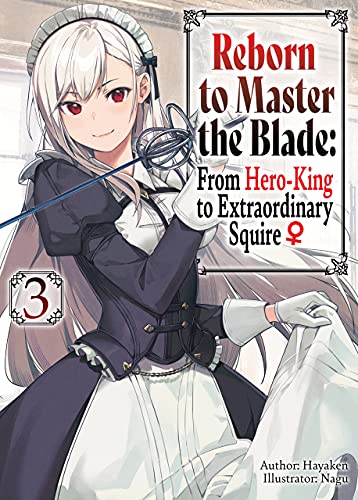
Our main cast are still trying to deal with Ripple, who is still sucking in mana and letting out monsters (and does not even have a pebble to toss or wind to blow). Unfortunately, the response of the kingdom to this seems to be “send Ripple back home and get a new heiral menace”. Which, it is implied but never outright stated, would mean Ripple’s death. What’s more, it becomes pretty clear that the reason all this is happening in the first place is that Ripple is being “punished” by one of the Highland factions in order to… well, in order to be sneeringly evil, because this is not the most subtle book in the world. Inglis and company try to work out a plan, part of which involves her and Rafinha going undercover as maids to a ceremony held by the King for a Highland ambassador. Sadly, he too is mostly cartoonishly evil. Fortunately, Inglis is there and can hit things very hard.

The other great part of this book, besides Inglis wanting to fight fight fight, is the introduction of her antimatter universe counterpart, Yua. Yua is astonishingly strong, just like Inglis, and you’d think that she’d finally found the perfect opponent. There’s just one problem: Yua doesn’t care about fighting. She’d rather take the path with the least effort where she can be lazy, and even has to be talked into fighting a bunch of potentially lethal monsters. She’s also got that ‘stoic’ Rei Ayanami-ish personality, which also balances next to Inglis’. Oh yes, and she gives everyone nicknames. Inglis is “Big Boobs”, because this is a Japanese light novel. Basically, she’s a hoot, and I am glad she was not killed off towards the end of the book, which looked like it might actually happen for a while. There’s also lots of terrorism and political maneuvering and people losing arms and then getting them sewn back on with magic, but… let’s face it, it’s not Inglis fighting.

So yes, if you like dumb meatheads who only think of one thing, this is still that thing. I do think this will work better in Vol. 3 than in Vol. 17, though…

Holmes of Kyoto, Vol. 7

By Mai Mochizuki and Shizu Yamauchi. Released in Japan by Futabasha. Released in North America by J-Novel Club. Translated by Minna Lin.

This volume was already starting off in a big hole as I read the synopsis before getting the book. I have to be honest, “I’m breaking up with you to keep you safe” is something that I really, really hate. It didn’t help that we get another of the plot devices I hate, which is the threat of rape framed as “I will despoil her”, because Virginity Is Important, Franklin. So yeah, this was already starting from a deep hole, and it’s a credit to the author that I will still likely be reading the next book. That said, they really need to accept that they are better at writing mysteries, antiquing and travelogues than they are romance, and also that the books work better in short story collections. It helps that the first half of the book does NOT involve this plot, even though it too has a trope that I’m not fond of, the “I’ve misunderstood a secondhand conversation and think my boyfriend is in love with someone else”. Honestly, this whole book is land mines.

Holmes and Aoi are dating, and are both calm and intelligent, but that doesn’t mean they aren’t free from stress. When Aoi hears that Holmes and Yoshie, the owner’s girlfriend, had an intimate conversation while in America, she knows it’s gonna be a misunderstanding but goes there anyway. After this Holmes is asked to judge a tea ceremony between two brothers to help figure out who’s going to take over the family. Unfortunately, after this, everyone’s least favorite Moriarty shows up to ruin the book. Ensho is back, trying to get Holmes to appraise an incense container and also to be creepy and threatening. After being startled that it’s actually genuine, he vanishes… only to show up at Aoi’s high school to threaten her. This is enough for Holmes, who decides to break up with her in order to keep her away from Ensho, who clearly has a vendetta.

It is suggested at the end of this book that we’ve seen the last of Ensho as a recurring villain, and thank God. It’s reminiscent of Jon Pertwee’s second season of Doctor Who, where you know who the villain is because The Master is in every story that season. He’s worn out his welcome. As for Aoi, honestly, given everything that happens to her here I’m rather stunned that she managed to sail through her college entrance exams. The “theme” of the book, such as it is, is that words can hurt and affect people even if they are aware that the words are complete bullshit. We see that with Holmes’s grandfather, father, and him, and it’s all the more startling because it’s people we know are calm and intelligent. That said, this series continues to be at its best when discussing antiques or touring landmarks of Kyoto, and those were once more the better parts of the book.

That said, the writer may be running out of Kyoto, as the next volume sees Homes and Aoi headed to Yawata City! Which, yes, is also in Kyoto Prefecture, but it’s the thought that counts. In the meantime, if you do read this for the potboiler soap opera, this will be filled with that sort of thing. For the rest of us, let’s hope it’s done.

Der Werwolf: The Annals of Veight, Vol. 13

By Hyougetsu and Nari Teshima. Released in Japan by Earth Star Novels. Released in North America by J-Novel Club. Translated by Ningen.

We continue the trend of the series gradually shifting from Veight’s adventures to Friede’s, though as long as the subtitle of the series remains the same I would not worry too much about losing everyone’s favorite vice-commander. (the best joke in this volume, by the way, is how everyone now wants to be a vice-commander because that’s what Veight was and they associate it with being all-powerful.) The narration here is closer to a balance between Friede and Veight, as is the action, though it’s weighted more towards Friede in the front. She’s something of a breath of fresh air in that, while she is undeniably strong and clever, she’s also a kid and thus cannot simply brute force her way through everything the way that Veight does. Indeed, late in the book Veight gets yelled at for solving a problem by blowing it up, even though, to be fair, that was likely the only way the problem could be solved. Friede is not super OP, so we are more interested in how she fixes things.

We pick up where we left off last time, with Friede, Shirin and Yuhette being sent to Rolmund as part of an ambassadorial visit, with the hopes that if it goes well it could lead to actual negotiations by adults in the future. What follows is essentially a continuation of the Rolmund arc from previous books, as it turns out that, unlike Meraldia, things are still very much in flux there politically. Eleora mostly has everything handled, but insurrections keep happening, and she cannot be everywhere. This is problematic when her niece, the heir (you know she’s not gonna get married, she’s one of the women who lost to Airia in the Veight sweepstakes) ends up kidnapped by one of the rival factions. Who’s going to be the one to find her? Will it be those whose job it is to do it? Or will it be our little girl protagonist? Take a guess.

I was amused at the niece/heir, Micha, who at first appears to be one of THOSE rich kids (you even see her pointing, always a sign in Japanese media that someone is rude) but quickly bonds with Friede, to the point where by the time the visit ends they’re best friends. Admittedly Friede also saves her life, which does help cement close friendships, or so I hear. As for Veight, he gets to do more on the back end of the book. Facing off against a sandworm is a scene for those who prefer the old, Veight is badass sort of story, but for me the highlight was the politics, including Veight opening up to his daughter about being a reincarnation. I too would miss easy to access potato chips if I were a werewolf in a fantasy kingdom. Not to mention paper curr3ency, which rears its ugly head as this book ends and will likely come up in Book 14.

Which we may or may not see soon. Square Enix has purchased the rights to Der Werwolf in Japan, so Vol. 14 and forward need to have J-Novel Club negotiate with a new publisher. Till then, fans of the series can enjoy this book which continues to very, very slowly pass the baton to its new heroine.