My Hero Academia: School Briefs, Vol. 5

By Kouhei Horikoshi and Anri Yoshi. Released in Japan by Shueisha. Released in North America by Viz Media. Translated by Caleb Cook.

There is a certain give and take with adaptations like these. The author of these light novels is Anri Yoshi, not Kouhei Horikoshi, and they are allowed to do some things but not others because, well, this is an ongoing manga and there is a limit to what one can do in a side story that won’t break the main story. Thus, in the last volume we saw Shinso look disparagingly at Mineta and wonder why he wasn’t expelled yet, but that’s all he did because the actual answer is Horikoshi has admitted he loves to write Mineta. This volume dances around the many revelations about the Todoroki family we’ve had since the last one, but does not actually allow the family to meet up in full again, because, well, the manga covers those times. That said, there’s still good stuff here. We see Izuku and Bakugo bond as much as they’re ever going to. We see the reader struggling to remember which classmate Shoji is. Oh yes, and we see Monoma straight up almost murder 3/4 of the cast, then try to cover it up.

The book has 5 larger stories interspersed with short vignettes of Jiro, Asui, Uraraka, and Yaoyorozu going home for the holidays. These are mostly short but cute, with some ship tease (and ship sinking) and a brief horror when you realize Momo’s parents are even worse than she is in regards to money sense. In the main stories: a) ida, Kirishima, Shoji and Tokoyami explore an underground dungeon under UA, filled with weird traps; b) The faculty all try to give Eri Christmas presents at the same time without waking her up; c) The Todoroki siblings get together for New Year’s, and Shoto realizes he is a terrible cook; d) Izuku and Bakugou try to mend the relationship between two fighting kids which is a mirror of their own; and e) after the 1-A hot pot party begins (as seen in the manga), 1-B show up and the party becomes a competition, then a yamanabe party… with potentially fatal consequences.

The stories get better as they go along, with the start of the book being the weaker side. The best are the stories with our “main three” heroes, as they dig into the deeper characterization we’ve seen from the manga and examine the tortured relationship Endeavor still has with his family (and the book does not shy away from using the word abuse). Bakugo too is very well used here, still angry at Izuku for anything and everything but realizing that this is mostly on him and trying not to actually make it worse. The most bonkers story is the last one, where Monoma accidentally feeds poison mushrooms to 3/4 of the cast, then the ones not affected have to go out into a blizzard and find the antidote. It’s good development for Kaminari, and has the best joke in the entire book (Shiozaki’s ingredient for the yamanabe), but I felt the author had trouble finding the balance Monoma desperately needs to be fun and not irritating, and the “please cover this up” ending left me slapping my head.

Still, overall I thought this was a decent volume in the series, which can never be as good as its source but is good enough.
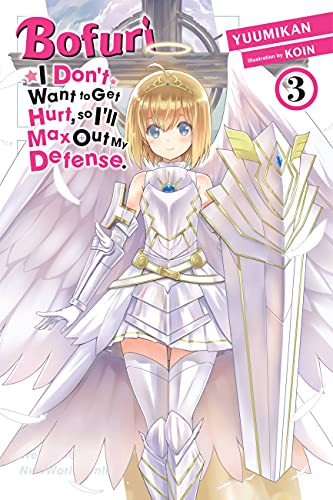
Bofuri: I Don’t Want to Get Hurt, So I’ll Max Out My Defense, Vol. 3

By Yuumikan and KOIN. Released in Japan as “Itai no wa Iya nano de Bōgyoryoku ni Kyokufuri Shitai to Omoimasu” by Kadokawa Books. Released in North America by Yen On. Translated by Andrew Cunningham.

If the first volume of Bofuri was showing us how a casual gamer can accidentally become one of the biggest monsters in it, and the second volume was dedicated to showing us how hardcore gamers are also capable of the exact same thing, then the third volume shows us that anyone, even you, can get a completely broken character. Of course, it also shows us there’s a right way and a wrong way to go about doing this. Simply trying to do exactly what Maple did isn’t cutting it – the admins have cut off doing that again. What’s more, trying to protect yourself against Maple by acquiring poison immunity assumes that this is all she has in her bag of tricks. Hardly – every 40 pages or so in this book, Maple gets a new, ludicrous ability. But thinking outside the box, as the other folks in Maple’s new guild realize, is the best way to go beyond and become like Maple.

Maple and Sally now decide to form a guild, called Maple Tree. Added to it are Kasumi, Kanade, Chrome and Iz, though they’re still looking for a couple more members to round things out. As the book goes on, each of the members of the guild, influenced by Maple and Sally, decide to go off on their own little side quests to try to get new skills as exciting and overpowered as hers. Meanwhile, this leaves Maple on her own. The third special event is designed to be for everyone BUT high defense sorts, so she’s not having much fun that way. Even recruiting newbie twins to the guild, who have maxed out in strength, doesn’t solve her wanderlust. What does? Well, fighting new battles so that she can become an Angelic Being. Or a Godzilla-like monster. Or even a mecha.

Reading these books is simply relaxing. They take place in an “idealized” game world, so there is no trolling, or sexual harassment. There’s just fun. It’s also been interesting, after having first experienced the anime, to see how it handled adapting this book. Some events are compressed – Kanade, Chrome and Iz’s fights were effectively compressed into a montage. Some stuff is changed – we meet Mai and Yui a bit later in the books than we do in the anime, and when Frederica shows up to fight Sally, there is not a beach party going on. The anime also makes things more… anime-esque, if you will. I would not call the light novel Maple deadpan per se, but she’s definitely a lot more mellow than her animated counterpart. The twins also seem a bit less hero-worshippey of Maple. These are things that don’t work as well in text, but when added to an anime give voice actors and animators a bit more to work with. It makes both enjoyable.

Next time we should get the team battles that formed the climax of the first anime season. Till then, enjoy this volume of Bofuri, which reminds you that you too can be ridiculous if only you try hard enough.

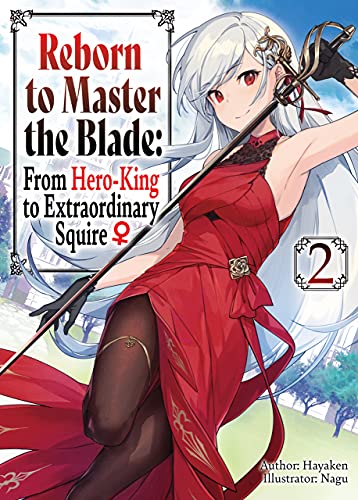
Reborn to Master the Blade: From Hero-King to Extraordinary Squire, Vol. 2

By Hayaken and Nagu. Released in Japan as “Eiyu-oh, Bu wo Kiwameru tame Tensei su. Soshite, Sekai Saikyou no Minarai Kisi ♀” by HJ Bunko. Released in North America by J-Novel Club. Translated by Mike Langwiser.

In general, when you’re reading a series that stars a big dumb person who only likes fighting, you’re not supposed to be on their side. The reader can see that there are advantages to talking things through, or do finding another way, etc. But, of course, there’s fighting anyway, because our hero just leapt in there and starting whaling away. That’s definitely true with Inglis in this second volume. What’s worse, her fights are almost all one-sided beatdowns, as she is ludicrously strong and powerful, even without any runes or talent of that sort. She is every reader’s OP nightmare. And yet… let’s face it, while reading this book, I was agreeing with her. The parts of the book that really came alive and felt like the most fun were those where Inglis had her sword out and was fighting monsters, or bad guys, or bad guys turned into monsters. She’s great fun as a meathead. The rest of the book has trouble keeping up with her.

Now that she and Rafinha are in the Academy, Inglis is ready to start learning. And by learning I mean “learning how to fight stronger and stronger opponents”. She and Rafinha have very few problems, mostly as they’re the cool kids. Leona, on the other hand, their new friend whose brother turned traitor, is having a terrible time, especially when her new roommate (the princess curl type) refuses to live with her. On their first day the three of them happen to come across a sea monster which they prevent from destroying a ship… a ship that turns out to be owned by the Rambach Company, whose heir became a Highlander in the first volume, if you’d forgotten. As a reward, they’re invited to be guards for a very important summit meeting between the company and various factions. Could it be a trap? No worries, I’m r pretty sure Inglis can punch traps away.

As noted, the fun in these books is seeing how ludicrous Inglis is all the time. We get occasional mention of her past as a male king, mostly when she’s trying not to gawk at women in the bath, but for the most part it’s just a flimsy excuse to have Inglis be less “ladylike” than some folks would like. Rafinha is supposedly her voice of reason… but is almost as bad as she is, occasionally trying to stop her but more often joining in. They’re also both desperate for food, another fun running gag, as chunks of this book are written in “Talk-with-your-mouth-full-ese”. There are actual political things going on and genuine danger to the city and country… but Inglis is content to leave that to the royal family and the knights who have to worry about politics. Indeed, her suggestion to allow the woman currently spewing out monsters on occasion to stay at the academy is “cool, monsters to fight without sneaking out!”.

So, basically, if you like smart intelligent girls and politicking, this is not the series for you. If you read it and think “I wish there was even more of Inglis hitting things”, by all means keep reading, I’m sure you will be satisfied.