Villainess: Reloaded! Blowing Away Bad Ends with Modern Weapons, Vol. 2

By 616th Special Information Battalion and Wuhuo. Released in Japan as “Doushitemo Hametsushitakunai Akuyaku Reijou ga Gendai Heiki wo Te ni Shita Kekka ga Kore desu” by K Lanove Books. Released in North America by J-Novel Club. Translated by Shaun Cook.

Fans of genres that have twenty billion books in said genre tend to fall into two distinct types: those who don’t just want to read the same old plotline and characters, and those who do, because it’s their comfort food. In most ways, Villainess Reloaded falls into Category Two. This is a magical academy series with villainess overtones, and so we get a lot of the usual staples: heroine tries to avoid her fate but doesn’t realize everyone loves her; lots of magic discussion and magic experimentation; a beach episode; and yes, for a brief moment, we meet the game’s heroine, who Astrid proceeds to try to avoid. There’s even a maid who seems cool and frosty but secretly cares about her charge! That said, there is one teeny, weeny problem with this being a comfort novel that’s more of the same: Astrid has no morals or ethics, and is turning more evil by the day as we read about her antics.
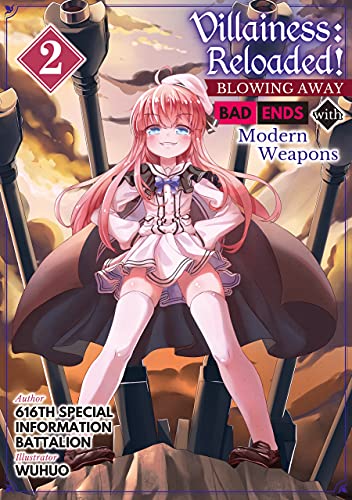
The book covers Astrid’s final year in elementary school and first year in middle school. She’s experimenting with new ways to fire guns, including howitzers, but is running into an issue: a lack of electricity won’t let her make the truly big guns. That said, she also has other things to worry about. Her father is against her doing much of anything. She meets Adolf’s younger brother, who immediately becomes infatuated with her. (He’s 6, she’s 10.) The Magic Research Club that already exists on campus is an excuse to hang out and eat cookies. And worst of all, she needs money to fund her magic experiments. This means sneaking out on weekends to become an adventurer, going on dragon-slaying quests, and meeting with a cabal of Witches who are holders of the lost magic… which was lost because it’s pretty much “magic you can use to torture or kill people”. Will Astrid join them?

She absolutely will. This should not surprise me, given that I dropped Her Majesty’s Swarm, by the same author, for having similar issues, but the heroine of this tale is morally bankrupt. That said, I will give it major points for thinking of “what if a villainess tried to avoid her fate by becoming MORE EVIL”, which is certainly *not* more of the same old stuff. Seeing Astrid experimenting with blood magic, first on animals and then on herself, to try to remove her conscience is creepy as hell, and the fact that it’s clearly the author’s intention to creep us out doesn’t really help. We do occasionally see her backing away from the darkness – she thinks about killing someone as part of an experiment but doesn’t because she’s not “quite that heartless”. Oh yes, and there’s also the fact that, like Katarina, she thinks of her fate as something that is inevitable unless she puts up a constant struggle… which also makes her a warmonger in terms of her politics.

I’m not sure I could describe this series as enjoyable. Fascinating, perhaps. I’ll be reading the next volume in the series. That said, if you enjoy villainess books in general, there are others that can scratch your itch far more than Little Miss Sociopath and Her Armory.
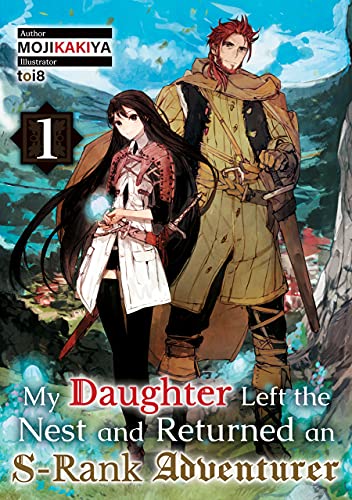
My Daughter Left the Nest and Returned an S-Rank Adventurer, Vol. 1

By MOJIKAKIYA and toi8. Released in Japan as “Boukensha ni Naritai to Miyako ni Deteitta Musume ga S-Rank ni Natteta” by Earth Star Novels. Released in North America digitally by J-Novel Club. Translated by Roy Nukia.

There is a certain disconnect in this novel which threw me off for a time till I realized what it was doing. The daughter leaving the nest happens right at the start of the book, and returning an S-Ranked adventurer right at the end, and so there’s a lot of middle to fill. Some of it can be frustrating at first glance, such as the running gag of Angeline starting off on a vacation to see her dad again at long last only to have it cut short because other issues take priority or because she’s the only really strong adventurer in the area. As it turns out, though, it’s more than a running gag, it’s a part of a greater problem that needs fixing. That said, we do get a reunion at the end, and there’s plenty of what I would call the meat of this book: Angeline praising her father to a ridiculous degree, and Belgrieve proving that it’s not just rose-tinted glasses, he really is that good.

Belgrieve left his village to be a top adventurer… but a bit later lost a leg. While still an E-rank. So he went back to the village, put up with the ridicule, and set out to do whatever else he could. In fact, despite his prosthetic leg, he’s managed to become quite strong simply by constant monster hunting and gathering supplies. Then one day he finds an abandoned child in the forest, and raises her as his own. Twelve years later, inspired by the stories her father told her, Angeline goes out to the big city to become an adventurer herself. She has a lot more success than her father did, and five years later is the top adventurer in the city, and possibly even in the top adventurers in the country. Unfortunately, there’s also a larger amount of fiends lately, meaning she has no time at all to return home and see her dad. What can she do to fix this?

As noted when this title was licensed, this is NOT going to be a Bunny Drop or If It’s for My Daughter, I’d Even Defeat the Demon Lord series. All 10 volumes of S-Ranked Daughter are out in Japan, and from what I hear the relationship remains a normal dad and daughter relationship. This doesn’t mean that she’s not obsessed with her dad – a lot of the comedy comes from hearing just HOW obsessed with her dad she is. But knowing it won’t go “there” means we’re able to enjoy it as a typical spoiled daughter behavior. Plus, honestly, he deserves most of it. Turns out, prosthetic or no, Belgrieve is able to take on C-class monsters with ease, and makes friends with the local gods to boot. Which might come in handy in future books, as we get hints that someone is trying to raise a lot of demons for some sinister purpose.

The cast is more than the two of them, of course. I particularly like the family of nobles we meet, three daughters who can be summed up as “sensible”, “airhead”, and “named after a font”. Still, it’s dad and daughter you’re hear to read about, and I will be looking forward to Book 2.

Invaders of the Rokujouma!?, Vol. 37

By Takehaya and Poco. Released in Japan as “Rokujouma no Shinryakusha!?” by HJ Bunko. Released in North America digitally by J-Novel Club. Translated by Warnis.

Given the longevity of this series – at 39 volumes (counting the two .5 volumes) it’s probably the biggest light novel series to hit North America in full translation – it’s not particularly a surprise that the more recent volumes are taking the time to look back at the past. This is particularly true of this, a short story volume that follows the usual pattern we’ve seen to date – three web-only short stories and a longer story written specifically for this book. The three web stories all involve looking back at the past in some way, shape or form, and seeing how far people have come. Harumi and Clan, who are in many ways opposites, each envy the other; Theia and Ruth reflect about the fact that they can trust other now and are better people as a result; and Sanae and Shizuka think about life without Koutarou in it and decide “no thank you”, even if at the time they may have felt differently. Fortunately, the final story in the book looks toward the future… and has swimsuits.

In the first story, Clan and Harumi (and Alaia, as Harumi’s later ego) are looking back over events of two thousand years prior, where Clan is forced to admit that Koutarou basically did all the cooking and laundry. The two then use magic and technology to swap bodies, essentially, so Koutarou can roughly rub Harumi’s head and treat Clan with respect and politeness. The second story has Theia and Ruth trying to pick out photos for a news article about the Blue Knight, and thinking about their childhood together and how difficult it was for both of them. The third story sees Shizuka and Sanae spring cleaning all the apartments in the complex, and also stirring up memories – be it Shizuka’s parents before their death or Sanae’s “haunting” of Koutarou before the others arrived. Finally, Koutarou and the girls go on a private beach holiday… but also find time to sneak in some plot-based activities.

Shizuka’s story reminded me that there are other residents of the apartment complex besides her and the 106 herd, and we really haven’t ever ran into any of them, have we? Even if they don’t complain about the noise and/or property damage, you’d think the idea of one man living with so many girls would cause them to at least talk to the manager. Then again, she *does* know martial arts… As usual with these short story volumes, the longest was the best, as we see Nefilforan and her troops wanting to train against Koutarou and the other girls, as they’re all basically powerhouses. This gives us a chance to see just how powerful everyone in the group has become… and yes, for once that includes Yurika, though she thinks sleeping gas is not very cute and magical girl-ey. Unfortunately for the girls, while Koutarou is slowly getting over his past traumas and personality flaws, he’s not really ready to admire the girls’ swimsuits at all or show that he is sexually attracted to them. Perhaps it might take another 39 books.

Of course, this still leaves a cliffhanger from the last book hanging there, and the author promises that we’ll get back to the main plot in Vol. 38, which should focus on Sanae. Till then, this is a good short story volume that is a definite buy for anyone who’s read close to forty other volumes of this series.