I Shall Survive Using Potions!, Vol. 7

By FUNA and Sukima. Released in Japan as “Potion-danomi de Ikinobimasu!” by K Lanove Books. Released in North America by J-Novel Club. Translated by Hiroya Watanabe.

After essentially rebooting the series last volume, possibly the biggest surprise here is how little Kaoru has to survive using potions. They come up a few times, notably when some of the cast need to be healed ASAP, but they aren’t the running gag of “make me an ‘x’ that’s really a potion bottle’ that they used to be. Mostly her abilities have become similar to Mile’s Storage, which is to say she can whip out transport or food when needs must. This is not to say that she’s just sitting around and doing nothing however; she and Reiko are getting a business off the ground, using their two new ex-orphans as employees, and there’s also the occasional muttering about finding a husband, though even Kaoru seems to have realized it won’t happen as long as she looks that young. Indeed, most of the first quarter of the book is about starting the business… and Kaoru finding loopholes to avoid paying taxes. Then they go looking for more employees…

Kaoru, of course, always seems to think that she can disguise her absolutely ludicrous abilities and just be an average, everyday businesswoman, and Reiko seems to be going along with this. Both of them seem to have forgotten what happened 70-odd years ago, and how Kaoru was literally enshrined into myth and legend. The running gag for this book, which is quite amusing, is how all of the young kids working for her know who she is but try not to say anything because she’s clearly avoiding the subject… even as she once again does something that only the legendary Kaoru could do. Speaking of the kids, this is a fantasy world isekai, so I will warn there is a lot of child labor here. That said, they’re paid well, and it’s an improvement on the virtual slavery they were stuck with before. As with Kuma Bear, you’re supposed to regard it as heartwarming.

The other subplots in the book feature Leia, another goddess who has essentially come down to Kaoru’s country so she can see why Celes is so fascinated with it. For the most part, she acts like a somewhat naive ojou, but there’s a very nice scene at the end of the book where she starts to realize what living actually means, and it’s well-handled. The other big event, right at the end of the book, is Kyoko’s arrival, the third of the “KKR” trio from Japan. As far as I can tell, the rule of thumb of their lives in Japan was that, while Kaoru threatened her way out of trouble, and Reiko blackmailed her way out of trouble, Kyoko seems to have simply gotten into trouble – she’s presented so far as a bit of a fluffhead. She shows up in a UFO, as her ability is to be able to create literally any ship – sadly, she can’t create crew for these ships, so she’s reduced to crafts that can be used by one person. She promises to add even more chaos.

For those who miss the old supporting cast, there is a brief after story showing what Francette and Roland are up to… and the answer is “raising kids so powerful that no one can defeat them, along with a Red Sonja-esque desire to marry only someone who can defeat them”. Still, while this wasn’t as world-shattering as the last book, it was a good solid volume.

Accomplishments of the Duke’s Daughter, Vol. 2

By Reia and Haduki Futaba. Released in Japan as “Koushaku Reijou no Tashinami” by Kadokawa Books. Released in North America by Seven Seas. Translated by Andria Cheng.

It’s not always easy trying to reform something. First of all, how much can you really do? Iris is the acting governor of her land, and is doing a great job of building it up and modernizing it. But what about the next domain over? What about the entire Kingdom? What about the Kingdom next door, which is not nearly as well off as you are? These are not questions one can easily answer, and Iris has trouble coming up with answers either, though she’s doing her best to try to make changes that everyone is going to want to emulate. Fortunately, as I noted in my previous review, she has a ridiculous number of allies who are there to help her make those changes. Unfortunately, she also still has a large number of enemies. The villainess otome game aspect of this continues to be a very small part, while the politicking and intrigue are definitely at the forefront. Which is for the best, really.

Iris may be the glory of Armelia, but that means little to the Kingdom as a whole, which does not know she’s behind the Azuta Corporation and thinks of her as the noble who got shunned by the second prince. That said, an invitation by the Queen Dowager to a major function helps her start to reintegrate into high society, helped along by the prince, who is being an absolute dick, and also Yuri, the protagonist of the otome game that this supposedly is based on, who is at best ridiculously unaware of everything and at worst an actual enemy agent. Then, just when things seem to be going really well, word comes from the Church that Iris has been excommunicated! With employees leaving her company and neighboring domains refusing to allow trade, is there anything Iris can do to possibly get herself out of this? If only she had a really hot assistant who was secretly the first prince…

As I said earlier, the otome game aspect of these books is minimized, but I do want to come back to the character of Yuri. I’m not sure if the author of Duke’s Daughter read My Next Life as a Villainess before starting this (there are many other examples of the genre, but Villainess did begin on the web about 8 months before this title), but it’s hard to look at Yuri and not see Evil Maria. Which makes sense, given that Iris is essentially Good Original Catarina, without the personality of the Japanese girl overwriting her. I appreciate that Iris can’t be sure if Yuri is a spy that is seeking to have the kingdom collapse simply because if she is, she’s so bad at it. There are many other ways to go about doing this rather than acting like a cliched otome game heroine trying to get all the Good Ends with the various boys. I doubt we’ll ever get anything from Yuri’s perspective, but it would be interesting.

With another crisis solved, you’d think the series would be wrapping up quickly. But alas, the first Prince absolutely does not want to marry Iris, as he’s far too content seeing her “flying free” and changing the entire world. it’s hard to disagree with him. That said, I hope Dean sticks around, if only for her own mental health. This was an improvement on the first volume, though it has the same flaws.

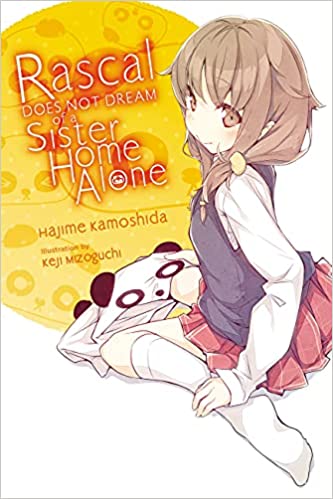
Rascal Does Not Dream of a Sister Home Alone

By Hajime Kamoshida and Keji Mizoguchi. Released in Japan as “Seishun Buta Yarou wa Orusuban Imouto no Yume wo Minai” by Dengeki Bunko. Released in North America by Yen On. Translated by Andrew Cunningham.

The first four books of the series had its main character, Sakuta, helping out a different girl each time who had what he termed “Adolescence Syndrome”, where an inner issue they were suffering from showed itself in an exterior way. Mai was turning invisible, Tomoe was time looping, Rio twinned herself, and Nodoka bodyswapped herself with her sister. Through all this, though, we were also learning of Sakuta’s own past – both his encounter with a high school girl named Shouko (who he rediscovers but not in high school) and his sister, whose reaction to bullying, and his frustration and reaction to her own pain, is what jumpstarted all of this. Now, at last, in this 5th book, we finally get to focus on Kaede. She’s more determined than ever to leave the apartment and go to school, to the point where she has a list of tasks in her diary. Together with Sakuta, can she succeed? Well, yes, but that’s not necessarily a wonderful thing for all involved.

Much of this book is about moving forward and trying to take a next step. For Sakuta that means actually applying himself. Mai, despite her celebrity, is going to college, and Sakuta wants to follow her there a year later. For Kaede, this means a whole lot of things. Just going to school is fraught with tensions, given that whenever she sees someone she doesn’t know, especially someone wearing her school uniform, she has a panic attack. She’s also re-exhibiting signs of her adolescence syndrome, which is definitely not a good thing. (Given that when this happened before, the authorities thought her mother abused her, I worried they might zero in on Sakuta, but thankfully this does not go there.) And there’s another, even larger issue: Kaede, as we discover here, has no memories from before two years ago. Given the way amnesia works, there’s a danger that she might lose herself no matter what the outcome.

There is a large chunk of this book that is very heartwarming. Seeing Kaede’s determination is great, trying to take small steps despite her terror. Sakuta strikes exactly the right notes, knowing when to push and when to retreat. The scenes at the zoo were magical, and brought a smile to your face… which of course makes the last fifth of the book all the more tear-jerking. It’s startling to see not just Kaede but also Sakuta re-develop symptoms from adolescence syndrome, and of course it happens when Mai is out of the city and can’t help him. Fortunately, he has Shouko – the older version – to help him once again. That said, she’s not Mai, and I wish that Mai had been there to talk him out of it. Mai remains the best part of this series. In any case, I’m not sure where Sakuta’s family relationship will go from here, but hopefully his romantic relationships will survive the cliffhanger. They probably will, she’s eminently sensible.

I joked on Twitter that the next two books would be light and fluffy – trust me, I saw the movie reviews, and while I don’t know what’s going to happen I know it’s a tear jerker. But so is this, in its own way, as we take a look at what makes up a person’s identity, and how fragile that can really be.