Outbreak Company, Vol. 17

By Ichiro Sakaki and Yuugen. Released in Japan by Kodansha Light Novels. Released in North America by J-Novel Club. Translated by Kevin Steinbach.

One thing that has always remained reliably on brand about this series is how all in it goes on its otaku evangelism. The author is clearly just as bad if not worse than his lead character, and it shows, as the books are littered with references to anime, manga, books, films, games, etc. And what’s more, this is shown in a (mostly) very positive light, with people who would otherwise be indifferent to if not hate each other bonding over their shared obsessions. This particular volume seems to really lay the references on thick – it trusts that readers will not only know what Area 88 is, but also buy into the extended Star Wars riff that comes at the climax of the book. It even affects the plot, as the Americans who show up in Eldant towards the end are somewhat stunned to see the princess swearing at them, as she’s quoting the cliched stock American from Japanese media. That said, the guys who show up in Eldant very much DO feel like stock characters – Outbreak Company is not only a huge fan of cliches, it’s also a client.

We pick up where the last book left off, after a brief prologue from the POV of Shinichi’s family showing how things are going back in Japan. Not well. The hyperspace tunnel is starting to really go to pieces, which is leading to lots of natural disasters. As such, Japan has decided to punt, and tells Shinichi and company they’re pulling out of Eldant in five days. Needless to say, the cast are varying levels of upset by this – Minori is pretty cool with just going back, Hikaru suddenly realizes his own feelings for someone else in the cast, and of course Shinichi is still waffling about what love really is and if he’s in it with anyone. If he stays behind, lacking any ability to either import or create anime and manga, isn’t he just useless? If he takes a girl back with him to Japan, won’t they just be captured and experimented on? And then suddenly the USS Nimitz appears on top of a forest in rival nation Bahairam, and everything gets blown to hell.

As is typical of this series, Shinichi can be thick or clever when the situation demands it, as with his being unable to understand why Petralka seems to be OK with him leaving forever, missing the subtleties of her response as well as her own true feelings. We’ve still got one volume to go, and it’s possible that he won’t pick anyone, but I’d still lay odds on Myusel, who also has a bit of a love revelation in this book. As for the subplot, it’s basically pure action movie – the book makes many references to the 1980 movie The Final Countdown, as our heroes have to infiltrate Bahairam – again – and try to stop the war breaking out between their country, already upset about losing the Dragons Den, and some very jumpy naval officers. Can Shinichi talk everyone down? Can they figure out how to return a battle carrier to its proper place in the world? And can we actually get anyone to confess their love at all without being under the influence?

The next volume is the last, though there’s also a short story collection that I’m not sure is licensed. Fans of the series should enjoy it, though I suspect, like me, they’re happy it’s finally drawing to a close.
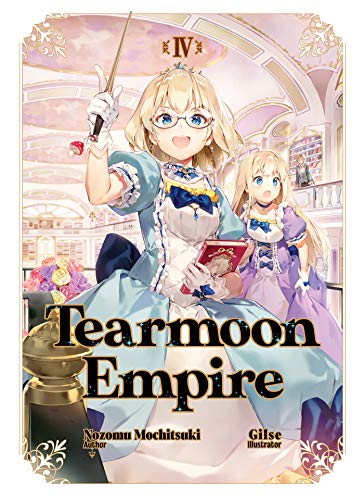
Tearmoon Empire, Vol. 4

By Nozomu Mochitsuki and Gilse. Released in Japan as “Tearmoon Teikoku Monogatari” by TO Books. Released in North America digitally by J-Novel Club. Translated by David Teng.

We’ve now had three books filled with Princess Mia doing something for either selfish or silly reasons (or, increasingly, because she is a very nice person) that ends up misinterpreted by everyone around her as pure brilliance, and we get plenty of that here as well. But we’re starting to also see the rest of the cast accomplish things away from Mia and have their own subplots. No, alas, I don’t mean Miabel, who’s still pretty much the mascot character of the series, and gets left behind for the second half of the book while the rest of the cast have a cruise. Instead, it’s Ludwig, thinking of some offhand remarks of Mia’s as well as what he thinks she would be doing in his place, that leads him to uncover a web of political intrigue that could end up crippling the Empire if things do end up happening the way that Mia predicts they will. His investigation and detective work is a refreshingly sedate part of this book. That said, rest assured there’s still a lot of Mia vs. reality here to love.

As with a couple of other Tearmoon books, the main plot is divided into two large chunks. The first picks up where the previous book left off: the school Mia had planned to start up is floundering, as ,most of the teachers and the headmaster have left. The answer is sadly obvious: Mia may be a very atypical noble now, but most nobles are far more like what Mia was in her previous “life”, and they are not having which this school where horrible farmers will be taught. To solve this, Ludwig suggests bringing in his former mentor, an eccentric old man whose grumpy tendencies and dislike of most nobles play right into Mia’s hands. After this, she is invited on a sea cruise to a tropical island by fellow noble Esmeralda, who IS like most nobles are – you will expect her maid to stab her in the face before the book finishes. Accompanied by Sion, Abel and Keithwood, all of whom supposedly go to “guard” Mia, they sadly run into a typhoon, leaving them stranded on an island that no longer looks as fun.

To get a big negative out of the way first, there is a subplot here about Mia getting a swimsuit for the cruise and realizing that she has tummy bulge, which unfortunately leads to a bunch of fat jokes, though Mia does end up losing most of the weight before the cruise itself. It’s not welcome. The rest of the book is filled with Tearmoon shenanigans, as most of the cast are content to listen to what she says and then make the most amazingly wrong conclusion imaginable, usually to the benefit of everyone involved. The semi-exception here is Keithwood, who knows Mia can be a flake, and is irritated with her mushroom obsession (especially as most of them are poisonous), but still regards her as a force for good. Which, honestly, she is. The narrative may frame Mia’s actions much of the time as self-interest or cowardice, but more and more we’re seeing Mia just be really nice to everyone – and get irritated when other nobles are not, as her anger towards Esmeralda’s treatment of her servant shows. Mia may be no Great Sage, but if things continue to go like this, she may make a very good leader.

The books are getting quite popular in Japan – the author talks about a stage play being made, and a 2nd one is due out this year – and it’s not hard to see why. Mia is fun, the books are exciting, there’s some good politics, and each book is long enough that you get a lot of bang for your buck. Hopefully fewer fat jokes next time, but otherwise still essential.

Holmes of Kyoto, Vol. 4

By Mai Mochizuki and Shizu Yamauchi. Released in Japan by Futabasha. Released in North America by J-Novel Club. Translated by Minna Lin.

Rarely have I had to eat my words quite so much as I have in the gap between my review of the third volume and this one, and I urge readers to absolutely not go back and read it. Still, it does mean we have to confront the elephant in the room, though admittedly the book is doing it as well. This series features a man just out of college in love with a girl still in high school, and Japan sure has no issues with this whatsoever given the sheer number of titles out lately featuring age-gap romances, but Western readers tend to dig in their heels a lot more. Now, let’s not kid ourselves, things are not going anywhere anytime soon. Indeed, I will be very surprised if anything happens before Aoi turns 18. Mostly as Aoi continues to delude herself about Holmes’s feelings towards her, which are not only obvious to the reader but are starting to be obvious to everyone else as well. Fortunately by the end of the book, Aoi has at least come to a different realization.

As with other books in this series, we get a short story and three longer ones. The short story is simply Holmes taking Aoi on a date, though she doesn’t actually realize that’s what it is. We then get to meet Holmes’ grandmother, who has a bisque doll that strangely is the distaff counterpart to one they have in the antique shop… and one which might be haunted! After that, despite the author’s assurances in previous afterwords, we get what amounts to a murder mystery, albeit one where the victim survived, and Holmes is forced to deal with a case whose only artwork is the books of an author. Lastly, we meet the owner’s stepson Rikyu, who idolizes Holmes and who clearly is NOT loving Aoi at all. Will she be able to win him over by being a quasi-appraiser at an event thrown by Rikyu’s grandfather to determine who gets his inheritance?

As noted, the second case, while quite well done, feels a bit different to the other “cases” we’ve read, even though we’ve dealt with death and attempted assault in previous books. Possibly for this reason, it also feels a bit overdone, with Holmes’ talents not feeling as natural as they do when he’s looking at antiques. The third story was the best, as Rikyu is a fun addition to the cast, basically being a sullen teen who’s unhappy that his favorite relative is being taken away from him by another woman. I will admit that Aoi’s preternatural progress in learning about artwork and antiques is almost as unrealistic as Holmes turning into Hercule Poirot, but the moment is set up really well and you feel so happy for her I’ll grant it. And we do get an awful lot about Holmes clear feelings for Aoi and mistrust of other men (he’s right, she is awfully naive) as well as Aoi’s tendency towards self-loathing cropping up, thinking that Holmes is “far beyond her”… but at least, right at the end, she can admit to herself she’s fallen in love with him.

So yes, last time I said this wasn’t one for romance fans, and I will have to take that back, but I do think that mystery fans will get more out of this. We’ll see what happens in the next volume, this is a long-running series.