Strike the Blood, Vol. 17

By Gakuto Mikumo and Manyako. Released in Japan by Dengeki Bunko. Released in North America by Yen On. Translated by Jeremiah Bourque.

This is the first of two books that will be adapting stories that originally came out back around the time of the first anime, from 2014-2015. This one was also originally a 7-page short story, but, needless to say, has a lot more going on now that it’s around 250 pages. (Remember when Strike the Blood books were short?) It’s not too much of a spoiler, really, so I will note that this is a ‘daughter from the future’ sort of plot, and honestly I am a sucker for those sorts of things. That said, there’s also a lot more added here to tie in to the rest of the series and to set up events going forward. Shizuri is now officially a main cast member, getting quite a bit to do, and we also see Yuiri and Shio showing up again. As for the enemy, well, it’s fairly light as Strike the Blood enemies go – it’s a rampaging demon beast. Still enough to cause massive amounts of property damage, of course.

After beating up Kojou and Shizuri’s two allies from the previous book, the demon beast has to be taken down – and Kojou can’t do it, as the beast basically feeds on magical and demonic energy. Yukina is able to temporarily defeat it, but – as the subtitle of the book suggests – this causes her main weapon to be destroyed. This is bad news all around, as she’s now being summoned back to Lion King Agency Headquarters and Yuiri is going to take her place watching Kojou. Both Yukina and Kojou hate this, but are still both in the “what do you mean we’re not in love with each other?” stage of things, so there’s mostly a lot of moping. To Yukina’s additional consternation, there’s a fake Yukina running around as well. Looks just like her… except Reina is a vampire, knows a lot more about everything than she should, and sometimes calls Yukina “mom” by accident.

Reina is the most fun part of the book. As you can probably guess, she doesn’t seem like the sharpest knife in the drawer, but she’s certainly got powers out the wazoo, and is here to make sure that Yukina is NOT recalled from the island… which would lead to her fading out of existence. I also liked Asagi trying to be a bit more proactive and creating a school club that’s on the lookout for demonic activities – if nothing else, hopefully this will help Kojou have fewer days absent. There’s also a lot of politics behind the scenes – there are those who want Yukina gone because, since she has no family to threaten, she could easily turn against them, not to mention her status as a Blood Bride. And, of course, this being Strike the Blood, half the book is fights, which are well-written as usual, and I’m sure look very good animated. Oh yes, and there’s evil twins.

So, overall, given I’m not making fun of it, I’d say this was on the high side of Strike the Blood volumes. Next time we see Kojou going to a party of La Folia’s, and hopefully get Sayaka, who has been absent from the story for I don’t know how many books, back in the equation.

The Apothecary Diaries, Vol. 1

By Natsu Hyuuga and Touko Shino. Released in Japan as “Kusuriya no Hitorigoto” by Hero Bunko. Released in North America by J-Novel Club. Translated by Kevin Steinbach.

I’ve been waiting for this one for a long time (this first novel came out in Japan in 2014), and it would have taken a major misstep for me not to be delighted by it. Spoiler: there was no major misstep. Now admittedly, I can see that it’s not a book for everyone. If your ideal of a fun light novel is along the lines of Sword Art Online or Haruhi Suzumiya, this is not going to be for you. I almost added A certain Magical Index to the list, but I’ll be honest: if you read Index for the political infighting (there must be some who do), this is your sort of book. It will also appeal to fans of Ascendance of a Bookworm, Accomplishments of the Duke’s Daughter and other series heavy on worldbuilding. But most importantly, this will appeal to fans of the classic mystery. Maomao is a reluctant forensic detective, but that is what she is called on to be here, and she excels.

The story opens in the Emperor’s vast royal palace, with our heroine, Maomao, already working there. She was kidnapped while in the woods one day and sold to the palace by “merchants”. For the most part, she does laundry and tries to keep a low profile… till she notices that two of the Emperor’s consorts, and their children, have taken ill with what Maomao (and the reader) can clearly see is mercury poisoning. She tries to subtly convey this, but is discovered by Jinshi, a eunuch who works for the Emperor, and is promoted to be poison tester for the consort whose life she saved. As the book goes on, Maomao finds herself getting involved with more poisonings, assassination attempts, and even standard bullying. The reader, meanwhile, discovers that Maomao is far from the stock shoujo light novel heroine… and even the stoic ones aren’t quite as odd as she is.

As you might guess, Maomao is the number one reason to read this. Her matter-of-fact dialogue and banter with Jinshi is beautiful (the translation shines throughout), and you can see exactly why Jinshi grows so attached to her so fast – she sees through his pretty face for the manipulator he really is, and looks at him “like a worm” – something that I’d say would turn him on if he weren’t a eunuch. (That said, I will not be too surprised if he has a secret to hide about that.) Maomao’s detective work is excellent, both when she’s in her wheelhouse of poisons and also when she’s having to guess motive and opportunity. And, well, she’s weird – curiosity always wins out for her, even when it comes to potentially lethal drugs or foods. I also liked the consorts and the wars between them, from the far too young girl who is passively bullied by her attendants, to the older one with a past to hide, to the sexy one who is on the outs with the Emperor till Maomao gives a very obvious – and hilarious – implied suggestion – as well as Maomao’s own savvy mistress.

The book ends in such a way that it could have been a one-shot, but there are nine volumes to date in Japan, and it has a manga that is being published here by Square Enix. Very much driven by the mysteries and its heroine, I found I was unable to put this book down. Bring on the second volume.

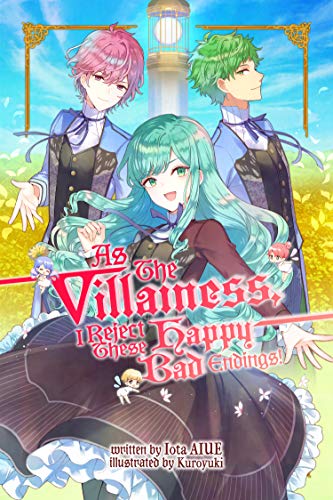
As the Villainess, I Reject These Happy-Bad Endings!

By Iota AIUE and Kuroyuki. Released in Japan as “Watashi, Tensei Akuyaku Reijōnanode, Meribaendo wa Soshi sa Sete Itadakimasu! !” by Berry’s Bunko. Released in North America by Cross Infinite World. Translated by Molly Lee.

By now we are so familiar with the Reincarnated As a Villainess genre that we start to look for differences or alternate takes that make this stand out from the pack. On that score, Happy-Bad Endings (as I’m going to call it) doesn’t hold up so well. This is almost textbook reincarnated villainess, down to the letter. Actually, it’s a good sign that, as I was reading along, I found myself thinking “I want to read the original VN the heroine was playing, it sounds ludicrously over the top. Iris as a heroine is not cheerful yet dim like Katarina, but she does possess a bit of the same “I cannot see this person as anything other than their character from the game”, which certainly frustrates her love interest, the prince. That said, I found this a very good book to read, mostly as it does the genre very well, and it has some individual scenes that are stellar set-pieces.

One morning, Iris du Chevalier wakes up from a horrible nightmare of the world burning to discover… she’s not in Japan playing her favorite otome, game, she’s in the game. And Iris is the villainess. And the game is notorious for even its happy endings being dark and twisted. Her twin brother chains up the love interest and brands her, the prince imprisons her in a tower forever, and the mage discovers that they’re really half-siblings and destroys the world. And, in ALL the endings, good or bad, Iris suffers. Death is not actually the worst thing. Now she has to a) make the three love interests less twisted, b) deal with the soilpox scars on her arm that cause her to be shunned, c) deal with going to the academy despite having literally zero magic, and d) avoid horrible fates. It’s harder than you think!

As I said, the plot itself is pretty much otome villainess 101, but it’s handled well. Iris searching for a way to beat soilpox (this world’s smallpox) is a compelling plot that has nothing to do with the game’s events. The world itself has several elements that weren’t present in the game at all, and finding out about them both gives Iris a huge leg up and also confuses the hell out of her. The heroine, Camille, is sweet as pie but also invites trouble – as you’d expect of an otome heroine. My favorite scene is near the end, where the cast approaches what, to Iris, is the final fate of the most dreaded of her bad ends. She’s long since made sure that this end is not going to happen, but it doesn’t matter – the fact that she is Iris, in the game world, and at THIS place causes her to have a tremendous stress reaction. It’s fantastically written.

So yes, once again, cliches can be defeated when the writing is good enough, which this certainly is. It’s also done-in-one, so you don’t need to worry about a cost sink. A must for Villainess fans, and a good read for shoujo light novel fans.

Also, please don’t name your otome game love interest de Sade. I beg of you.