Fushi no Kami: Rebuilding Civilization Starts with a Village, Vol. 2

By Mizuumi Amakawa and Mai Okuma. Released in Japan as “Fushi no Kami: Henkyou kara Hajimeru Bunmei Saiseiki” by Overlap. Released in North America by J-Novel Club. Translated by Maurice Alesch.

Not to spoil or anything, but around 4/5 of the way through this second volume, a demon monster shows up. It startled me, as the entire book before this had essentially been ‘let’s learn how to make fertilizer’ and ‘tomatoes are awesome!’. What I said when reviewing the first book goes double for this one: it’s a slow life book where the slow life is running at top speed. Indeed, the inability of anyone to stop Ash and his ideas becomes a running gag. But then ‘rebuilding civilization’ is in the title, and it can’t be denied that Ash’s ideas are very good. So the demon monster, just like the bear from the first book, is there to give Ash a chance to be a more typical hero, one that can fight against huge antagonists rather than simply be an intellectual. It’s a good fight, too. That said, I think I like Ash casually tipping over all preconceptions of what society is like a bit better than stabbing a creature through the eye.
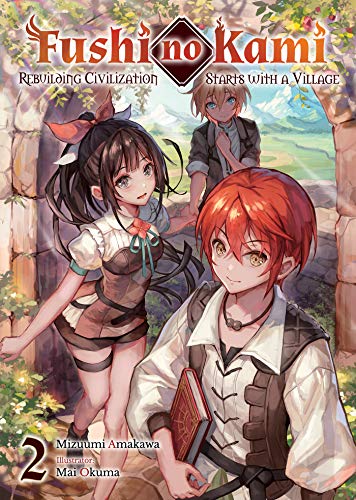
Ash and Maika have arrived at the nearest city to continue their educations. It’s not the grandest city in the world… Ash is unimpressed. But it’s certainly got more books than his village had, and maybe here he can learn to make better fertilizer. His roommate is Arthur, a noble who is actually a girl disguising herself as a boy. Ash, sensing tragic backstory, doesn’t let on he’s guessed this and merely gives Arthur space every morning and evening. They’re theoretically there to learn reading adn writing, but both know how already, so instead Maika works on her martial arts and swordsmanship, and Ash works on overthrowing all common sense. He makes liquid soap… which turns out to be illegal, but eh. Semantics. He grows delicious tomatoes… which everyone thinks are poisonous, and he has to research why. Can he drag this city kicking and screaming into the modern world? And can Maika ever get through to Ash that she’s in love with him?

As with the first volume, the POV here alternates between Ash and various other characters to show both things happening when he’s not around/unconscious, or to show how others react to his eccentricities. Maika is the most interesting of these, as it’s become clear that her love for Ash is burgeoning on obsession, as she talks about making sure she’s worthy to stand at his side. Honestly, there’s a very messianic quality about Ash in general, not helped by the author’s afterwords supposedly being written years later showing us Fushi no Kami as a “history textbook”. The other main character introduced here is Arthur, and I was rather surprised that we only got a few hints of their rather unhappy life to date, and don’t get into the reason for the disguise. Arthur is mostly miserable, meaning their fake smiles piss Maika off, and seeing the three of them bond is the heartwarming part of the book.

Ash may not have magic swords or fireballs, but in his own way he’s just as OP as other isekai heroes. How much you enjoy this book might depend on how much you can tolerate everyone worshiping the ground he walks on. That said, it’s a very readable book, and you never feel bored, even when discussing things like “I need seaweed in order to take the next step in my plan”.


Der Werwolf: The Annals of Veight, Vol. 10

By Hyougetsu and Nishi(E)da. Released in Japan by Earth Star Novels. Released in North America by J-Novel Club. Translated by Ningen.

Now that Veight has pretty much succeeded in uniting the continent, and Airia is settling in as the new Demon Lord (and also getting pregnant, which answers that whole ‘can werewolves and humans mate?’ question from the last book), the book have been branching out into other unrelated countries, showing how they really need Veight to come in and shake things up. His trip to Wa was fairly straightforward and normal, despite the past life shenanigans, but this time things are a lot more difficult, and Veight is going to be forced to take action despite wanting nothing more than to stay by Airia’s side. Oh yes, and teach young students how to be a good leader. In fact, this book may be outdoing Realist Hero on the subject of running a country, and it also does not need to venerate Machiavelli, which is always a plus. Most of all, though, we get a really nasty and horrible villain here, something we haven’t seen in these books for a while.

Kuwol, a southern kingdom with lots of sea transport, is getting close to a civil war between two varieties of nobility and a rather shallow and brainless king. Veight is trying his best to stay out of it, knowing that they don’t have the ships to send a huge army and also don’t want to get involved in foreign affairs, but as things go further south, and Parker goes missing, he is forced to act. What he finds is that one of the groups of nobles has hired mercenaries to supplement their forces, led by Zagar, who is a thoroughly reprehensible man who nevertheless commands intense loyalty from those at his command. Veight doesn’t trust him, but is not particularly a violent man, so is content to wait and watch and try to make things better for the civilians caught in the war. Unfortunately, this proves unwise as Zagar has grander plans than a simple civil war.

The main plot is pretty much what you’d expect, and the author says in the afterword he wanted to show Veight’s hands-off approach being the wrong choice. That said, there are lots of little details in this book I liked. Seeing Veight’s young students trying to come up with forward thinking ideas. Airia’s absolutely awful morning sickness, and Veight feeling somewhat helpless to do anything for her. There’s a moment near the end when Zagar offers Veight three of the former lord’s mistresses for pleasure, and Veight, naturally, is uninterested in anything but Airia. However, Zagar is determined to second the women to Veight’s company (are they spies?) and so asks if they can be secretaries, and they promptly show off a savviness that I quite liked. That said, the brutality of the final scenes is start, and we’re left with a cliffhanger that makes us wonder how Veight is going to handle things without the whole nation falling apart.

The next book is supposed to be the last book in the “main series”, though I know there’s at least one after it. I suppose peace and prosperity are harder to write about, which is probably why Veight is traveling to a civil war. In the meantime, Der Werwolf remains very underrated, and has a minimum of Veight being super modest this time around.

She’s the Cutest… But We’re Just Friends!, Vol. 1

By Akamitsu Awamura and mmu. Released in Japan as “Ore no Onna Tomodachi ga Saikou ni Kawaii” by GA Bunko. Released in North America by J-Novel Club. Translated by Kristine Johnson and airco.

I tend to read a bit more into the plot and characterization of light novels than they sometimes deserve. This is, honestly, a survival technique – I read a lot of light novels, and only a few of them are worthy of really high praise. Most of them are “well, OK, that was decent”. So you try to look for things you enjoy, things you can sink your teeth into. For me, in this book, it was the character of Reina. She’s not the titular just friend, but she is the ‘queen bee’ of the classroom and one of Jun’s best friends. And, despite how much the two of them deny it, everyone thinks that Kai and Jun, our protagonists, are dating. So we’re meant to be happy when Kai chooses to go out with a pack of her friends to karaoke. He doesn’t have a good time, nor does she, but he thinks he did a good job, held his own. Then Reina destroys him the next day. I really liked that. That said, the book is still “decent”.

Kai is our somewhat generic protagonist. He loves manga, light novels, and games, and is known as an otaku, but is not really on the ‘creepy’ end. He goes to this high school as they are very “freedom” oriented, so you can game in school provided it’s not during class. On his first day, he meets the gorgeous Jun and acts like a typical sputtering guy… till he sees she’s whipping out Breath of the Wild. She’s an otaku as well! The two quickly bond, and over the course of the next year they become best friends, with her going over to his house to game multiple times a week. The trouble is… they look like a couple;. They sometimes act like a couple. And not everyone approves of this. Can Kai deal with both Jun’s friends AND the jerk jocks and come out with his friendship intact?

As I said, this has issues. It’s a big ol’ male fantasy, despite the male lead’s desire to stay friends with Jun rather than date her. (Fanservice is actually relatively low, limited to “wow those breasts are big”, though when Jun’s friends interrogate him they’re very coarse.) You had better enjoy high school drama or else you’re going to hate this. There’s a subplot added near the end with a teacher in the school turning out to also be someone else that I felt was perhaps one subplot too many. The ending implies this is going to be one of those “new lead girl every book” series, which subverts the premise. Most importantly, it’s a walking ad for GA Bunko, mentioning so many of their main series by name (no censoring in this book) that I almost felt ill. Don’t be a shill.

That said… I found the leads very likeable and sympathetic. I really liked Kai thinking he was doing great and getting torn apart, reminding us he’s still very much a guy who doesn’t get women. And there’s a secondary friend of Jun’s who is so annoying she actually flips back over towards hilarious. You look for the little things. And that’s enough for me to recommend this to romcom fans. I’ll get Vol. 2, despite the change in lead girls.