Our Crappy Social Game Club Is Gonna Make the Most Epic Game, Vol. 1

By Oriori Siki and Azuri Hyuga. Released in Japan as “Jakushou Soshage-bu no Bokura ga Kamige wo Tsukuru Made” by Overlap Bunko. Released in North America by J-Novel Club. Translated by Mikey N.

Sometimes you just have to power through even when your initial impression is bad. This novel started off iffy for me. A sad-sack protagonist who had difficulties communicating with others. A perky, happy ball of sunshine who ends up dragging him back into a world he was desperately trying to avoid. Even the world the book takes place in didn’t impress me; it’s not a fantasy or isekai, but it does take place in a world where education has become driven by “gacha”, that game mechanic where you spend money to get a cool thing – possibly. I’m not sure why it needed to jump through the extra hoops, unless a pre-reader asked why everyone cared so much about social games. Fortunately, after a rough start it settles into what the book is actually about: the trauma of past failures crippling your ability to move forward and recognize your own worth, and how others can help you move past that.
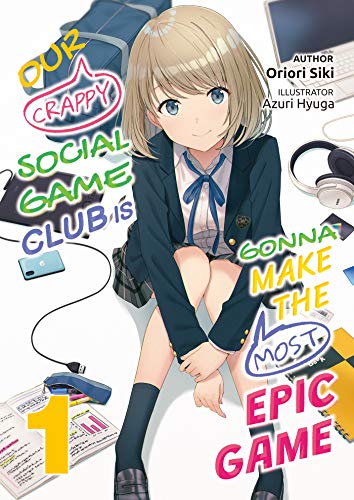
Kai has just moved far from Tokyo after being driven from his previous school, one of the best in the country, for sabotaging a popular social game for reasons we are not immediately privy to. He’s trying to move on and have nothing to do with social games, but unfortunately, he’s arrived at one of those “everyone has to be in a club” schools, and the girl showing him around, Aoi, is head of the Social Game club, which consists of her, programmer and gacha-addict Aya, and perpetually angry artist Eru. The club is about to be shut down, and the Student Council President hates it, so Kai joins up impulsively. Unfortunately, the club is a mess – Eru is angry at Aoi, Kai, and most everything else, Aya is never there as she has to gacha all the time, and Aoi’s bubbly, happy side masks a girl who fears she is useless and a burden. Can the club be saved in time?

As I said, when you get past the original cliches (there’s also a pervy older sister who loves to tease Kai, and the arrogant/snarky student council duo are pure 100% cliche), there’s more to like here than expected. Kai, of course, did not sabotage the game back in Tokyo because he was being a villain, it was for a very good reason. Both he and Aoi suffer from crippling self-doubt, and both of them have to have it demonstrated to them, explicitly, that their fears are unfounded. Kai really does have terrific value as a planner, as his sempai at the Tokyo school (who is awesome, and has a great semi-robotic speech pattern) demonstrated to him, and while Aoi’s art is still not as good as Eru’s, she is improving constantly and is ready to take the next step. They make their game better AND they step in to help save the original game that Kai sabotaged. It’s quite the feel good ending.

So yes, there’s gold to be found here, though I’d recommend liking gacha games a whole lot more than I do if you really want to get the full experience.

The Genius Prince’s Guide to Raising a Nation Out of Debt (Hey, How About Treason?), Vol. 5

By Toru Taba and Falmaro. Released in Japan as “Tensai Ouji no Akaji Kokka Saisei Jutsu ~Sou da, Baikoku Shiyou~” by GA Bunko. Released in North America by Yen On. Translated by Jessica Lange.

This volume was always going to have trouble living up to the high point of the previous one, and it does. It’s a very short light novel, coming out at not even 160 pages. And that, I think, is the problem – this volume is too rushed, leaving everything sort of half-baked. The joy of these books is seeing Wein come up with plans, wriggle around as they’re upended by a surprise disaster, and then come up with even more clever plans. but you need time for each of those things to simmer, and we don’t get that here. There’s also very little of Falanya, who was the star of the fourth book, and also a minimal amount of romantic tension between Wein and Ninym. There’s nothing wrong with the book, it’s reasonably fun to read, and gets exciting a few times. But the reader is left with the feeling that “that could have been better”.

Natra has been doing very well for itself under Wein’s leadership… VERY well, and has started to attract attention to itself, both good and bad. It also has to worry about Marden, its recent acquisition, which is far better located than Natra itself, and could easily wind up surpassing Natra itself. They need more allies. So he turns to the nations beyond Marden, Soljest (which is run by Gruyere, the very obese Holy Elite we briefly saw in Book Three, and Delunio, which is basically being ruled by its slimy Prime Minister. Wein heads to Marden, expecting Zenovia to try to solve Marden’s problems by a marriage proposal, which he plans to turn down, and then goes to Soljest, where he ends up suggesting that the two nations ally themselves to each other, something Gruyere quickly agrees to. And then… well, everything falls apart for Wein.

By now, the strengths and weaknesses of this series are pretty well locked in. Sadly, I find the art a weakness, as it’s frequently just too goofy for my tastes, and also leans into fanservice when it shouldn’t (there is a low-angle shot of Zenovia sleeping on her tits at a desk that should be taken out back and shot). The plotting and scheming is fun, both when Wein is being brutally clever and also when he’s being out-thought, and I really liked the idea that Zenovia *is* in love with him but refuses to marry him if she’s not his equal at being a clever person. Gruyere is also a lot of fun, and I did like the introduction of his daughter, who appears to be there mostly so that she can be a rival to Falanya in future books. But… everything happened too fast. The battles, the scheming, the dialogue, even the dumb goofy comedy. Ninym screws up Wein’s hair in an amusing way! Why was nothing done with that?

The series is still worth reading, and I look forward to the next book, but this one just feels… half-baked.

I’m in Love with the Villainess, Vol. 2

By Inori and Hanagata. Released in Japan as “Watashi no Oshi wa Akuyaku Reijou” by GL Bunko. Released in North America by Seven Sas. Translated by Jenn Yamazaki. Adapted by Nibedita Sen.

(While I try not to spoil TOO much, this does talk about events in this book a bit more than some might be comfortable with, so this is your spoiler warning.)

When we last left Rae and Claire in the first volume of this series, things were still great fun, with lots of teasing and tsundere antics, but there was also excellent discussions of LGBT identity and a few hints of ominous rumblings on the horizons. This second volume proceeds – immediately – to walk up to our heroine’s happy, relaxed life and clever plotting and scheming and kick at it till it falls over, requiring a stronger structure. Things do not relax from that point forward. Even a trip back home to visit Rae’s parents, the slightest chapter in the book, is still filled with economic inequality and the difference between the haves and have nots. Rae’s past in Japan, which barely came up in the first book, gets an amazing flashback in the third chapter, which also gets into transgender rights. And all of this? Is before the Revolution that is the subject of the original otome game. Rae may be trying to save Claire… but is that what Claire wants?

There is a certain amount of ridiculousness to the plot that you are just going to have to accept. I won’t spoil everything, I will just note that there is a volcano eruption that is only fourth or so on the list of ridiculous things. It is also clear that the author has an agenda, and is here to push it, and honestly that’s great as well. I mentioned Rae’s past – as Rei – and it gets into the nitty gritty of coming out – internally and externally – and how that can be for good and ill and both. It also has a literal love square, the kind that you see arrow diagrams of, and also has Maria-sama Ga Miteru novels (or a very thinly disguised version of) as the gateway into this. So as you can see, it manages to combine the heartfelt and the over the top without sacrificing either.

Things definitely get more serious as the book goes on, though we know they’re going to right from the start, when Rae is forced to deal with her love for Claire, something that she states out loud multiple times a day, and how dedicated to it she really is. First as comedy, and second as tragedy, events conspire to force Rae to abandon her cool, logical, and calculating persona and admit that she does, in fact, not only love Claire but want to be with Claire for the rest of her life – fuck “I want my beloved to be happy” tropes. Once the actual revolution revs up, there’s no time for school – first Rae has to maneuver events so that Claire can avoid being executed for being the symbol of all that is bad as aristocrats, and then watch in horror as Claire’s growth, acceptance and love of Rae results in all those plans being shattered to bits.

Claire’s growth is, in my opinion, even more stunning than Rae’s because we get so much of it filtered through Rae, who gets it but also does not. She knows that Claire is far nicer than she pretends to be. She shows her what their country is really like, whose lives it is built on top of, and what the commoners really feel about all this. And Claire then resolves to make things better. She helps ferret out corrupt nobles with Rae. She helps pass out food to those who are starving with Rae. And, in the end, she makes a decision that Rae can’t do, which is to accept that she is a symbol of everything that was wrong with the class system, and go to her execution in order to take responsibility. As in the first chapter, Rae is devastated and almost gives up. Seeing how far Claire has come from the standard arrogant ringlet girl is my favorite thing about this book. It even pays off in the epilogue and side story, which shows Claire adapting to commoner life rather well – indeed, a bit better than Rae is.

There’s more I can talk about, like the whole plot with Yu and Misha, which revolves around (like, honestly, a lot of this book) a metaphor that turns out to be literal. There’s Manaria, who has gallant Takarazuka vibes up the wazoo, and without whom everyone would likely be dead. There’s the young cardinal who is in love with Rae and is also… well, I’ll leave that for now. There is the fact that the book has a large number of characters who are not only yuri, but also queer, a word used by Rae in the book. (As is lesbian.) There’s the fact that there is apparently a third volume in Japan, which surprises me given that this reads very much like an ending. Above all of this is the fact that the book is simply unputdownable – it has a very large page count, but I was forced to finish it in one day anyway. It may be the best light novel of 2021, and it’s only January 8th. Read it, please. You won’t regret it.