Slayers: The Battle of Saillune

By Hajime Kanzaka and Rui Araizumi. Released in Japan by Fujimi Fantasia Bunko. Released in North America by J-Novel Club. Translated by Elizabeth Ellis.

The first three volumes of Slayers are filled with humor and wackiness, but they are also very, very dark, with the third one ending in the destruction of an entire city and everyone in it. It often feels like a fantasy version of Dirty Pair, with Lina and Gourry accidentally spreading chaos as they go from town to town. This volume, which introduces another one of our “regulars” (I use the word in quotes because everyone in the novels except Lina and Gourry tends to be mostly absent half the time.) also features a lot of dead bodies, and has Lina almost die at least three times, to the point where her waking up in a hospital bed is almost a running gag. Despite that… this feels like an attempt at a lighter, fluffier volume of Slayers. Sure, there’s assassination attempts on royalty, assassination attempts on Lina, betrayal, and lots of death… but any book with Prince Phil and Amelia in it is by definition lighter. Even if Amelia feels a bit odd at first.

When this book was first published, both in Japan and North America, it had a much more serious cover, featuring Lina and Gourry. But J-NC has licensed the updated reissues, and they know what readers want, and so we get Amelia pointing at us for justice. As for the plot, Lina, Gourry and Sylphiel arrive in Saillune and are caught up in a royal struggle, as someone is trying to kill Prince Phil. Lina, who has met the prince before, is underwhelmed, but she and Gourry quickly agree to help him try to resolve things, despite the fact that his brother seemingly has a mage on his side who can do all sorts of lethal things to our heroine. But how many “sides” are there in this battle? And why would the villain be trying to kill Lina personally as well?

As stated, Amelia shows up here for the first time, and seems… surprisingly savvy and clever. Honestly, it feels like her characterization takes a step back as the book goes on, with the author realizing on the fly that she’s funnier when she’s goofier, hence the additional cries of justice and the pratfall towards the end. The book is funny, though sometimes it’s not as funny as it would like to be – the way Sylphiel is written out of the book is simply dumb, no two ways about it. I was also very impressed at the traps that are created for Lina in the book, with the endless corridor you can’t get out of (which Lina promptly does), the evil bug that nearly succeeds in annihilating Lina and puts her in the hospital, and an assassin that really, really wants to kill her. We do get some reasons as to why this is happening towards the end, but a lot of it is still vague, and no doubt will be examined in the next book.

This book is very 1990s at times, and “ha ha, it’s funny because he’s not handsome!” is not the laff riot it’s meant to be, but this was a very solid Slayers, and introduces one of my favorite regulars, even if she’s not quite cooked characterization-wise. Next time we’ll meet another regular, a certain “priest”, and things should get even more chaotic.

Ascendance of a Bookworm: I’ll Do Anything to Become a Librarian!, Part 3: Adopted Daughter of an Archduke, Vol. 3

By Miya Kazuki and You Shiina. Released in Japan as “Honzuki no Gekokujou: Shisho ni Naru Tame ni wa Shudan wo Erandeiraremasen” by TO Books. Released in North America digitally by J-Novel Club. Translated by quof.

Last time I talked about how Rozemyne, try as she might, is not going to drag this world kicking and screaming into the 20th century anytime soon. Indeed, anyone reading this series hoping for a class war starting between the elite nobles and the clever commoners has probably already checked out by now. Rozemyne may tell Ferdinand that she will never be comfortable with killing another person – and thank God for that! – but she is still going to stay a noble and try to follow noble rules. Of course, there are other ways to subvert society, and we find that her cards and picture books are doing this far more than most people are ready for. Kids are learning fast. Very fast. Heck, even Angelica, her bodyguard who took the job because it would mean she didn’t have to study at school – ends up learning with a sufficient reward dangled in front of her. The Revolution Will Be Printed.

As you can see by the cover, much of this book takes place in winter, though fortunately Rozemyne only has one “and then I was in bed for days” incident in the book. She’s gathering ingredients for her cure, which can involve fighting a massive snow leopard monster who can create hideous blizzards, or can involve collecting nectar from a hot spring that proves to be a lot more sentient than Ferdinand was expecting. So there’s actually a fair bit of action here. We also get to see Rozemyne play politics, as she gets the noble kids to work together, teaches them without it being overt (the best kind of teaching), and starts to create the idea of lending libraries, getting one poor noble’s daughter books in return for hearing new stories that her mother had told her. Honestly, if it were not for the resolution of what happened with the Mayor last book, this would be a light and fluffy volume.

It is not a light and fluffy volume. Rozemyne is forced to not only watch the Mayor, his wife, and a few people who had shown (thank to Ferdinand’s magic) that they were disloyal be killed, but also to see how nobility in general regards commoners as little better than animals, and their lives absolutely do not matter. Much as we would like to see her fix this, Rozemyne is still about 7 years old here, and cannot bend the world to their will quite that much. The execution itself is fantastical in nature but also horrific, and much is made of the fact that those killed with be unburied and unremembered. Fortunately, we do move from this to the Hot Springs episode, which, fortunately, does not lead to a bunch of fanservice as it would in any other title. The closest we get to fanservice is Rozemyne giving Brigitte a present of a fashionable dress, and remarking on her large chest. As for the hot springs ingredient gathering, it’s honestly hilarious, especially in retrospect. Even Rosemyne and Brigitte getting eaten by a giant toad just made me think of KonoSuba (it’s OK, they get out).

There’s two more volumes to go in this arc, and I’ve really no idea where it’s going to go, other than better printing, more books, etc. But that’s fine. Even the chapters discussing springs and leverage are interesting in this series. It remains a must read.

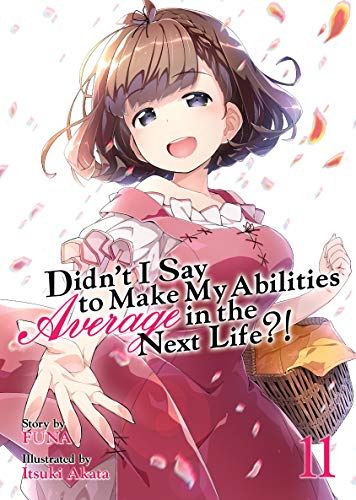
Didn’t I Say to Make My Abilities Average in the Next Life?!, Vol. 11

By FUNA and Itsuki Akata. Released in Japan as “Watashi, Nouryoku wa Heikinchi de tte Itta yo ne!” by Earth Star Novels. Released in North America by Seven Seas. Translated by Diana Taylor. Adapted by Maggie Cooper.

There was a point in the second story here, when they came across a scavenger that is trying to repair the machines keeping the world alive, that I realized that this was actually a plot that we had seen several volumes ago, and was meant to be quite important. MMAA does have an ongoing plot thread, but it can take many volumes to get back to it, as we’ve seen, and then it will happily wander away from it again. The book is here for fun overpowered little girls, and not much else. And you know, that’s fine too, because – sorry, nanomachines – I’m not really that invested in saving this world as a long-term plotline. And neither is Mile, who points out – possibly incorrectly – that she’ll be dead before it happens so doesn’t care. (I get the sense, honestly, that Mile may end up living forever.) I want to read fluff and cute character moments. We get both of those here.

Pauline is on the cover, and is also the focus of the first story, where our heroes meet a mother and daughter who are in trouble with money lenders. I appreciated Pauline’s vigorous defense of them, but of course, this book being the type of series it is, it turns out the money lenders ARE assholes, so she turns on a dime and gleefully destroys them. We then go to a mountain village which has a few golems on the mountain, who are mysteriously… not really doing much. This ties in most with the main plot I mentioned above, and is also an excuse to watch Mile and company accidentally go crazy without realizing it to help a group of orphans who live up there. We then cut back to Adele’s friends from the noble school, who have graduated and set off, at the princess’ request, to find Adele by any means necessary. Naturally, they walk right past each other without knowing it. The best story in the book has the Crimson Vow meeting up again with the Servants of the Goddess, who have managed to temporarily escape Leatoria’s protective father, and the two have a friendly competition.

I really liked this last story a lot. It had some great action scenes, and, given the groups weren’t trying to kill each other, relied a lot more on tactics than the group usually does. This also leads to Reina’s biggest concern with the Vow, which is that they’re not a TEAM – they’re four overpowered girls who basically blast through anything. They’re not coordinating the way most hunter teams do. (There’s also Reina’s crush on the leader of the SotG, but that’s mostly played for laughs – indeed, one senses the author found out about the slight yuri fandom this series has and took offense, as there’s another extra story at the end with Mile wishing she had a boyfriend… but her sights are set way too high.) Honestly, I think Reina’s concern is not really needed – the Crimson Vow may not fight as a tactical team, but they are still the best of friends.

Despite the occasional carp, this was a strong volume in the series, which I think is almost caught up with the Japanese release. We’ll see if the nanomachines get Mile to care a bit more about the world in the next book.