The Hero Is Overpowered But Overly Cautious, Vol. 5

By Light Tuchihi and Saori Toyota. Released in Japan as “Kono Yuusha Ga Ore TUEEE Kuse Ni Shinchou Sugiru” by Kadokawa Books. Released in North America by Yen On. Translated by Matt Rutsohn.

This is the end of an arc, and given the way the LAST arc ended, I think that fans of the series were going to be a little suspicious. The element of surprise is gone. Likewise, it’s hard to top “I was responsible for the end of the world and also my wife and unborn child were eaten in front of me before I died” for tragedy. That said, this is a relatively serious volume by Cautious Hero standards. There’s still a lot of the usual silly comedy we’ve come to expect, of course. Rista overreacts to things, helped along here by Jonde as tsukkomi #2. Seiya’s actions always seem, at first, to be completely ludicrous (at least until later in the book, when you see he was absolutely right to be crazy prepared). But the book actually has two depressing and tragic parts, one midway and one near the end, and both are handled pretty well. The author is learning to balance.
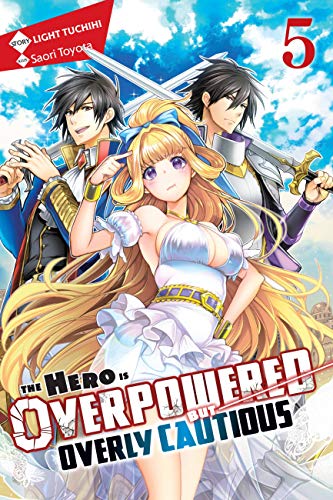
The cover shows off the first half of the book. Seiya, Rista, Jonde and Kiriko arrive at a desert wasteland that is the home of End Boss #4… only to find there’s a thriving village there, everyone knows who Seiya is, and he defeated the Demon Lord a year before. Its clearly a trap, and even Rista knows it’s a trap, but it’s hard not to find a happy, monster-free village likeable, especially when the OTHER Seiya shows up. You know, the reckless one. This version had ONE moment of caution when, after his wife begged him, they go see an oracle who pointed out the Demon Lord’s ability to resurrect himself. After this trap is sprung, Seiya and company go back to the God’s world to train. And train. And train. Why does Seiya seem to be avoiding the final battle? And why is he telling Rista to play with literal toys?

I will try not to get too into spoil territory here, but both tragedies that I mentioned before are pulled off very well, especially the second, which leaves Rista once again devastated and also explains how Seiya’s seemingly annoying and callous actions were once again him trying to be thoughtful and nice without actually being so. It’s notable that this volume has the least amount of abuse towards Rista of the five, though I’m not sure if Seiya is laying off or if it’s just due to the book’s more serious tone. There’s also a suggestion of where things are going to go from here, and it’s not a pretty one, as we’re led to question everything about the current world that the deities have for themselves. Are we headed for Cautious Hero: Civil War? And is the relationship between Seiya and Rista going to go anywhere?

I suspect the answer to the last is “no”, at least not till the final book. But as for next time, we’re starting a new plot, so I expect a lot more wacky gags. Till then, enjoy a series that manages to pull off “why am I crying about a slapstick comedy character – AGAIN?”.
Rascal Does Not Dream of Logical Witch

By Hajime Kamoshida and Keji Mizoguchi. Released in Japan as “Seishun Buta Yarou wa Logical Witch no Yume wo Minai” by Dengeki Bunko. Released in North America by Yen On. Translated by Andrew Cunningham.

The first two books in this series were not exactly loud and obnoxious, but they were fairly action-packed and things happened in them. By contrast, the third book, focusing on Sakuta’s friend Rio, is a quiet, muted affair, which fits well with the nature of her Adolescence Syndrome. Indeed, hers is the most relatable one that we’ve seen to date, dealing with issues that would affect a number of other girls her age. It also makes a lot of sense that, despite literally being split into two, both Rios are not all that far apart – this is not an example of an evil twin here, and even the things that the non-glasses wearing Rio do are something Rio started before the split. As such, Sakuta’s role here is mostly to listen, and occasionally yell, because Rio has possibly read too much science fiction and thinks the only way that this can end is if one of her two selves dies.

There are, of course, other things going on in Sakuta’s life besides Rio’s cloning blues. Mai is back to work with a vengeance, meaning that she is not really available to date him all that much – and when the two of them are spotted, she’s reminded by her agency that the fans would go ballistic if they heard she was dating a guy, which… well, yes, is true. What’s more, the girl he fell in love with from the past is still in the present, only she’s 12, and we’re STILL not sure what’s going on there. We do find out that she has a heart condition, which I expect will be fairly important and/or tragic later on. His sister is still a shut-in and acting much younger than her age. His best friend’s girlfriend still despises him, though she also proves to be a major help here as well. And what’s this idol group that we hear about?

But yes, for the most part curing Rio merely involves being there for Rio, learning about her past as an early bloomer, and her somewhat alarming present posting salacious selfies to an Instagram-ish site. There’s a somewhat awkward explanation for this from Sakuta’s annoying reporter friend, but the cycle of elation and loathing is one that feels a bit TOO real for a series that tends to rely on supernatural phenomenon that are secretly psychological damage. And of course there’s also her crush on Yuuma, which is awkward, as I suspect nearly everyone reading this or watching the anime would rather that Yuuma be dating Rio. But… Yuuma is not in love with Rio, even though they’re best friends. We don’t hear it (i.e. Sakuta doesn’t), but it’s implied she confessed to him at the end and was rejected. And, fortunately, no Rios were killed in the making of this book. It is a nice, bittersweet and calm ending.

Well, aside from the cliffhanger, which seems to imply that a bodyswap is the next crisis we’ll face. Till then, this is one of the better written light novels I’ve seen for some time, assuming you can put up with Sakuta’s personality. Well, he is a rascal, after all.

Reincarnated As the Last of My Kind, Vol. 1

By Kiri Komori and Yamigo. Released in Japan as “Tensei Shitara Zetsumetsu Sunzen no Kishou Shuzokudeshita” on the Shōsetsuka ni Narō website. Released in North America by Cross Infinite World. Translated by Roman Lempert.

As I was reading this book, I kept getting an odd feeling, and I wondered what it was. The premise was simple enough – indeed, we’ve seen it before, as it’s very Mushoku Tensei if that were a slow life title. The heroine is sweet, remembering some details of her past in Japan when she needs to, but also allowed to at times be the cute little girl we see on the cover. The overpowered nature of the title is actually pretty tolerable, and this was startling given how many times the main character gets called a genius (don’t make it a drinking game). Then I realized about 3/4 of the way through what the issue was: this book gets to the end of Vol. 1, and we have a LOT of questions unresolved, including the main one about Tina’s origins. It’s the first of a long-running series. And that’s weird given it’s put out by Cross Infinite World, whose idea of “a huge long-runner” is about three books.

The cover is a bit of a fakeout, as I was absolutely expecting this young girl to be raised by the multi-tailed wolf on the cover, and that does not happen. After getting something of a 1978 Superman movie sendoff from her parents (who are about to die tragically), she ends up, after a series of terrifying moments, adopted by Marcus, an ex-soldier who lost his arm in the war and is headed back to his parents’ inn in the country. Naming her Tinaris, or Tina for short, they proceed to have a relatively sedate life, despite the passing of first Marcus’ mother and this his father, and the occasional eccentric guests at their inn, who usually get drawn into what Tina is doing. Because, well, Tina is odd. The fact that she’s very smart for her age we’d normally put down to the reincarnation memories, but it isn’t just that. She has an ability for alchemy and potions that’s off the scale–at five years old! And then there’s her pointy ears. She’s not an elf… but she’s clearly not human either.

The book’s world building is more complex than I expected, and can get very dark. Tina starts the book as a baby, and is immediately found by Bandits, who suggest assaulting her. Marcus has lost an arm, and his prosthetic isn’t great. A colleague of his lost half her face in a potion accident. And there’s an ongoing annoying running gag of everyone asking Tina about romance, despite the fact that at the end of the book she’s still only six years old. (That said, I’m pretty sure this last part is meant to be irritating, judging by Tina’s reaction to it all). That said… the book is still pleasant overall. Marcus is a good dad, occasionally hapless but not bumbling. Tina’s POV is well-balanced, as I said above, between the “woman from Japan” part of her and Tina herself, and she really does have a talent for alchemy and magic, and FAR more mana than humans. There’s an undercurrent of racism towards non-human races from another country, and slavery pops up (though thankfully no one ends up buying a slave). It’s… well, look at that, I started describing it and it got dark again.

There is sweet and fun stuff here, most of which I didn’t mention. The series, though, is clearly not remotely done, so don’t expect the classic done-in-one CIW story. This is in it for a longer haul. I’ll read the next one.