So I’m a Spider, So What?, Vol. 10

By Okina Baba and Tsukasa Kiryu. Released in Japan as “Kumo Desu ga, Nani ka?” by Kadokawa Books. Released in North America by Yen On. Translated by Jenny McKeon.

(There are spoilers in this review for the previous volume, so make sure you’ve read 9 first. Or are spoiled.)

I seem to be eating crow a lot in my recent reviews, usually as I read what I said at the end of the last one and realize that no, it went counter to all my expectations. And last time I said that I felt that White’s encounter with D would not likely change her all that much, and boy howdy was I wrong. It’s not perfect, and only with alone with the Demon Lord is she starting to be “herself”, but the days of “White Can’t Communicate” are coming to an end, as she now… talks in sentences! Expresses emotions! Thanks people! I’ve gotten used to her main character trait being the dissonance between her chatty inner monologue and her deadpan outside self that I was not expecting that she would finally bridge the gap. A lot of this is likely due to D, and the big revelation from last time of who her real self is.

The Demon Lord gets a lot accomplished in this book, firstly by taking out a major rebellion against her (which White actually gave her all the details on), then by meeting with the pontiff and making a deal with save Miss Oka and a group of elves that were part of the rebellion (at White’s request) in return for promising to kill off all the Elves at a later date (we do see some of this in earlier books). The Demon Lord also finally hears about what’s really happening with this world,. again thanks to White, but does not hear how much sacrifice and deaths it will take to fix things, again because White does not tell her. The Power Behind The Throne has never felt more appropriate, even as everyone continues to attribute this to the Demon Lord being just that brilliant. Oh, yes, and White can now actually cause physical pain to Ariel as well, though this is passed off as a gag.

I will admit that I do appreciate the gags, because let’s face it, this series has gotten about as dark as Overlord, which I dropped for being too dark. So White being all embarrassed is funny, as is most everything about Sophia being a massive spoiled brat. And then there’s D, a totally awful God, who is still finding the idea that the new God of this world is really a tiny spider that she swapped roles with so as to get away from being found after being reincarnated. The other reason the series is still good to read is the occasional heartwarming moment. I liked White trying to save Ms. Oka, and the flashback back to the classroom where we see why: Ms. Oka stopped the class killing the spider, and hence White herself, before they all got exploded. I also liked the ending with White taking Ariel to meet the legendary Sariel, and we see how she’s suffering for the entire world. It gives “saving the world” a face.

Still, there’s no denying this series is pretty damn dark – lots of slaughter in this book as well. That said, the best thing about this volume is White really starting to come into her own and take over as THE protagonist once more.
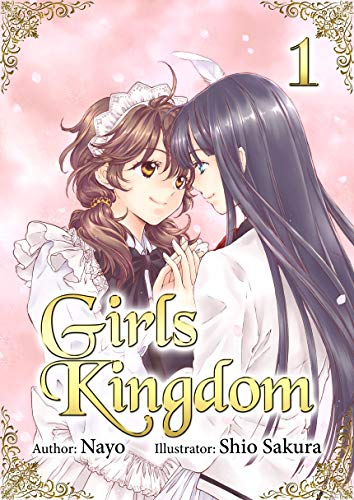
Girls Kingdom, Vol. 1

By Nayo and Shio Sakura. Released in Japan by GL Bunko. Released in North America by J-Novel Club. Translated by Philip Reuben.

Despite the fact that this is a review of Vol. 1 of a fairly new light novel series, the one thing I took away from it most was nostalgia. This book is drenched in Maria-sama Ga Miteru and Strawberry Panic, two series from the 00s that defined a generation of yuri, for better and worse. (In that order – Maria-sama for Better, Strawberry Panic for worse.) I think the author is well aware of what the audience wants here, and is quite happy to give it to them with the maximum amount of ridiculousness. There may be heartwarming moments and genuine yuri in future volumes, though I’m skeptical. What we get here, though, is one girl’s entry into a magical kingdom, one where she ends up having the Golden Ticket – almost literally – that puts her among the elite. And we get another girl, at the pinnacle of that elite, and her desire to try to have as little to do with it as possible. They need each other. They make a great pair.

Misaki is a young girl starting her first day at a new school. She runs out of her house screaming she’s going to be late (no toast, sadly), but ends up being VERY late, as the school is ridiculously huge. So late she jumps the gate – an expellable offense – but it’s OK, as Himeko is standing there, and is highly amused at the fact that a) Misaki jumped the gate at ALL, and b) Misaki seems to know NOTHING about the school that she’s starting in today. So she gets Misaki to agree to be her maid, in exchange for getting her out of being expelled. Misaki is rather baffled by this, then finds out why this school that she signed up for but knew nothing about is free: the half of the class she’s in are all training to be maids, so they may serve the OTHER half of the class. Which has Himeko, who is daughter of the Chairman of the Board.

As you can see, this premise is bananas, for many, many reasons. Misaki’s ignorance of EVERYTHING about her new school is hilarious. A school for maids-in-training and their rich young mistresses is so egregiously classist that your jaw will drop. Misaki’s roommate Kirara, who in any other series like this would be the protagonist, does things that made me physically recoil from my phone as I was reading the book. There are identical twins – with the same first name – who appear to be on the maid side for shits and giggles, which is fine as that’s how they live everything else in their life. Himeko is the perfect rich young girl, right down to living like an absolute slob and not giving a rat’s ass what anyone thinks of her. The book is basically a series of train wrecks set to prose.

That said, I had a grin on my face reading it. If you can put up with its silliness, it’s fun. If you ever saw or read Strawberry Panic, it’s required reading.

Bloom Into You: Regarding Saeki Sayaka, Vol. 3

By Hitomi Iruma and Nakatani Nio. Released in Japan as “Yagate Kimi ni Naru: Saeki Sayaka ni Tsuite” by Dengeki Bunko. Released in North America by Seven Seas. Translated by Jan Cash and Vincent Castaneda. Adapted by Jenny McKeon.

As I was reading the 3rd and final volume of this spinoff series, I began to feel that it was less of a novel and more of a reward. A reward for Sayaka, who, after two books of repressed feelings and failed romances, finally gets to experience a joyous love. And a reward for the reader, because man, this book is a bright ball of sunshine. Sayaka and Haru’s interaction is simply a joy to read, Sayaka’s ongoing inner monologues are revelatory, especially her growing realization that yes, this is in fact real love she is feeling and it’s not the same thing as the love she has for Those Two Girls. (Though that may be the funniest scene in the book… are those two also a couple, by the way?) The continuity between the three books is fantastic, playing into reader expectations very well. And, at last, Sayaka and Touko finally get together to talk post-graduation, though that is the one note of bittersweetness in this sugary book.

The cover pretty much sets the stage. After seeing Haru crying at the end of the previous volume, the two have become friends, and the book begins with Haru confessing to Sayaka… though also admitting that her personality is the sort that also lets go of things easily. This actually doesn’t become apparent as the book goes on, as Haru is quite patient with Sayaka, who spends the entire book musing about what she feels for Haru, how it compares to her feelings for her old sempai, or Touko, or even the girl from the pool in elementary school. The book is mostly a series of conversations, showing us a Sayaka who is opening up to others far easier than she used to but is still definitely herself. Sayaka agrees to go out with Haru on a “trial basis”, as Haru puts it, and rapidly realizes that this *is* different from the others, and that she really has fallen in love.

Addressing the elephant in the room, yes, Haru sure does look like Yuu, but they’re not very much alike. She also resembles the swimming girl from Book One, to the point where the author includes a scene with Sayaka watching a TV show interviewing a swimmer who is clearly meant to be the same girl. What’s more, the climax of the third book once again takes place in a pool, with Sayaka and Haru’s underwater “confession” being incredibly emotional and heartwarming. (I admit I was also happy to see the swimming girl had recovered from Sayaka’s fleeing.) The conversations, both in dialogue and in text messages, felt very in character on all sides, and I was once again very happy to see that this is nothing whatsoever like the author’s other series, Adachi and Shimamura. And I really enjoyed the emphasis on names, and how Sayaka’s manner of addressing Haru changes over the book as her feelings grow. (But she still says “Koito-san”.)

There is a question in this book about whether a college student really is more “grown up” than a high school student, and you get the sense Sayaka is still maturing in that regard. The epilogue shows she has not gone as far with Haru as Yuu and Touko have. But that’s fine, because they’re different couples behaving differently. And even though there’s some sadness as Sayaka realizes she and Touko will likely grow more distant over time, the overall feeling after finishing this book is happiness that Sayaka and Haru are really in love, and what they brought to each other’s lives.